
Bitcoin · 4 min read
Updated September 19, 2026: refreshed with current market data, regulation and network upgrades.
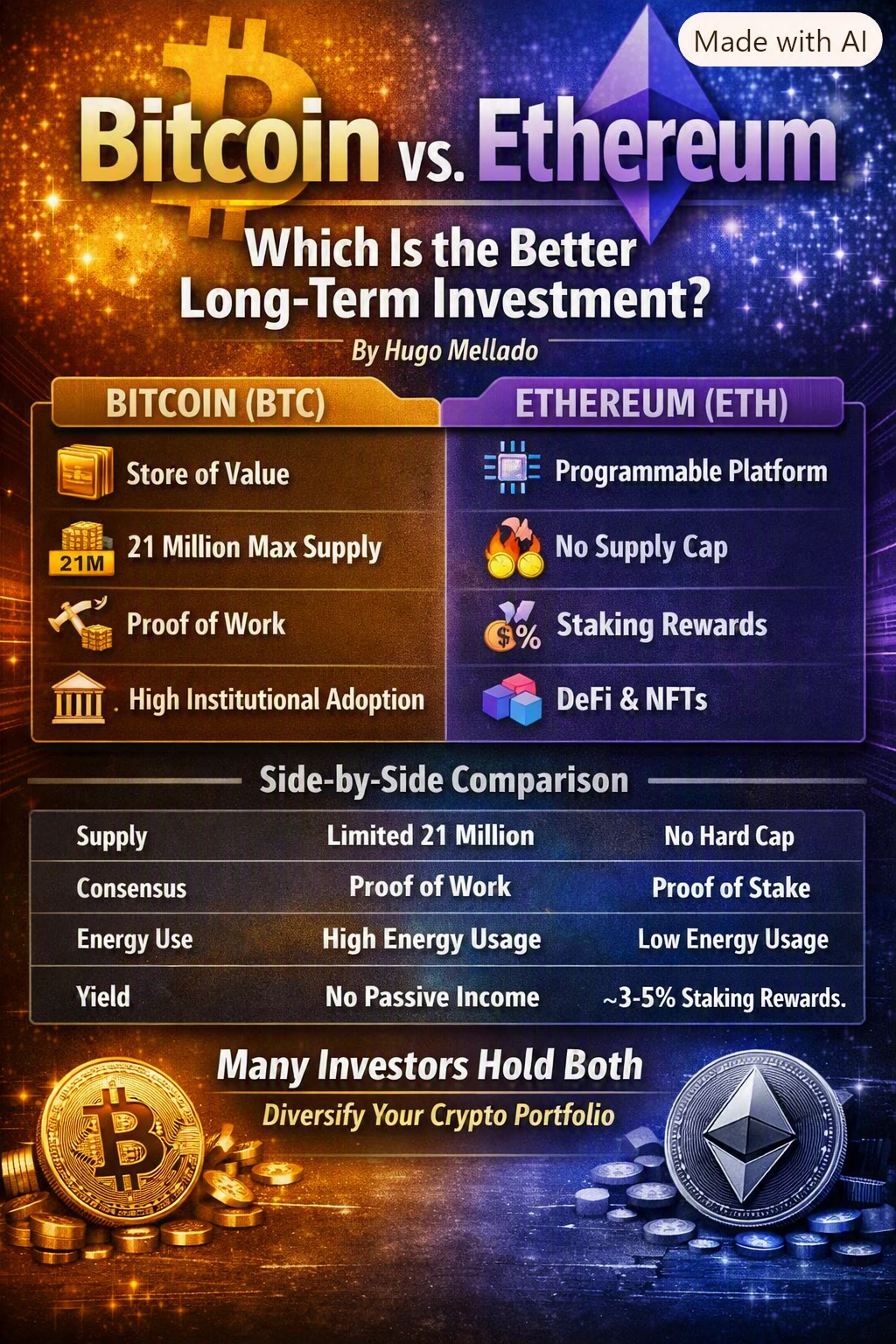
Few questions spark more debate in crypto than this one. There isn’t a single correct answer, because Bitcoin and Ethereum aren’t really competing for the same role: one aims to be a store of value, the other aims to be the infrastructure much of decentralized finance is built on. Understanding that distinction is the first step toward deciding where your money is best placed.
Two Different Value Propositions
Over more than a decade, Bitcoin has built a very specific identity: a scarce, decentralized, censorship-resistant asset with a hard cap of 21 million coins and no issuing authority. Its design deliberately avoids complexity — changing the protocol is extremely difficult, which is both its greatest strength (stability, predictability) and its main limitation (slower innovation).
Ethereum plays a different game. It’s the foundation that most DeFi protocols, a large share of NFTs, and countless Web3 applications run on. ETH isn’t purely speculative — it’s needed to actually use the network, giving it a utility component on top of its investment case. That extra potential comes with more technical risk, since Ethereum’s upgrade roadmap is far more active than Bitcoin’s.
Side-by-Side Comparison
| Factor | Bitcoin (BTC) | Ethereum (ETH) |
|---|---|---|
| Primary use case | Store of value | Programmable platform |
| Supply | Capped at 21 million | No hard cap; deflationary via burns |
| Consensus | Proof of Work | Proof of Stake |
| Energy use | High | ~99.9% lower after “The Merge” |
| Passive yield | None | ~2.6% via staking (Sept. 2026) |
| Institutional adoption | High (ETFs, corporate treasuries) | Growing (ETH ETFs, DeFi) |
| Pace of development | Slow and conservative | Fast and active |
The Case for Bitcoin
The launch of spot Bitcoin ETFs in the US in January 2024 changed the game: asset managers overseeing trillions of dollars now offer Bitcoin exposure to millions of clients who previously wouldn’t buy crypto directly. On top of that, the halving cycle — which cuts new coin issuance in half — has historically preceded major bull markets, although the rally that followed the April 2024 halving peaked in October 2025 and was followed by a deep drawdown. As of September 18, 2026, Bitcoin trades around $78,000, roughly 38% below its record of about $126,000 (Fortune). For investors who prefer a simple thesis that’s easy to hold onto during volatility, Bitcoin offers exactly that: simplicity.
The Case for Ethereum
Since the EIP-1559 upgrade (2021), a portion of every transaction fee on Ethereum is permanently burned, which can make ETH deflationary during periods of high activity. Add to that staking, which currently offers an annual yield of roughly 2.6%, with about 35% of all ETH staked (Staking Rewards, September 2026) — something Bitcoin simply doesn’t provide. Ethereum also carries what could be called “ecosystem optionality”: if DeFi, real-world asset tokenization, or Web3 applications achieve mainstream scale, Ethereum stands to be one of the biggest beneficiaries. The market has not rewarded that thesis lately, though: ETH trades near $2,500, about 45% lower than a year ago and roughly half its August 2025 peak (Fortune). In March 2026 BlackRock also launched a staked-Ether ETF, bringing staking yield to ETF investors.
Network Activity and Usage Metrics
Ethereum consistently leads Bitcoin in development activity, measured by GitHub commits, developer count, and protocol deployments. Ethereum processes far more transactions than Bitcoin on a daily basis when including Layer 2 activity. Bitcoin’s on-chain transactions are dominated by high-value transfers and exchange settlement, while Ethereum’s ecosystem supports the entire DeFi, NFT, and token economy. Ethereum has kept shipping upgrades: Pectra in May 2025, Fusaka in December 2025, and Glamsterdam targeted for late 2026 (see the Ethereum roadmap). Neither network has faced a sustained decline in security or validator participation — both ecosystems demonstrate robust health metrics in recent cycles.
Regulatory Treatment: A Critical Difference
In the United States, the SEC has treated Bitcoin as a commodity under CFTC jurisdiction — a relatively clear and favorable regulatory status. Ethereum’s status is more complex: the SEC debated whether the switch to Proof of Stake made ETH a security (validators earn rewards, similar to dividends). The approval of spot ETH ETFs in 2024 provided significant regulatory clarity, effectively treating ETH as a commodity as well, and in September 2025 the SEC approved generic listing standards that make it easier to launch new crypto ETFs. The wider U.S. picture is still unsettled: the CLARITY Act, a market-structure bill that passed the House in July 2025, fell short in a Senate vote on September 15, 2026. Internationally, regulatory treatment varies significantly, with jurisdictions like the EU’s MiCA framework providing clearer guidance; its transitional period for existing providers ended on July 1, 2026 (see the ESMA statement).
Weighing the Risks
Bitcoin’s main risks are regulatory — a coordinated crackdown across major economies could hit its price — and, to a lesser extent, technical, though its deliberately simple codebase has never suffered a critical vulnerability. Ethereum carries additional risk tied to its complexity: smart contract vulnerabilities across the ecosystem, potential issues from protocol upgrades, and competition from other layer-1 blockchains.
What If You Don’t Have to Choose?
Most crypto investors don’t treat this as an either/or decision — it’s really a question of portfolio allocation. The splits below are illustrative examples of how some investors think about it, not recommendations for you:
- Conservative: 80-90% Bitcoin, 10-20% Ethereum
- Balanced: 50-60% Bitcoin, 30-40% Ethereum, 10% other assets
- Growth-oriented: 40% Bitcoin, 40% Ethereum, 20% selected altcoins
Conclusion
There’s no objectively correct answer to “Bitcoin or Ethereum?” Bitcoin is the simpler, more stable, more institutionally backed choice. Ethereum offers greater upside potential, but with more complexity and technical risk. That’s exactly why many investors simply choose to hold both.
Sources and further reading
The explanations above are checked against official regulators, statistical agencies, standards bodies and non-profit financial education organisations. Use these primary sources to verify figures and rules before you act on them.
- Satoshi Nakamoto — “Bitcoin: A Peer-to-Peer Electronic Cash System” (2008 white paper)
- Ethereum Foundation — Ethereum white paper
- Ethereum Foundation — Consensus mechanisms (proof of work and proof of stake)
- U.S. Securities and Exchange Commission — Crypto assets
- Internal Revenue Service — Digital assets
- Fortune — Price of Bitcoin, September 18, 2026
- Fortune — Price of Ethereum, September 18, 2026
- Staking Rewards — Ethereum staking data
- ethereum.org — Ethereum roadmap
- ESMA — Markets in Crypto-Assets Regulation (MiCA)
Related reading
- What is Bitcoin? The Complete Beginner’s Guide to the World’s First Cryptocurrency
- Ethereum Explained: Why It’s Much More Than Just Another Cryptocurrency
- Understanding Crypto Market Cycles: Bull Markets, Bear Markets, and Everything Between
This content is for informational purposes only and does not constitute financial advice. Cryptocurrency investments carry high risk — always do your own research.