
NFT · 6 min read
Updated September 19, 2026: refreshed with current market data, regulation and network upgrades.
The $69 Million JPEG
In March 2021, a digital artwork by Beeple (Mike Winkelmann) sold at Christie’s for $69.3 million — making it one of the most expensive artworks ever sold by a living artist. The buyer received an NFT: a blockchain record proving ownership of a digital file. This sale crystallized global awareness of Non-Fungible Tokens and launched one of the most explosive — and subsequently controversial — financial phenomena in recent memory. Understanding what actually happened, and what lasting value NFTs represent, requires looking past both the hype and the cynicism.
What Does “Non-Fungible” Actually Mean?
Fungible assets are interchangeable: one $10 bill is exactly equivalent to any other $10 bill; one Bitcoin is exactly equivalent to any other Bitcoin. Non-fungible assets are unique: the Mona Lisa is not equivalent to any other painting even if identical photographs of it exist. NFTs bring this property to the digital world. Before NFTs, digital files could be infinitely copied with no degradation — there was no meaningful distinction between an “original” digital file and a copy. NFTs create a publicly verifiable, unforgeable record of who holds the “original” — as defined by blockchain ownership. The record exists on the blockchain regardless of how many copies of the underlying file exist.
How NFTs Actually Work: The Technical Reality
An NFT is a token on a blockchain (most commonly Ethereum, using the ERC-721 standard) with a unique identifier (token ID). Creating an NFT (“minting”) writes a record to the blockchain defining the token’s unique properties: its contract address, token ID, and typically a URI pointing to metadata describing the token (name, description, image URL). The smart contract governs all ownership transfers and can encode creator royalties, although since 2022–23 many marketplaces have made royalties optional, so they are no longer guaranteed on every secondary sale.
Important nuance: in most cases, the actual image or file is not stored on the blockchain — storing large files on-chain would be prohibitively expensive. Instead, the NFT stores a link (URI) to the file hosted elsewhere. If the file host disappears, the NFT token remains on the blockchain but its metadata may become inaccessible — a risk called “link rot.” Projects using IPFS (a decentralized file storage system) mitigate this risk considerably better than those hosting images on standard web servers.
Token Standards
ERC-721 is the original NFT standard on Ethereum: each token is completely unique and individually tracked. ERC-1155 is a multi-token standard allowing both fungible and non-fungible tokens in a single contract — more efficient for gaming applications where you might have many copies of a common item but only one of a rare item. Solana’s Metaplex standard powers most Solana NFTs, offering lower minting costs. Most major NFT collections use ERC-721 or ERC-1155 on Ethereum, though Solana and other chains have developed significant NFT ecosystems.
The NFT Boom: What Actually Happened
2021 saw extraordinary NFT trading volume driven by several converging forces: near-zero interest rates encouraging speculation, widespread pandemic-era online activity, celebrity endorsements, and genuine innovation in the creator economy. Projects like CryptoPunks (launched 2017, retroactively significant), Bored Ape Yacht Club, and Azuki sold for staggering sums. BAYC apes regularly traded for hundreds of thousands of dollars; a collection of CryptoPunks sold for $7 million. NFT trading volume on OpenSea alone reached $3.4 billion in August 2021.
The bubble exhibited classic speculative mania characteristics: FOMO-driven buying, influencer promotion, low-effort copycat projects flooding the market, and the greater fool theory (buying to sell to someone willing to pay more, rather than for intrinsic value). Most participants could not distinguish quality from hype.
The NFT Bust: What Happened Next
By 2022, trading volumes had collapsed over 95% from peak. The specific combination of rising interest rates (reducing appetite for speculation), crypto’s broader bear market, NFT market saturation (too many projects, too little genuine demand), and the realization that most collections had no utility beyond speculative value drove the collapse. Most individual NFTs from the 2021 rush are now worth a fraction of their peak prices. Many are essentially worthless. This was predictable — speculative bubbles in new asset classes are historically common and follow recognizable patterns. The market did not disappear, though: DappRadar’s Q3 2025 report counted 18.1 million NFTs sold in the quarter, generating about $1.6 billion in trading volume, well below the 2021 peak but far from zero.
What Has Lasting Value?
Digital Art for Established Artists — For artists who built genuine fanbases, NFTs created permanent new revenue models. The ability to issue provably limited editions and encode royalties on secondary sales (where marketplaces honor them) is a genuine innovation for creator economics. Artists like Refik Anadol and Tyler Hobbs built sustainable careers through NFT art even after the bubble deflated.
Gaming and Virtual Worlds — NFTs as in-game assets where players truly own their items represents a fundamental shift in gaming economics. If you earn a rare sword in a game where items are NFTs, the game company cannot delete it, and you can sell it on any NFT marketplace. Games like Axie Infinity demonstrated the concept (though with execution problems); the next generation of blockchain games is building more sustainable models. The potential is significant: global gaming markets exceed $180 billion annually, and player-owned economies could transform how value flows through gaming.
Tickets and Memberships — NFT event tickets enable transparent secondary markets where artists can receive royalties on resales. They also allow perpetual proof of attendance and can unlock ongoing perks. Companies including Ticketmaster and AXS have experimented with NFT ticketing.
Music Rights — Artists including Kings of Leon, 3LAU, and Royal have tokenized music rights, allowing fans to own a share of streaming royalties directly. This disintermediates record labels in a potentially significant way.
Real-World Asset Tokenization — Perhaps the most significant emerging application: using NFT-like structures to represent ownership of physical assets (real estate, luxury goods, collectibles, financial instruments). This enables fractional ownership and 24/7 global trading of assets currently locked in illiquid markets. The category is already measurable: rwa.xyz tracks about $38.5 billion of distributed tokenized real-world assets as of September 19, 2026.
How to Buy and Evaluate NFTs Intelligently
If you’re considering buying NFTs, evaluate projects on these dimensions: Team — Are the founders doxxed (publicly known)? Do they have relevant track records? Community — Is there genuine engagement, or is activity artificial? Utility — What does owning the NFT actually give you beyond speculation? Roadmap execution — Has the team delivered on previous promises? Smart contract audit — Has the code been reviewed by reputable auditors? On-chain metrics — What’s the actual trading volume? (many collections inflate apparent volume through wash trading). For most investors, NFTs should represent a very small and purely speculative portion of a crypto portfolio.
Conclusion: The Sober Assessment
NFTs are neither the revolutionary wealth-creation machines of 2021 hype nor worthless JPEGs. They are a genuinely useful technology — the ability to create verifiable digital scarcity and programmable ownership rules has real applications — whose most valuable implementations are still being developed. The speculative frenzy of 2021 obscured genuine innovation; the subsequent crash cleared away most of the noise. What remains is a technology in search of its killer application, with legitimate candidates in gaming, creator royalties, ticketing, and real-world asset representation.
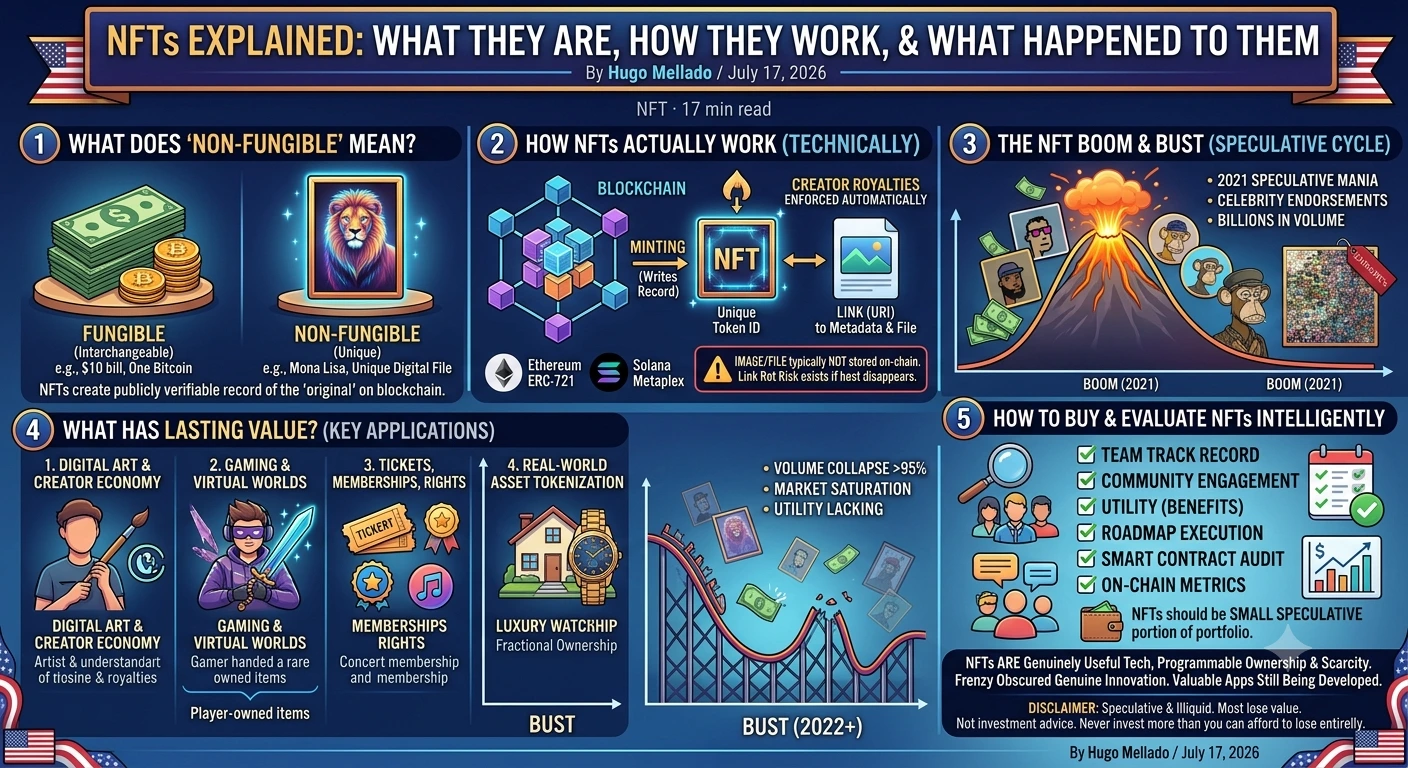
⚠️ Disclaimer: NFT investments are extremely speculative and illiquid. Most NFTs lose value over time. This article is educational only and does not constitute investment advice. Never invest more than you can afford to lose entirely.
Sources and further reading
The explanations above are checked against official regulators, statistical agencies, standards bodies and non-profit financial education organisations. Use these primary sources to verify figures and rules before you act on them.
- Ethereum Foundation — Non-fungible tokens (NFTs)
- EIP-721: Non-Fungible Token Standard (Ethereum Improvement Proposals)
- U.S. Securities and Exchange Commission — Crypto assets
- Internal Revenue Service — Digital assets
- DappRadar — State of the dApp industry, Q3 2025
- RWA.xyz — Tokenized real-world assets dashboard