
DeFi · 8 min read
Updated September 19, 2026: refreshed with current market data, regulation and network upgrades.
What Is DeFi?
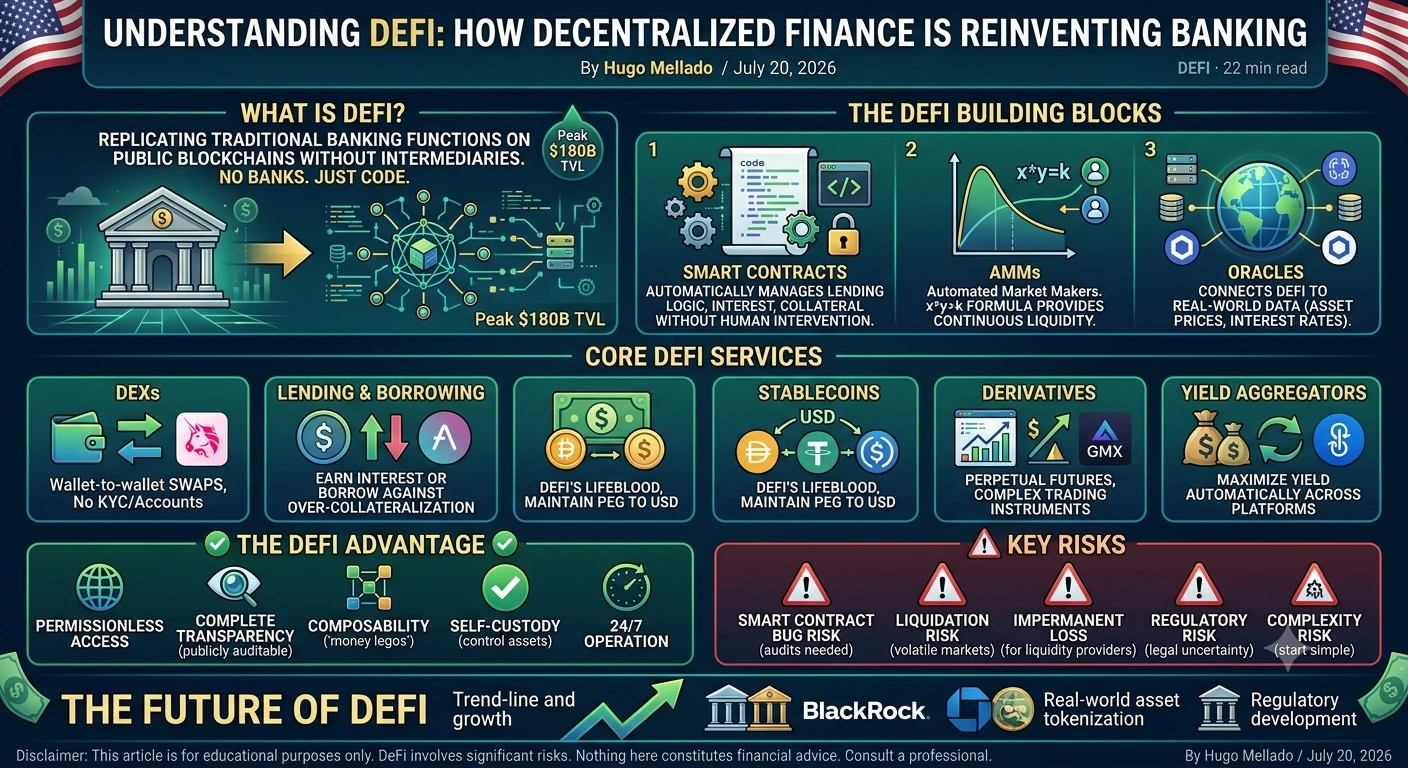
Decentralized Finance — universally abbreviated as DeFi — refers to financial applications built on public blockchains that replicate and reimagine the functions of traditional banking without centralized intermediaries. No banks. No brokers. No clearinghouses. No compliance officers. Just code, executing transparently and automatically according to pre-defined, publicly auditable rules.
In just a few years between 2018 and 2022, the DeFi ecosystem developed functional equivalents of savings accounts, loans, trading platforms, derivatives markets, insurance products, and asset management services — all accessible to anyone with an internet connection and a crypto wallet. At its 2021 peak, over $180 billion in assets were locked in DeFi protocols. Despite significant contraction in the 2022 bear market, the ecosystem has grown more sophisticated, more secure, and more institutionally relevant in the years since. As of September 2026, DefiLlama shows roughly $75 billion locked across the five largest chains: Ethereum (about $52.5 billion), Solana ($6.3 billion), Base ($5.9 billion), BNB Chain ($5.8 billion) and Tron ($5.6 billion).
The Building Blocks of DeFi
Smart Contracts
Every DeFi application is built on smart contracts. When you deposit assets into a lending protocol, a smart contract holds those assets and programmatically manages the lending logic — calculating interest rates based on supply and demand, accepting collateral, enforcing liquidation thresholds, and distributing yield — all without human intervention at any stage. This creates a system that is simultaneously more transparent, more accessible, and more efficient than traditional finance.
Automated Market Makers (AMMs)
Traditional exchanges use order books: buyers place bids, sellers place asks, and trades execute when they match. DeFi introduced the Automated Market Maker model, where trading pairs are funded by liquidity pools contributed by users. When a trader swaps Token A for Token B, they’re trading against the pool rather than a counterparty. A mathematical formula (most commonly x*y=k, where x and y are the quantities of the two tokens and k is a constant) determines the price based on the ratio of assets in the pool. The formula automatically adjusts the price as the pool composition changes — providing continuous liquidity without requiring any active market makers.
Oracles: Connecting DeFi to the Real World
Smart contracts cannot natively access external data — they can only read the blockchain. Oracles are services that bring real-world data (asset prices, interest rates, sports results) onto the blockchain so smart contracts can use it. Chainlink is the dominant oracle provider, with its decentralized network of data providers used by hundreds of protocols. Oracle manipulation — tricking a protocol’s price feed to show false data — has been the source of several major DeFi exploits, making oracle security one of the field’s most important challenges.
Core DeFi Categories
Decentralized Exchanges (DEXs) — Uniswap pioneered the AMM model and remains one of the most used DEXs: in a recent 24-hour window it handled about $3.2 billion of the roughly $10.4 billion traded across all DEXs, according to DefiLlama (September 2026). Curve Finance specializes in stablecoin-to-stablecoin swaps with minimal slippage. SushiSwap, Balancer, and dYdX serve various niches. DEXs allow wallet-to-wallet swaps with no account creation, no KYC, and no company holding your assets at any point.
Lending and Borrowing — Aave and Compound allow users to deposit assets to earn interest, or post collateral to borrow. All positions are over-collateralized; if the value of your collateral drops below the required ratio (typically 150–200%), smart contracts automatically liquidate it to repay the loan. This over-collateralization requirement is DeFi lending’s primary limitation — it’s capital-inefficient compared to traditional under-collateralized lending. Protocols like Aave are experimenting with uncollateralized “flash loans” (borrowed and repaid within a single transaction) and credit delegation.
Stablecoins — DeFi depends heavily on stablecoins. DAI, issued by MakerDAO (now rebranded as Sky, which also issues USDS), is a decentralized stablecoin minted by users depositing crypto collateral into smart contracts. No company issues it, no bank holds reserves — it’s maintained entirely by code and economic incentives. FRAX takes a partially algorithmic approach. Even USDC and USDT — centrally issued — are the lifeblood of DeFi trading and lending. Stablecoins in total are worth about $304 billion as of September 2026, with USDT at roughly $183 billion and USDC at roughly $74 billion (DefiLlama).
Derivatives — dYdX and GMX offer perpetual futures contracts on-chain, processing billions in daily volume with no central operator. Synthetix allows trading synthetic versions of any asset (stocks, commodities, forex) on-chain. These protocols democratize access to complex financial instruments previously available only to institutional traders.
Yield Aggregators — Protocols like Yearn Finance automatically move user deposits between lending protocols to maximize yield, rebalancing continuously as rates change across platforms.
Yield Farming and Liquidity Mining
Yield farming is the practice of moving crypto assets between DeFi protocols to maximize returns. At its simplest, you might deposit USDC in the lending protocol currently offering the highest interest rate. More complex strategies layer multiple protocols: deposit ETH as collateral in Aave, borrow stablecoins against it, supply those to a liquidity pool, then stake the LP tokens to earn additional reward tokens. These “leveraged yield” strategies can generate high returns but also amplify risks.
Liquidity mining refers specifically to earning a protocol’s governance token as a reward for providing liquidity or using the protocol. In DeFi’s 2020 “Summer,” protocols distributed governance tokens aggressively to bootstrap adoption — creating enormous yields for early participants but also inflating token prices unsustainably. Today, liquidity mining rewards are more measured and sustainable.
The DeFi Advantage
Beyond access, DeFi offers: Complete transparency — all code, all transactions, all positions are publicly auditable in real time. Composability — DeFi protocols are “money legos” that can be stacked into complex strategies by anyone with programming knowledge. Self-custody — you maintain control of your assets; no one can freeze your account or reverse your transactions. 24/7 operation — DeFi protocols never close, never take weekends off, and never go offline for maintenance.
DeFi’s Track Record: Hacks and Recoveries
DeFi has suffered significant hacks. In 2022 alone, over $3.8 billion was stolen from DeFi protocols. Major incidents include: the $325M Wormhole bridge hack (February 2022), the $600M Ronin/Axie Infinity hack (March 2022, attributed to North Korea), and the $190M Nomad bridge hack (August 2022). These attacks exploit smart contract bugs, oracle manipulation, bridge vulnerabilities, or governance attacks. The vast majority of losses occurred in bridges (protocols connecting different blockchains) and relatively new, less-audited protocols. Established protocols like Uniswap, Aave, and Compound — which have been running for years with billions locked — have maintained remarkably clean security records due to extensive auditing and battle-testing. Attackers have also gone after centralized platforms and individual users: the February 2025 Bybit exploit, worth about $1.5 billion, is the largest crypto theft on record, and Chainalysis attributes roughly $2 billion of 2025 thefts to North Korea-linked hackers (see its 2026 Crypto Crime Report).
DeFi Risks
Smart Contract Risk — Bugs in code can be exploited to drain funds permanently. Professional audits reduce but do not eliminate this risk. Liquidation Risk — Borrowers posting volatile collateral face liquidation in fast-moving markets; a 50% crash in your collateral during a sleep period could liquidate your position before you can respond. Impermanent Loss — Liquidity providers can suffer value reduction relative to simply holding the assets when prices diverge significantly. Regulatory Risk — Increasing global regulatory scrutiny creates ongoing legal uncertainty for DeFi participants. Complexity Risk — DeFi strategies can be complex enough that users misunderstand the risks they’re taking. Start simple.
How to Get Started with DeFi Safely
Begin with well-established protocols only. The safest entry points are: lending USDC or USDT on Aave or Compound (minimal smart contract risk relative to more complex strategies); providing liquidity on Uniswap V3 for liquid pairs like ETH/USDC; and simple token swaps on Uniswap to understand how DEXs work. Use Layer 2 networks (Arbitrum, Base, Optimism) to reduce gas costs while learning. Always start with amounts you can afford to lose entirely. Never put money needed for living expenses into DeFi. Use dedicated “hot” wallets for DeFi interaction — keep most assets in a hardware wallet.
The Future of DeFi
DeFi is converging with traditional finance in ways unimaginable two years ago. BlackRock, JPMorgan, and Goldman Sachs are exploring or actively building on blockchain infrastructure. Real-world asset tokenization — putting bonds, real estate, and private credit on-chain — could dwarf the current DeFi ecosystem in size. The sector is already sizeable: rwa.xyz shows about $38.5 billion of distributed tokenized real-world assets as of September 19, 2026. Regulatory frameworks are developing that will allow regulated entities to participate in DeFi while maintaining compliance. In the United States the picture is still unsettled: the CLARITY Act, a market-structure bill that passed the House in July 2025, fell short in a Senate vote on September 15, 2026, with DeFi developer liability among the sticking points. Congress had already repealed the IRS broker rule aimed at DeFi front-ends in April 2025. The line between “DeFi” and “TradFi” may blur significantly over the next decade as the technology proves its value in institutional contexts.
⚠️ Disclaimer: This article is for educational purposes only. DeFi involves significant risks including smart contract bugs, liquidations, and total loss of funds. Nothing here constitutes financial advice. Always conduct your own research and consult a licensed financial professional.
Sources and further reading
The explanations above are checked against official regulators, statistical agencies, standards bodies and non-profit financial education organisations. Use these primary sources to verify figures and rules before you act on them.
- Ethereum Foundation — Decentralised finance (DeFi)
- Ethereum Foundation — Smart contracts developer documentation
- U.S. Securities and Exchange Commission — Crypto assets
- CFTC — Customer advisories and articles
- DefiLlama — Total value locked by chain
- DefiLlama — DEX volumes
- DefiLlama — Stablecoins
- Chainalysis — 2026 Crypto Crime Report (introduction)
- RWA.xyz — Tokenized real-world assets dashboard
- CoinDesk — Senate vote on the CLARITY Act, September 15, 2026