
Bitcoin · 9 min read
Updated September 19, 2026: refreshed with current Bitcoin market data, ETF figures, U.S. regulation and the latest halving-cycle numbers.
Introduction: The Currency That Changed Everything
In October 2008, an anonymous programmer using the pseudonym Satoshi Nakamoto published a nine-page white paper titled “Bitcoin: A Peer-to-Peer Electronic Cash System.” Few who read it understood they were witnessing the birth of an entirely new asset class — one that would grow from worthless code to an asset with a market value of roughly $1.3 trillion by September 2026.
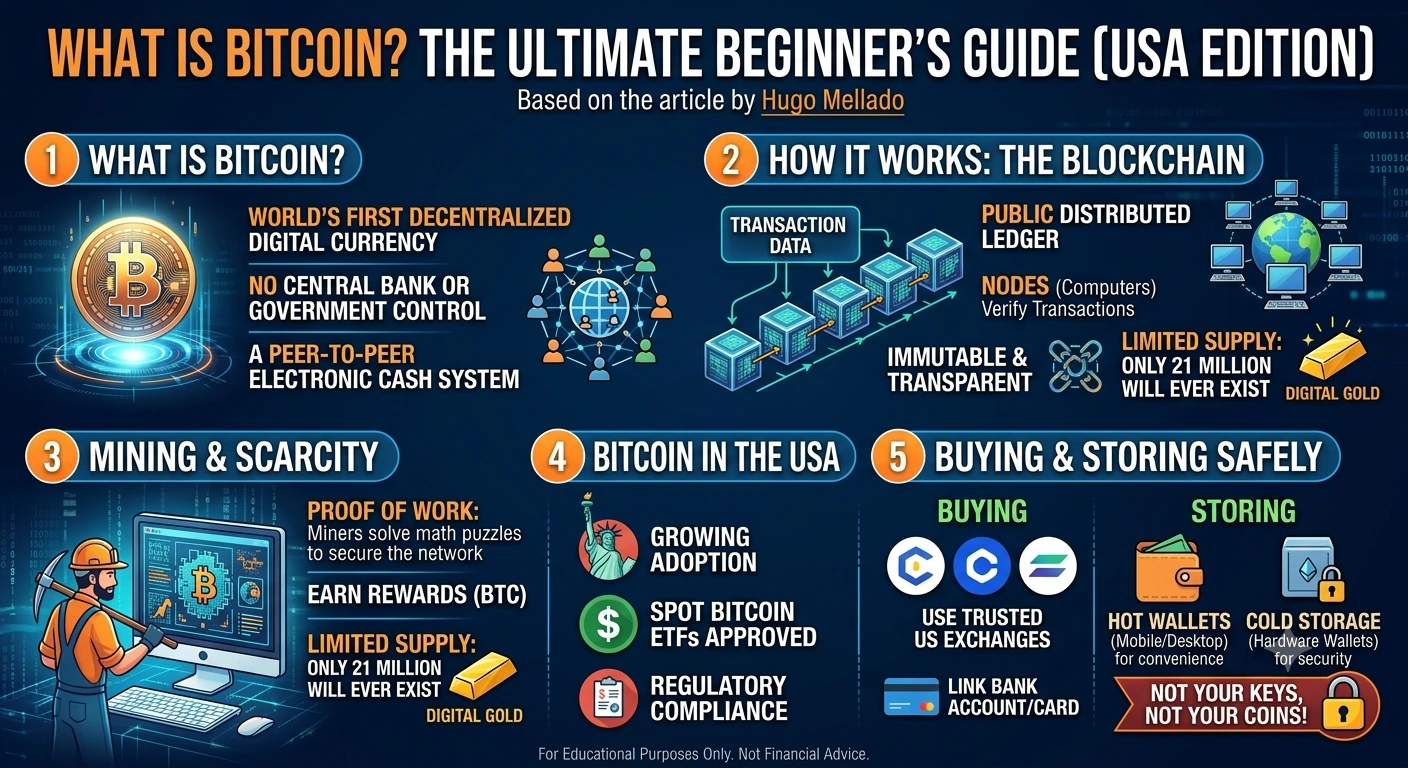
Bitcoin is the world’s first decentralized digital currency. Unlike the dollars in your bank account, Bitcoin is not controlled by any government, central bank, or corporation. It exists purely as software running on thousands of computers simultaneously around the globe — a monetary system governed by mathematics rather than human institutions. Understanding Bitcoin is no longer optional for anyone who wants to understand modern finance.
What Problem Does Bitcoin Solve?
Traditional financial systems depend on trusted intermediaries — banks, payment processors, governments — to verify and record transactions. This creates several significant problems: censorship (banks can freeze accounts at will), exclusion (roughly 1.3 billion adults worldwide remain unbanked, according to the World Bank’s 2025 Global Findex), inflation (governments can print money at any rate they choose), high fees on international transfers (often 5–10%), slow settlement times, and counterparty risk if your bank collapses.
Bitcoin was designed to solve all of these problems simultaneously by creating a financial system with no central point of control. Anyone with internet access can send Bitcoin to anyone else in the world in minutes, for a small fee, without asking permission from any authority. That is genuinely revolutionary.
How Does Bitcoin Actually Work?
Bitcoin runs on a technology called the blockchain — a public, distributed ledger that records every single Bitcoin transaction ever made. Instead of one bank keeping the official record, thousands of computers (called nodes) each maintain an identical copy of this ledger. When a new transaction occurs, it gets broadcast to all nodes, verified against a strict set of rules, and permanently recorded. Altering any historical transaction would require controlling more than half the entire network’s computing power simultaneously — a practically impossible feat.
How a Bitcoin Transaction Works
When Alice sends 0.5 BTC to Bob, her wallet software creates a transaction message containing Bob’s address, the amount, and a cryptographic signature proving Alice authorized the transfer. This message is broadcast to the Bitcoin network. Nodes verify the signature and confirm Alice has sufficient funds. Miners bundle the transaction into a block and add it to the blockchain. After 6 confirmations (approximately 60 minutes), the transaction is considered final and irreversible.
The Mining Process
New transactions are bundled into “blocks” by special participants called miners. To add a block to the chain, miners must solve an extremely difficult mathematical puzzle — a process called Proof of Work. The puzzle requires finding a number (a nonce) that, when combined with the block’s data and run through Bitcoin’s SHA-256 hash function, produces a result meeting a specific difficulty target. There’s no shortcut — miners try trillions of combinations per second. The first miner to solve the puzzle earns the block reward (currently 3.125 BTC) plus all transaction fees in that block.
The 21 Million Cap
One of Bitcoin’s most important properties is its fixed supply. There will never be more than 21 million Bitcoin. This built-in scarcity is hard-coded into Bitcoin’s protocol and cannot be changed without the consensus of the entire network — which would be extremely difficult to achieve. This fixed supply is a core reason many investors view Bitcoin as “digital gold” and a hedge against currency debasement. As of September 2026, approximately 20.1 million BTC have been mined (block height was about 965,000 in early September), leaving roughly 0.9 million yet to be created.
Bitcoin Halving
Approximately every four years (every 210,000 blocks), the reward miners receive for adding a block is cut in half — an event called the halving. This reduces the rate at which new Bitcoin enters circulation. The four halvings so far occurred in 2012 (50→25 BTC), 2016 (25→12.5 BTC), 2020 (12.5→6.25 BTC), and 2024 (6.25→3.125 BTC). Historically, the 2012, 2016 and 2020 halvings were followed by large price rallies, and the 2024 halving was followed by a peak of about $126,000 in October 2025, roughly 17 months later. Past cycles are not a guarantee, and the price has fallen sharply since that peak. The next halving is expected around April 2028 (block 1,050,000), when the reward will drop to 1.5625 BTC.
Bitcoin’s Price History
Bitcoin’s price history is extraordinary by any measure. After years trading for fractions of a cent, Bitcoin hit $1 in 2011. It reached $1,000 in late 2013, crashed to around $200 in 2015, then surged to nearly $20,000 at the end of 2017 before plummeting over 80% to $3,200. In 2020–2021, institutional adoption drove a powerful bull market that peaked near $69,000 in November 2021, followed by a bear market down to $15,700 in late 2022. Following the 2024 halving and the approval of spot Bitcoin ETFs in the United States, Bitcoin set new all-time highs in 2024 and again in 2025, peaking at about $126,198 on October 6, 2025. It then entered a deep drawdown: in August 2026 it traded mostly between $63,000 and $65,400, roughly half below that peak, before recovering to about $78,000 on September 18, 2026 (still about 38% below the high, and about a third lower than a year earlier). Always check a live price before making any decision.
How to Buy Bitcoin Safely
Buying Bitcoin today is far easier than even five years ago. Centralized exchanges like Coinbase, Kraken, Binance, and Gemini allow you to create an account and buy Bitcoin with a debit card, credit card, or bank transfer. The process typically takes 10–15 minutes for basic verification. Bitcoin ATMs — roughly 38,900 worldwide as of March 2026, nearly four in five of them in the United States — allow cash purchases with minimal verification, though fees are higher (typically 5–15%). Peer-to-peer platforms like Bisq connect buyers directly with sellers for more privacy, though with less convenience.
When choosing an exchange, prioritize: regulatory compliance in your country, two-factor authentication support, cold storage of the majority of user funds, proof of reserves, and transparent fee structures. Never buy Bitcoin from social media or messaging app offers — these are virtually always scams (the FBI reports that crypto fraud cost Americans more than $11 billion in 2025).
How to Store Bitcoin Safely
The phrase “not your keys, not your coins” is the most important lesson in Bitcoin security. When you leave Bitcoin on an exchange, the exchange controls it — as thousands of users discovered when FTX collapsed in 2022 and their funds became inaccessible.
Hot wallets (software wallets connected to the internet) are convenient for everyday use and include apps like Electrum, BlueWallet (mobile), and Exodus. They are more vulnerable to online attacks, so only keep small amounts you are comfortable potentially losing. Cold wallets (hardware devices from makers such as Ledger and Trezor) store private keys offline in a dedicated secure chip. Even if your computer is completely compromised, a hardware wallet’s keys remain inaccessible to attackers. Hardware wallets are the gold standard for securing significant amounts of Bitcoin and cost $60–$200.
Your wallet generates a seed phrase — 12 or 24 words — that is the master backup to your entire wallet. Write it on paper (never type it or photograph it), store it in a fireproof safe or safety deposit box, and never share it with anyone for any reason. Losing your seed phrase means losing access to your Bitcoin permanently.
Is Bitcoin a Good Investment?
Arguments for Bitcoin investment include its extraordinary historical track record, fixed supply that cannot be inflated, growing institutional adoption (BlackRock, Fidelity, and other asset managers now offer Bitcoin ETFs; BlackRock’s IBIT alone held more than $60 billion in September 2026, and U.S. spot Bitcoin ETFs have drawn roughly $64 billion in cumulative net inflows), its role as a reserve asset for corporations and some governments (the U.S. created a Strategic Bitcoin Reserve in March 2025, funded only with forfeited coins and budget-neutral measures), and its function as a hedge against currency debasement in inflationary environments. Arguments against include extreme price volatility (80% drawdowns are part of Bitcoin’s history), regulatory uncertainty in various jurisdictions, the psychological difficulty of holding through severe bear markets, and the energy consumption of Proof of Work mining.
Important disclaimer: This article is for educational purposes only. Nothing here constitutes financial advice. Cryptocurrency is a high-risk asset class. You should consult a qualified financial advisor and only invest amounts you can afford to lose entirely.
The Lightning Network: Bitcoin as Everyday Money
Bitcoin’s base layer processes 7–10 transactions per second — too slow for everyday retail use. The Lightning Network is a “Layer 2” payment system built on top of Bitcoin that enables near-instant, extremely cheap transactions. Users open payment channels with small deposits of Bitcoin, then route payments through the network. Only channel opening and closing transactions are recorded on Bitcoin’s main chain. El Salvador adopted Bitcoin as legal tender in 2021 but, as part of an IMF agreement, made its acceptance voluntary in early 2025, so Lightning is now one payment option there rather than a national requirement. Strike and Cash App both support Lightning, making it increasingly accessible to ordinary users.
Common Bitcoin Myths Debunked
Myth: Bitcoin is anonymous. Bitcoin is pseudonymous — all transactions are publicly visible. With analytics tools, Bitcoin transactions are often traceable. Myth: Bitcoin has no intrinsic value. Bitcoin’s value derives from its network effects, fixed supply, and the computing power securing it. Myth: Bitcoin has been hacked. Bitcoin’s protocol has never been successfully hacked. Exchange hacks steal Bitcoin stored on exchanges, not the Bitcoin network itself. Myth: Bitcoin will be replaced by a better cryptocurrency. Bitcoin has unique properties — first-mover advantage, extreme decentralization, maximum security — that are very difficult to replicate. Most “Bitcoin killers” serve different purposes rather than replacing Bitcoin.
The Future of Bitcoin
Bitcoin’s future is shaped by several converging trends: growing institutional adoption as Bitcoin ETFs become mainstream investment products, increasing nation-state interest in Bitcoin as a reserve asset, ongoing development of the Lightning Network expanding Bitcoin’s utility for payments, and potential regulatory clarity creating a clearer path for mainstream adoption. On that last point, a U.S. Senate vote on September 15, 2026 on the CLARITY Act (the crypto market-structure bill the House passed in July 2025) fell short of the 60 votes needed, so comprehensive federal rules remain unsettled for now. The greatest uncertainties remain the long-term regulatory environment, the security implications of quantum computing (though quantum-resistant solutions are being developed), and whether Bitcoin’s primary role will ultimately be as digital gold (a store of value) or as a global payment network.
“Bitcoin is a remarkable cryptographic achievement and the ability to create something that is not duplicable in the digital world has enormous value.” — Eric Schmidt, Former CEO of Google
⚠️ Disclaimer: This article is for informational and educational purposes only. It does not constitute financial or investment advice. Cryptocurrency investments are highly speculative and you may lose your entire investment. Always do your own research and consult a licensed financial professional before investing.
Sources and further reading
The explanations above are checked against official regulators, statistical agencies, standards bodies and non-profit financial education organisations. Use these primary sources to verify figures and rules before you act on them.
- Satoshi Nakamoto — “Bitcoin: A Peer-to-Peer Electronic Cash System” (2008 white paper)
- U.S. Securities and Exchange Commission — Crypto assets
- U.S. Commodity Futures Trading Commission — Digital assets
- Internal Revenue Service — Digital assets
- NIST — “Blockchain Technology Overview”, NISTIR 8202 (U.S. National Institute of Standards and Technology)
- Fortune — Price of Bitcoin, September 18, 2026
- CoinDesk — Senate vote on the CLARITY Act, September 15, 2026
- Federal Register — Establishment of the Strategic Bitcoin Reserve (Executive Order 14233)
- World Bank — Global Findex Database