
Mining · 8 min read
Updated September 19, 2026: refreshed with current market data, regulation and network upgrades.
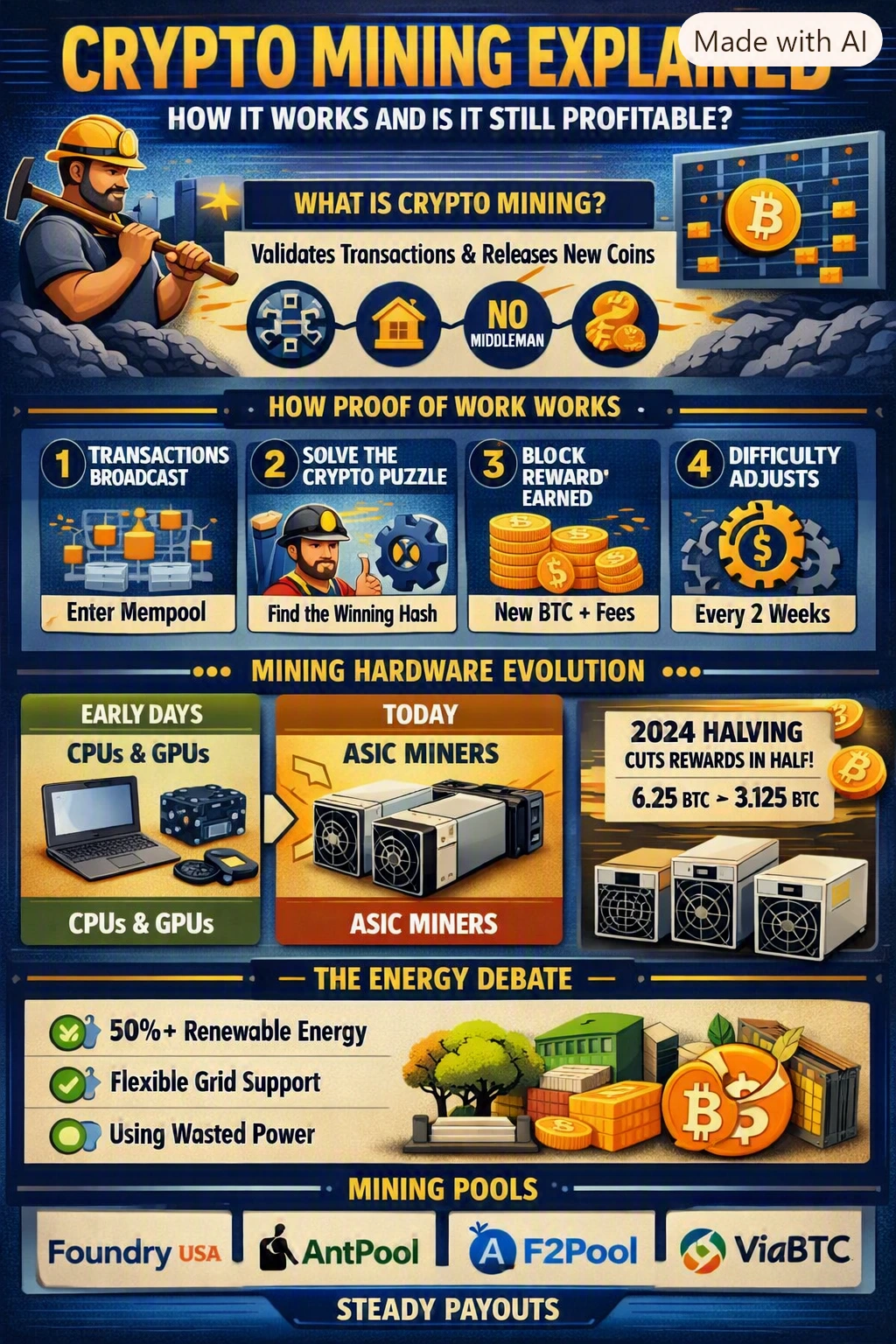
Mining is the engine room of Bitcoin. It is the process that confirms transactions, secures the network against tampering, and releases new coins into circulation — all without a bank, a clearinghouse, or any central authority deciding which payments count.
It is also one of the most misunderstood corners of crypto. Mining has evolved from a hobby you could run on a laptop in 2009 into a capital-intensive industry built on warehouses of specialized chips and long-term power contracts. Here is how it actually works, and what the economics look like today.
What Is Crypto Mining?
Cryptocurrency mining is the process by which new transactions are verified and appended to a blockchain, and new coins are issued. On Bitcoin, it is the mechanism that replaces the trusted middleman: instead of a bank confirming that you really own the money you are spending, thousands of competing machines do it by burning electricity.
The metaphor is a good one. Gold miners spend energy and equipment to pull metal out of the ground; crypto miners spend computing power and specialized hardware to pull new coins out of the protocol. And much as gold gets harder to extract as the easy deposits run out, Bitcoin gets harder to mine as more of its fixed supply is claimed — by design, not by accident.
How Proof of Work Actually Works
Bitcoin runs on a consensus mechanism called Proof of Work (PoW). Stripped to its essentials, it is a four-step loop that repeats roughly every ten minutes.
Step 1: Transactions Are Broadcast
When you send Bitcoin, your transaction is broadcast to the network and lands in a waiting area of unconfirmed transactions known as the mempool. Miners pull transactions from that pool to build the next block, usually favoring the ones offering higher fees.
Step 2: Miners Compete to Solve the Puzzle
To add a block, a miner has to find a number called a nonce that, when hashed together with the block’s data, produces an output below the network’s current difficulty target — in practice, a hash beginning with a required number of zeros.
There is no clever shortcut. Machines simply guess, trillions of times per second, until one of them gets lucky. That brute-force cost is the whole point: rewriting history would mean redoing all of that work. A miner’s odds of winning any given block are proportional to its share of the network’s total hash rate.
Step 3: The Winner Takes the Reward
The first miner to find a valid nonce broadcasts the finished block. Every other node checks it — verification takes milliseconds even though finding the answer took quadrillions of attempts — and appends it to its own copy of the chain. The winner collects the block subsidy of newly created bitcoin plus every transaction fee in the block.
Step 4: Difficulty Adjusts
Every 2,016 blocks — about two weeks — the protocol recalibrates difficulty so that blocks keep arriving roughly every ten minutes no matter how much computing power is pointed at the network. More miners join, difficulty rises; miners switch off, difficulty falls. It is a self-correcting thermostat, and it is the reason Bitcoin’s issuance schedule stays predictable.
The Hardware: From Laptops to ASICs
The Early Days: CPUs and GPUs
In 2009, a standard laptop CPU was enough to mine Bitcoin. As the network grew, miners realized graphics cards handled the same repetitive math far more efficiently. GPU mining dominated for several years and still powers a number of altcoins today.
The ASIC Era
Modern Bitcoin mining belongs to Application-Specific Integrated Circuits (ASICs): chips built to do nothing but the SHA-256 hashing Bitcoin requires. They are orders of magnitude more efficient than GPUs at that one job and useless at everything else. Bitmain (Antminer) and MicroBT (Whatsminer) supply most of the market.
A current flagship machine gives a sense of the scale involved:
| Specification | High-end ASIC (e.g., Antminer S21 Pro) |
|---|---|
| Hash rate | ~234 TH/s |
| Power draw | ~3,500 W |
| Hardware cost | $3,000-$5,000 |
| Gross revenue | ~$9 per day before electricity (September 2026) |
| Practical needs | Constant airflow, industrial noise tolerance, stable power |
Is Mining Profitable in 2026?
This is where most curiosity lands, and the honest answer is that almost everything hinges on one number: what you pay for electricity. The arithmetic is not complicated.
Daily profit       = daily revenue - daily electricity cost
Daily revenue      ≈ (your hash rate / network hash rate) × daily block rewards × BTC price
Daily electricity  = (watts / 1,000) × 24 × rate per kWh
Run a 3,500-watt machine through that formula and the spread between cheap industrial power and a typical household rate decides everything:
| Electricity rate | Typical setting | Daily power cost | Result at ~$9/day revenue |
|---|---|---|---|
| $0.05/kWh | Industrial contracts in parts of the US, Canada, Central Asia | ~$4.20 | Small profit (about +$5/day) |
| $0.10/kWh | Favorable commercial or hosted mining | ~$8.40 | Roughly break-even (about +$1/day) |
| $0.15/kWh | Average US residential | ~$12.60 | Loss (about -$3/day) |
The 2024 halving sharpened all of this considerably, cutting the block subsidy from 6.25 BTC to 3.125 BTC and erasing half of miners’ per-block revenue overnight. The operations that came through it comfortably tended to share the same three traits: unusually cheap power, the most efficient hardware generation, and a stack of previously mined bitcoin that had appreciated.
Conditions have tightened further in 2026, which is why the table above uses roughly $9 per day rather than the $15–25 that was typical earlier. Hashprice, the revenue a miner earns per petahash of computing power per day, was about $27.66 in late June 2026, about $31.70 in early August and about $39.63 on September 7 (see this September 2026 update). The network hash rate is around 934 EH/s and difficulty about 127.45 trillion after the September 6 adjustment. According to CoinDesk, difficulty fell below its year-earlier level this summer as low revenues pushed operators to switch off machines, and a number of them are redirecting capacity to AI and high-performance computing. The next halving, expected around April 2028, will cut the block subsidy again from 3.125 BTC to 1.5625 BTC. The table figures are our own estimate for an Antminer S21 Pro at these hashprice levels and change with Bitcoin’s price
Mining Pools
A single machine’s chance of winning a block is vanishingly small, which turns solo mining into a lottery: you might run for months and earn nothing. Mining pools solve that by combining hash rate from thousands of participants and splitting rewards proportionally, charging roughly 1-3% for the service in exchange for steady, predictable payouts.
The largest pools include Foundry USA, AntPool, F2Pool, and ViaBTC, with Foundry USA consistently near the top by hash rate in recent years.
The Energy Question
Bitcoin’s aggregate electricity use is genuinely large — comparable to a mid-sized country — and it has made mining a lightning rod for environmental criticism. The fuller picture is more textured than the headline number suggests:
- A growing renewable share. Industry surveys, including those published by the Bitcoin Mining Council, put the sustainable-energy portion of mining somewhere in the 50-60% range.
- Unusually flexible demand. Miners can be powered down in seconds when the grid is stressed, which makes them useful demand-response partners for grid operators.
- Stranded energy. Operations sited next to curtailed wind and solar, remote hydro, or flared natural gas convert power that would otherwise be wasted into revenue.
None of that erases the footprint, but it explains why the debate has shifted from raw consumption toward where and when that consumption happens.
Alternatives to Running Your Own Rig
Cloud Mining
Cloud mining contracts let you rent hash rate while somebody else runs the hardware. Approach this corner of the market with real skepticism: it has a long history of outright scams, and even legitimate contracts have often returned less than simply holding the coin would have.
Mining Altcoins
Some networks — Monero, Ravencoin, and Ergo among them — use ASIC-resistant algorithms deliberately, which keeps consumer GPUs competitive. That lowers the barrier to entry, though these coins typically carry thinner liquidity and sharper price swings than Bitcoin.
Proof of Stake Validation
On Ethereum and most newer chains, mining no longer exists. Proof of Stake replaces hardware with capital: validators lock up coins instead of buying machines, consume a fraction of the energy, and can participate without a warehouse or a power contract.
The Bottom Line
For a home miner paying residential rates, the numbers rarely add up once power, noise, heat, and hardware depreciation are accounted for. Where mining still works is at the industrial end of the spectrum: power below roughly $0.06/kWh, current-generation ASICs, and the technical capacity to keep them running.
That is why many people interested in Bitcoin’s trajectory never touch a mining rig at all — the exposure is available without the capital outlay or the operational headaches. Mining, in the end, is less a way to acquire coins than a business in cheap electricity and thermal management that happens to be paid in bitcoin.
This content is for informational purposes only and does not constitute financial or legal advice. Crypto assets are highly volatile and you can lose your entire investment. Always do your own research before acting on anything you read here.
Sources and further reading
The explanations above are checked against official regulators, statistical agencies, standards bodies and non-profit financial education organisations. Use these primary sources to verify figures and rules before you act on them.
- Cambridge Centre for Alternative Finance — Cambridge Bitcoin Electricity Consumption Index
- U.S. Energy Information Administration — Electricity data and analysis
- Ethereum Foundation — Consensus mechanisms (proof of work and proof of stake)
- NIST — “Blockchain Technology Overview”, NISTIR 8202 (U.S. National Institute of Standards and Technology)
- Internal Revenue Service — Digital assets
- CoinDesk — Bitcoin mining difficulty and miners pivoting to AI, August 1, 2026
- Cryptolexicon — Bitcoin difficulty and hashprice, September 2026