
Regulation · 5 min read
Updated September 19, 2026: refreshed with current market data, regulation and network upgrades.
Crypto’s rise hasn’t gone unnoticed by the institutions it indirectly challenges. Central banks and governments around the world are answering back with their own digital money — Central Bank Digital Currencies, or CBDCs — designed to bring the efficiency of digital payment rails together with full government control over how that money is issued, distributed, and tracked.
As of May 2026, the Atlantic Council’s CBDC tracker counts 146 countries and currency unions, together accounting for over 98% of global GDP, that are exploring, piloting, or launching some form of CBDC; only three (the Bahamas, Jamaica and Nigeria) have fully launched one. It’s one of the more consequential monetary shifts of the decade, and one that anyone who saves, earns, or simply cares about financial privacy should understand.
What Exactly Is a CBDC?
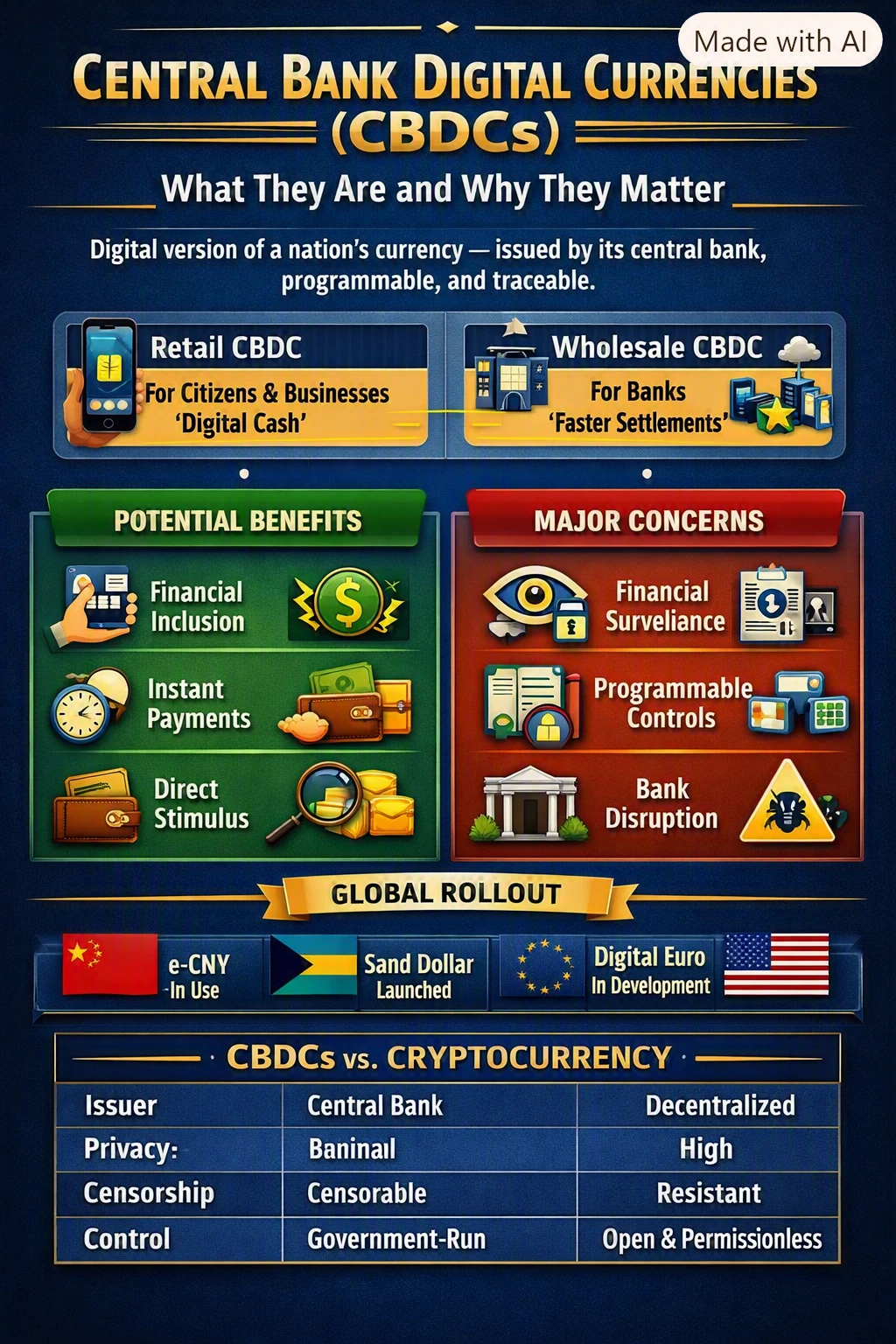
A CBDC is a digital version of a country’s official currency, issued and backed directly by its central bank — essentially the digital counterpart of physical cash, but potentially programmable and fully traceable.
That’s a meaningful difference from the money already sitting in your bank account. Ordinary bank deposits are a claim on a commercial bank, not the central bank itself, which is why deposit insurance exists in the first place. A CBDC would instead be a direct claim on the central bank, removing that layer of commercial-bank risk — while also giving up the relative anonymity that comes with physical cash.
Two Flavors: Retail and Wholesale
Retail CBDCs are made available to ordinary people and businesses as a form of digital cash — the most talked-about and potentially disruptive version. China’s e-CNY, the European Central Bank’s digital euro project, and the US Federal Reserve’s earlier research into a digital dollar all fall into this category.
Wholesale CBDCs are restricted to financial institutions, used for interbank settlement and cross-border transfers. They attract far less controversy but could meaningfully speed up international payments, which today rely on a slow, costly web of correspondent banks.
The Case in Favor
Supporters point to several potential upsides: broader financial inclusion for people who currently have no bank account but do have a phone; near-instant, low-cost domestic and cross-border payments; more direct monetary policy tools, such as sending stimulus funds straight into citizens’ digital wallets; easier detection of money laundering and sanctions evasion thanks to full transaction visibility; and lower costs tied to printing, moving, and securing physical cash.
The Case Against
Financial surveillance. The biggest concern by far: a retail CBDC with complete transaction monitoring would hand governments an unprecedented window into everyone’s spending — from political donations to everyday purchases. Civil liberties groups see this as a fundamental expansion of state power.
Programmable money cuts both ways. The same programmability that makes CBDCs flexible could allow expiration dates on funds to force spending, restrictions on which goods money can be used for, automatically enforced negative interest rates, or automatic tax withholding. Whether that’s useful policy or overreach depends entirely on who’s holding the controls.
Pressure on commercial banks. If people can hold money directly at the central bank, they have less reason to keep it in a commercial bank account — a shift that could trigger deposit flight during periods of stress and undercut the lending model banks rely on.
A single point of failure. Concentrating a country’s entire payment system on centrally controlled infrastructure creates a tempting target for cyberattacks and a systemic risk if that infrastructure ever goes down.
Where Things Stand Globally
China leads the pack, with an e-CNY that had processed about 3.48 billion transactions worth roughly 16.7 trillion yuan (around $2.4 trillion) by November 2025. Since January 1, 2026, e-CNY wallet balances have also paid interest like bank deposits, according to Chinese government reporting. The Bahamas became the first country to fully launch a retail CBDC, the Sand Dollar, back in 2020, followed by Jamaica and Nigeria. The European Union is further along than a year ago: on June 23, 2026 the European Parliament’s economic affairs committee approved its position on the digital euro, which moves the file into negotiations with member states. The ECB says a pilot could begin in 2027 and a first issuance in 2029, but only if EU legislation is adopted in 2026 (see the ECB’s digital euro page). The United States has moved more cautiously — a digital dollar has faced real political pushback, with several states restricting its use and multiple political figures publicly opposing it. On January 23, 2025, an executive order also barred federal agencies from establishing, issuing or promoting a CBDC.
CBDCs vs. Crypto: What Actually Separates Them
| Property | CBDC | Bitcoin / Crypto |
|---|---|---|
| Issuer | National government | Decentralized, no single issuer |
| Supply control | Set by government | Fixed by algorithm/protocol |
| Privacy | Minimal to none | Pseudonymous to private |
| Censorship resistance | None | High |
| Programmability | Defined by government | Open, permissionless |
| Counterparty risk | Minimal (central bank) | None (decentralized) |
Crypto advocates are split on what this means for the industry. Some argue that CBDCs will end up highlighting exactly why decentralized alternatives like Bitcoin matter, pushing more people toward them. Others believe CBDCs could crowd out crypto altogether by offering similar convenience without asking users to manage their own private keys.
Sources and further reading
The explanations above are checked against official regulators, statistical agencies, standards bodies and non-profit financial education organisations. Use these primary sources to verify figures and rules before you act on them.
- Federal Reserve Board — “Money and Payments: The U.S. Dollar in the Age of Digital Transformation”
- Bank for International Settlements — Central bank digital currencies: foundational principles and core features
- Atlantic Council — Central Bank Digital Currency Tracker
- Federal Reserve — About the FedNow Service
- Federal Reserve Board — Monetary policy
- Atlantic Council — CBDC Tracker (146 countries, May 2026 update)
- European Central Bank — Digital euro
- CoinDesk — European Parliament committee vote on the digital euro, June 23, 2026
- Government of China — e-CNY developments (December 29, 2025)
- The White House — Strengthening American Leadership in Digital Financial Technology (January 23, 2025)
Related reading
- Cryptocurrency Taxes: What Every Investor Needs to Know
- What Are Stablecoins and How Do They Work? USDT, USDC, DAI Explained
- What Is Web3? The Decentralized Internet Explained
This content is for informational purposes only and does not constitute financial or legal advice. Crypto assets are highly volatile and you can lose your entire investment. Always do your own research before acting on anything you read here.