
Regulation · 8 min read
Updated September 19, 2026: refreshed with current market data, regulation and network upgrades.
Taxes are the part of crypto that almost nobody researches before their first trade and almost everybody researches in a panic afterward. The rules are not as exotic as the technology suggests — most of them fall out of a single classification decision made more than a decade ago — but they punish poor record-keeping severely, and that is where most of the pain comes from.
Why “Invisible to the IRS” Stopped Being True
A generation of early investors assumed crypto gains sat outside the reach of tax authorities: too new, too technical, too pseudonymous to trace. That assumption has aged badly. Exchanges now issue tax forms, chain-analytics firms work directly with enforcement agencies, and the compliance questions on tax returns are explicit rather than incidental.
The reassuring half of the story is that crypto taxation is arithmetic, not alchemy. Understand a handful of principles, keep your records as you go, and the annual exercise becomes routine. What follows covers the fundamentals for US taxpayers, with notes on how other countries differ.
The Core Principle: Crypto Is Property
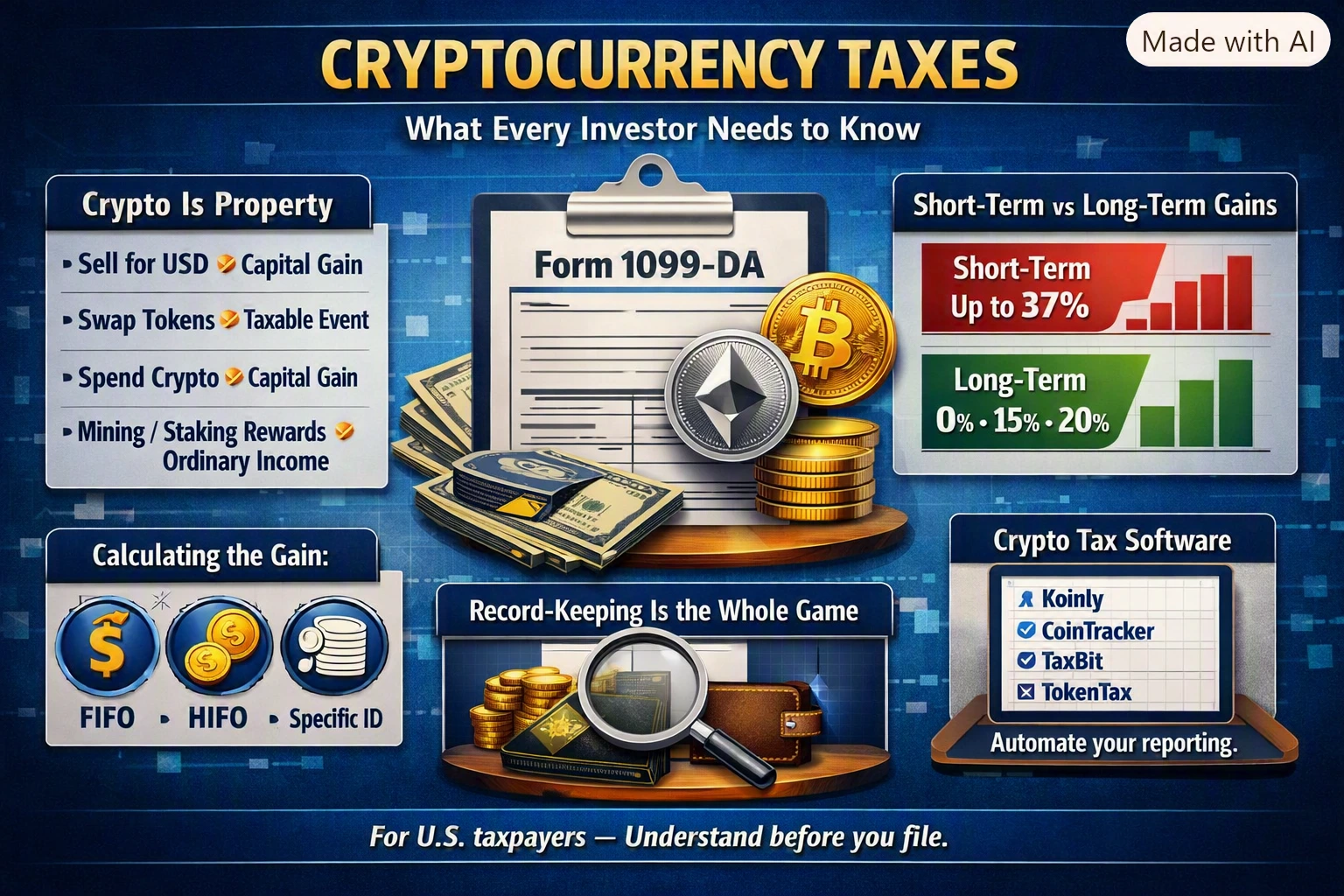
Since Notice 2014-21, the IRS has treated cryptocurrency as property rather than currency. Nearly every consequence below descends from that one line, and the same broad approach applies in the UK, Canada, Australia, and most other developed economies.
The practical translation is that disposing of crypto — not just cashing out — triggers a tax consequence:
| Action | Treatment | Timing |
|---|---|---|
| Selling crypto for dollars | Capital gain or loss | At the sale |
| Swapping one token for another | Capital gain or loss on the token given up | At the swap |
| Spending crypto on goods or services | Capital gain or loss | At the purchase |
| Mining rewards | Ordinary income at fair market value | On receipt |
| Staking rewards | Ordinary income at fair market value | On receipt |
| Airdropped tokens | Generally ordinary income | On receipt or control |
| Buying and holding | Nothing | Not a taxable event |
| Moving coins between your own wallets | Nothing | Not a taxable event |
The trap that catches the most people is the second row. Swapping ETH for SOL feels like rearranging one portfolio, but it is legally a sale followed by a purchase — and a year of enthusiastic rotation can generate a taxable gain even if the wallet’s dollar value never grew.
Note too that income and capital gains stack: a staking reward is taxed as income when it lands, and taxed again on any appreciation when you eventually sell it. The amount taxed as income becomes that coin’s cost basis, so the second bite applies only to the gain.
Short-Term Versus Long-Term Gains
How long you held an asset before disposing of it changes the rate dramatically, and it is the single most consequential number in crypto tax planning.
| Holding period | Classification | Federal rate |
|---|---|---|
| 12 months or less | Short-term | Taxed as ordinary income, up to 37% at the top bracket |
| More than 12 months | Long-term | 0%, 15%, or 20% depending on taxable income |
For many middle-income filers, the long-term rate lands at 15% — often less than half the short-term cost on the same profit. High earners may also owe the 3.8% net investment income tax on top, and state tax applies separately in most states. That gap is why crossing the one-year mark is worth tracking deliberately: holding a position eight extra weeks can be worth more after tax than a modest additional gain.
Calculating the Gain
The formula is unremarkable: proceeds minus cost basis. Cost basis is what you paid, including purchase fees. The difficulty appears once you have bought the same asset repeatedly at different prices and need to decide which units you just sold.
| Method | How it works | Practical effect |
|---|---|---|
| FIFO | Oldest units are treated as sold first | Simplest and most defensible; in a rising market it usually realizes larger gains, though more of them qualify as long-term |
| HIFO | Highest-cost units are treated as sold first | Generally minimizes the current gain; permitted in the US only with records adequate to identify the lots |
| Specific identification | You designate the exact lots sold | Maximum flexibility, maximum documentation burden |
Whichever method you use, apply it consistently and keep the evidence. HIFO and specific identification are not defended by intention; they are defended by lot-level records showing which units left which wallet, and when.
Tax-Loss Harvesting
Harvesting losses means realizing a decline on paper by actually selling, then using that loss to offset gains elsewhere. Capital losses offset capital gains without limit, a portion of any excess can offset ordinary income, and the remainder carries forward to future years.
Crypto has historically enjoyed an unusual advantage here. The wash-sale rule, which blocks the deduction when a substantially identical security is repurchased within 30 days, is written in terms that have not applied to digital assets — so selling at a loss and buying back promptly has been possible without forfeiting the loss. Legislative proposals to close that gap have appeared repeatedly, and, as of mid-2026, none has become law: the statute itself (26 U.S.C. § 1091) still refers to “stock or securities”. Rules can change, so confirm the current status for the tax year you are filing before relying on it.
Used deliberately, this turns a bad year into a useful one: losses banked during a drawdown remain available to offset gains when the market recovers.
DeFi: Where the Guidance Runs Out
DeFi generates the hardest questions in crypto tax, and the honest answer to several of them is that authoritative guidance does not yet exist. Conservative practice among specialists looks roughly like this.
Liquidity Pools
Depositing assets in exchange for LP tokens is most often treated as a disposal of what you deposited, and withdrawing a different mix of assets as another disposal. Trading fees accruing to the position are generally income. A single “provide liquidity, earn, withdraw” cycle can therefore produce several taxable events.
Yield Farming
Reward tokens are typically ordinary income valued at the market price when received, which then sets their basis. Selling later is a separate capital gains event. Rewards that accrue continuously make timing and valuation genuinely laborious without software.
Wrapped Tokens
Whether wrapping ETH into WETH is a disposal remains unresolved. Many practitioners treat it as non-taxable on the reasoning that economic ownership does not change, but the position is a judgment call rather than settled law.
Reporting Is Getting Tighter
Three shifts matter for anyone filing in the United States. First, custodial brokers now report digital-asset sales on Form 1099-DA: gross proceeds for transactions on or after January 1, 2025, and cost basis for certain transactions on or after January 1, 2026 (see the IRS final regulations). Second, the broader broker-reporting rules aimed at decentralized platforms were repealed by Congress in April 2025, so DeFi front-ends do not issue these forms, but your own obligation to report is unchanged. Third, guidance issued in 2024 pushed taxpayers toward tracking basis wallet by wallet rather than pooling everything into one universal account, which makes clean per-wallet records considerably more important than they used to be.
Rules in this area have been changing quickly, so treat the specifics as a prompt to check the current instructions for your filing year rather than as a fixed description.
Software That Does the Bookkeeping
Beyond a handful of trades a year, dedicated software stops being a convenience and becomes the only realistic way to file accurately.
| Tool | Strengths |
|---|---|
| Koinly | Strong DeFi coverage, hundreds of exchange integrations, support for many countries |
| CoinTracker | Broad exchange connections and smooth handoff into consumer filing software |
| TaxBit | Enterprise-grade reporting, used by exchanges themselves |
| TokenTax | Software plus access to CPAs who specialize in digital assets |
All of them work by importing history through exchange APIs and public addresses, which is another argument for connecting accounts early: reconstructing three years of activity retroactively is where the real cost shows up.
How Other Countries Handle It
Treatment varies widely enough that residency changes the entire calculation. Germany has exempted gains on crypto held longer than a year. Portugal was long a favorable outlier before tightening its rules. Singapore and the United Arab Emirates levy no capital gains tax at all, which is why both appear so often in relocation discussions. In the EU, the DAC8 directive has applied since January 1, 2026, obliging crypto-asset service providers to collect and report their users’ activity to tax authorities, with the first exchanges of data due in 2027. None of this generalizes safely — jurisdictional detail is exactly where professional advice pays for itself.
Record-Keeping Is the Whole Game
For every transaction, keep the date, the asset and amount, the dollar value at the time, the fees, and which wallet or account it touched. The blockchain preserves the transactions but not the context, and reconstructing valuations after the fact from explorers and exchange statements is slow, imprecise, and unpleasant.
- Export exchange history at least once a year, before an account or a company disappears.
- Label wallet transfers as they happen so internal moves are not mistaken for sales.
- Record the fair market value of income events on the day they occur, not at year end.
- Keep the underlying files, not just the software’s summary output.
The Bottom Line
Crypto taxes reward preparation and punish improvisation. The investors who find filing painless are rarely the ones with the simplest portfolios; they are the ones who set up tracking before they needed it, understood that swaps and rewards are events in their own right, and let holding periods rather than impulses dictate when they sold. The right time to build that habit is now, not the week before the deadline.
This content is for informational purposes only and does not constitute tax, legal, or financial advice. Tax law changes frequently and varies by jurisdiction and personal circumstances. Consult a qualified tax professional about your own situation.
Sources and further reading
The explanations above are checked against official regulators, statistical agencies, standards bodies and non-profit financial education organisations. Use these primary sources to verify figures and rules before you act on them.
- Internal Revenue Service — Digital assets
- IRS Notice 2014-21 — Virtual currency treated as property (PDF)
- IRS — About Form 8949, Sales and Other Dispositions of Capital Assets
- IRS Topic no. 409 — Capital gains and losses
- IRS Publication 544 — Sales and Other Dispositions of Assets
- IRS — About Form 1099-DA, Digital Asset Proceeds From Broker Transactions
- IRS — Final regulations on broker reporting of digital-asset sales and exchanges
- Cornell Law School LII — 26 U.S.C. § 1091 (wash sales)
- European Commission — DAC8 (crypto-asset reporting)