
Ethereum · 6 min read
Updated September 19, 2026: refreshed with current market data, regulation and network upgrades.
Ask someone new to crypto what Ethereum is and you will usually hear some version of “the second-biggest coin.” That answer misses the point entirely. Bitcoin set out to be money. Ethereum set out to be infrastructure — a shared computer that anyone can program, with money built in as a native feature rather than bolted on afterward.
The World Computer
Vitalik Buterin sketched out Ethereum in 2013, at nineteen, out of frustration with how deliberately limited Bitcoin’s scripting was. His proposal was a blockchain with a general-purpose programming language built in, so that applications could inherit the network’s properties instead of merely referencing them: permissionless to use, resistant to censorship, and verifiable by anyone who cares to check.
The result behaves less like a payment network and more like a public utility for computation. Thousands of independent nodes execute the same code and agree on the outcome, which means an application deployed to Ethereum keeps running whether or not its authors stick around.
The Core Innovation: Smart Contracts
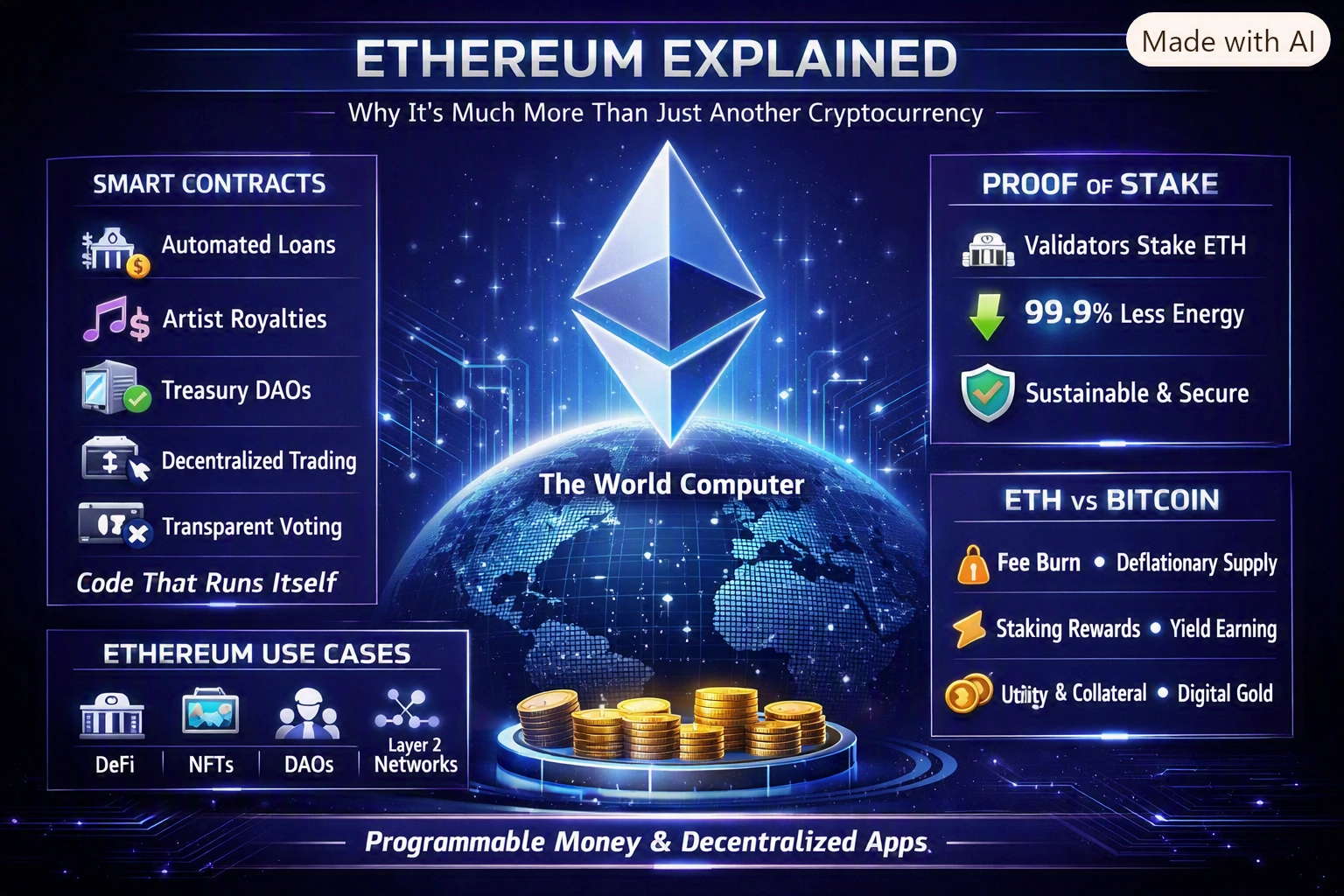
Everything distinctive about Ethereum traces back to a single idea. A smart contract is a program stored on-chain that runs automatically when its conditions are satisfied. There is no bank, notary, or intermediary to instruct — the code executes, and the network enforces the result.
- A loan that liquidates its own collateral the moment the value falls below a set threshold.
- An artwork that pays its creator a royalty on every resale, indefinitely.
- A treasury that releases funds only when a required number of signers approve.
- An exchange that matches trades with no company operating it.
- A vote whose tally anyone can verify and nobody can quietly edit.
None of these are hypotheticals. All five patterns are in production today, handling billions of dollars in value — which also means their bugs are real, permanent, and occasionally expensive. Code being the contract cuts both ways.
Ether: Fuel First, Asset Second
Ether (ETH) is the network’s native unit, and it plays two distinct roles that are easy to confuse.
Gas: Paying for Computation
Every action on Ethereum consumes network resources — a transfer, a swap, minting an NFT, deploying a contract. Users pay for those resources in gas, priced in ETH and usually quoted in gwei, a billionth of an ETH. Because block space is finite, gas is an auction: when demand spikes, fees rise, and a simple interaction on the base layer can cost more than the transaction is worth.
Collateral and Reserve Asset
ETH is also the default collateral across decentralized finance, backing loans and stablecoins throughout the ecosystem. That gives it a demand profile tied to activity: the more the network is used, the more ETH is needed to use it and to secure positions built on it. As of September 18, 2026, ETH traded near $2,506, about 45% lower than a year earlier (Fortune).
The Merge: Switching Engines Mid-Flight
In September 2022, Ethereum replaced its consensus mechanism while live. The Merge moved the network from Proof of Work mining to Proof of Stake validation and cut energy consumption by more than 99.9% essentially overnight, without downtime and without disrupting the value flowing through the network at the time.
Under Proof of Stake, validators post 32 ETH as collateral and are selected to propose and attest to blocks in proportion to their stake. Honest participation earns rewards; provable misbehavior gets the stake slashed, meaning part of it is destroyed. Smaller holders typically participate through staking pools or liquid staking tokens rather than running a validator alone. As of September 2026, the average staking yield is about 2.6% and roughly 35% of all ETH is staked, according to Staking Rewards.
As an engineering achievement, swapping the foundation of a live multi-hundred-billion-dollar system on schedule remains the strongest evidence available of Ethereum’s capacity to coordinate complex upgrades.
What Actually Gets Built on Ethereum
Decentralized Finance
DeFi is the largest category by value locked. Lending, trading, derivatives, and insurance get rebuilt as contracts rather than institutions, composable enough that protocols plug into one another like software libraries. At the peak of the last cycle, well over $100 billion sat in Ethereum DeFi. As of September 2026, DefiLlama shows about $52.5 billion locked on Ethereum itself, still well ahead of Solana (about $6.3 billion) and Base (about $5.9 billion).
NFTs
The token standards that made unique on-chain assets practical — ERC-721 and ERC-1155 — originated here, and most of the NFT market still settles on Ethereum. Beyond the art market that dominated headlines, the same standards underpin game items, event tickets, and membership credentials.
DAOs
Decentralized autonomous organizations replace corporate hierarchy with contracts and token-holder voting. In practice they manage protocol treasuries, grant programs, and investment pools, and they have become a live experiment in how far governance can be encoded rather than negotiated.
Layer 2 Networks
Ethereum’s answer to congestion has been to push execution outward. Layer 2 networks such as Arbitrum, Optimism, Base and zkSync process transactions off the main chain and periodically settle proofs or batched data back to it, inheriting mainnet security while cutting costs by orders of magnitude. For most everyday users today, “using Ethereum” increasingly means using a Layer 2. According to L2BEAT in September 2026, Base (about $15.6 billion of value secured) and Arbitrum One (about $11.5 billion) are the two largest, while Polygon shut down its zkEVM rollup on July 1, 2026.
How ETH Behaves Differently From Bitcoin
Setting price aside, the two assets have structurally different mechanics. Three differences do most of the work:
| Property | Mechanism | What it implies |
|---|---|---|
| Fee burn | Since EIP-1559 (August 2021), part of every gas fee is destroyed rather than paid out | When activity is heavy, more ETH can be burned than issued, making net supply contract |
| Staking rewards | Staked ETH earns protocol issuance and fees, historically in the low single digits annually | Gives ETH a yield-like profile Bitcoin does not have, alongside lockup and slashing risk |
| Usage-linked demand | ETH is required to transact and widely used as collateral | Demand tracks network activity rather than narrative alone |
Real Challenges
Ethereum’s problems are not hypothetical either. Base-layer fees remain unpredictable and can price out ordinary users exactly when the network is most interesting. Rival Layer 1 chains — Solana, Avalanche, BNB Chain, Cardano and others — compete hard on throughput and cost, and some have won real developer mindshare. Pushing activity onto Layer 2s solves much of the fee problem but introduces fragmentation, with liquidity and users spread across networks that do not always interoperate cleanly.
The multi-year roadmap addresses this by treating the base layer as a settlement and data-availability foundation while execution scales outward. Recent milestones include Dencun (March 2024), which cut Layer 2 costs with data blobs; Pectra (May 2025); and Fusaka (December 2025), which introduced PeerDAS to expand data capacity. The next upgrade, Glamsterdam, is planned for the fourth quarter of 2026 (see the official roadmap). Whether that architecture wins is a genuinely open question rather than a settled one.
The Bottom Line
Ethereum remains the most actively developed platform in the industry, with the deepest developer ecosystem, the most value deployed, and by far the widest range of working applications. Whether it holds that position through the next decade is unknowable. What is already settled is narrower and more durable: the idea that financial logic can be written as public, executable code, running on infrastructure that no single party owns, is now a permanent part of computing history.
This content is for informational purposes only and does not constitute financial or legal advice. Crypto assets are highly volatile and you can lose your entire investment. Always do your own research before acting on anything you read here.
Sources and further reading
The explanations above are checked against official regulators, statistical agencies, standards bodies and non-profit financial education organisations. Use these primary sources to verify figures and rules before you act on them.
- Ethereum Foundation — Ethereum white paper
- Ethereum Foundation — Smart contracts developer documentation
- Ethereum Foundation — Consensus mechanisms (proof of work and proof of stake)
- Ethereum Foundation — Protocol roadmap
- EIP-20: Token Standard (Ethereum Improvement Proposals)
- DefiLlama — Total value locked by chain
- L2BEAT — Layer 2 scaling summary
- Staking Rewards — Ethereum staking
- Fortune — Price of Ethereum, September 18, 2026
- Polygon Forum — Sunsetting Polygon zkEVM Mainnet Beta in 2026