
Trading · 9 min read
Updated September 19, 2026: refreshed with current market data, regulation and network upgrades.
Crypto markets never close, the charts are hypnotic, and the barrier to entry is a phone and a few dollars. That combination makes trading feel like the natural way to participate — which is exactly why it is worth understanding what the different approaches actually demand before choosing one.
Start With the Uncomfortable Part
The evidence is consistent and unflattering: most active crypto traders end up behind where they would have been simply holding Bitcoin or a basket of large-cap assets. This is not a crypto quirk. Decades of research in equity markets point the same direction, because active trading pits retail participants against desks with better data, faster execution, and full-time attention.
None of that is an argument for staying away from the market. It is an argument for humility about which approach you pick, and for matching that approach to the time, temperament, and knowledge you actually have rather than the ones you plan to acquire later. With that framing in place, here is how the main strategies work.
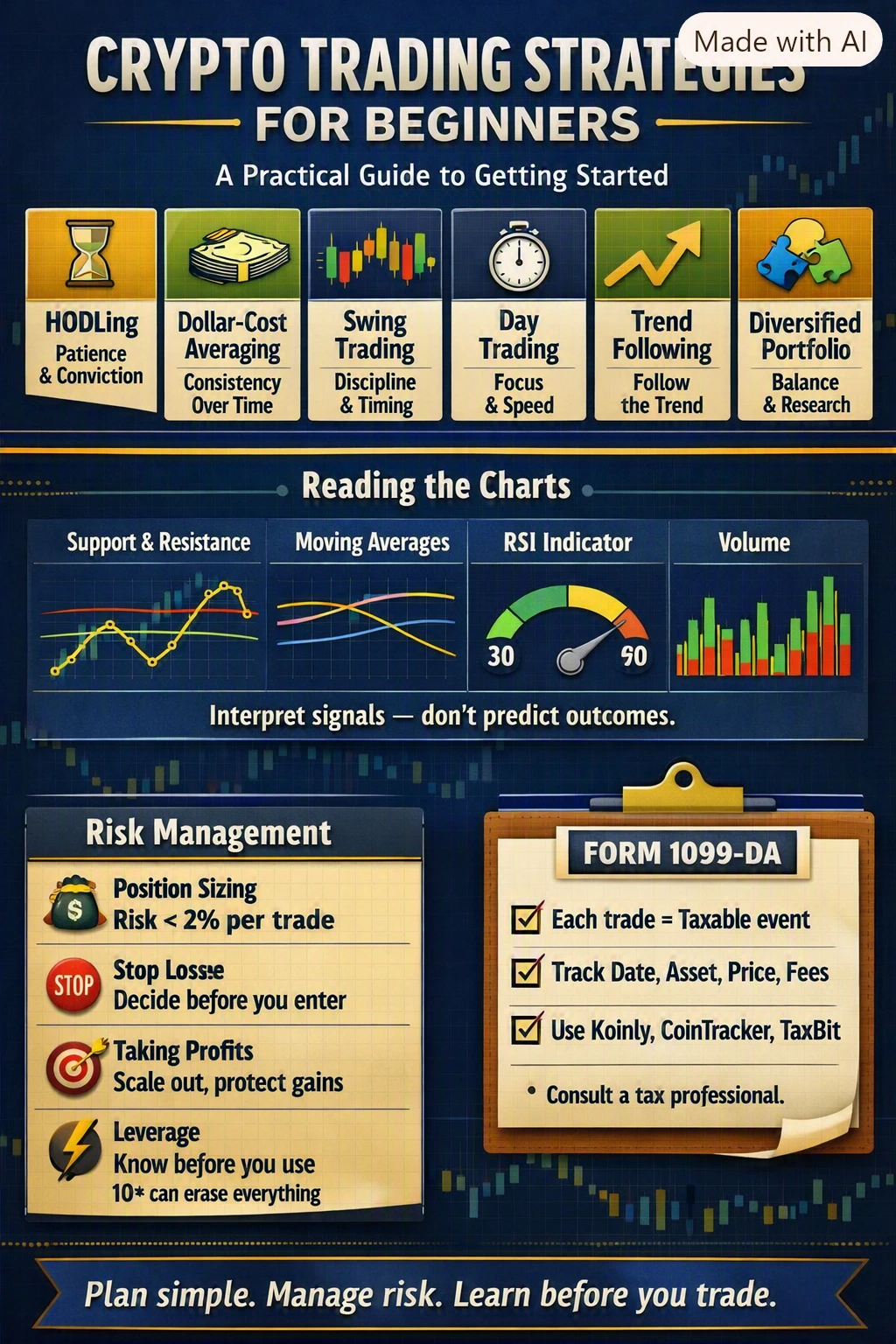
The Six Approaches at a Glance
| Approach | Typical holding period | Effort required | Skill demanded |
|---|---|---|---|
| HODLing | Years | Minimal | Patience and conviction |
| Dollar-cost averaging | Years, bought in slices | Automatable | Consistency |
| Swing trading | Days to weeks | Daily attention | Chart reading, discipline |
| Day trading | Minutes to hours | Full-time | Very high |
| Trend following | Weeks to months | Weekly check-ins | Rule adherence |
| Diversified portfolio | Years, rebalanced | Periodic | Research and sizing |
1. HODLing: Long-Term Holding
The term comes from a typo. A 2013 forum post titled “I AM HODLING,” written by someone riding out a crash, turned into shorthand for buying and refusing to sell through the noise. It is less a strategy than a decision made in advance about how you will behave when the price falls.
The reasoning rests on Bitcoin’s history of drawdowns of 50-80% followed by recoveries to new highs. Someone who bought the 2017 peak near $20,000 — a purchase declared hopelessly late at the time — watched the position fall toward $3,000 before it went on to multiply several times over by 2021. The catch is that the outcome depended entirely on not selling during the worst of it, and past cycles carry no obligation to repeat. The 2025–26 cycle is a live example: Bitcoin peaked near $126,000 in October 2025, traded mostly between $63,000 and $65,400 in August 2026, and stood around $78,000 on September 18 (Fortune).
In practice, this approach demands three things: genuine conviction in the asset, a position small enough that an 80% decline does not force your hand, and a horizon measured in years rather than months. Its main advantage is that it requires almost no ongoing skill, which is precisely why it has been hard for active strategies to beat.
2. Dollar-Cost Averaging
Dollar-cost averaging means committing a fixed amount on a fixed schedule — weekly, biweekly, monthly — no matter what the price is doing. Instead of trying to identify the bottom, you accept the average and let the schedule do the work.
- It removes the pressure of timing, which is the part most people get wrong most consistently.
- Fixed dollar amounts naturally buy more units when prices are low and fewer when they are high.
- Automation strips emotion out of the moment of purchase, which is where most damage happens.
- Scale is irrelevant to whether it works: $20 a week is a legitimate implementation.
Most major exchanges support recurring buys, so the whole thing can run without further decisions. Over multi-year windows, this mechanical approach has historically held up well against far more elaborate ones — largely because it never requires you to be right about tomorrow.
3. Swing Trading
Swing traders hold for days or weeks, aiming to capture a meaningful move rather than every tick. It sits between the two extremes: more engaged than holding, less punishing than trading intraday, and dependent on reading price structure rather than predicting news.
The Core Toolkit
| Tool | What it describes | How traders commonly read it |
|---|---|---|
| Support and resistance | Price levels where moves have historically stalled | Support acts as a floor where buyers appear; resistance as a ceiling where sellers do |
| Moving averages | Smoothed average price over 50 or 200 days | 50-day crossing above the 200-day is read as bullish (“golden cross”); the reverse as bearish |
| RSI | Momentum on a 0-100 scale | Above 70 suggests overbought conditions, below 30 oversold; divergence from price can precede reversals |
| Volume | How much was actually traded | Moves on heavy volume are treated as more credible than the same move on thin volume |
4. Day Trading
Day trading means opening and closing positions inside the same session, sometimes within minutes. Because crypto trades around the clock, there is no bell to save you from yourself.
It is also the hardest approach on this list by a wide margin. Studies of equity day traders repeatedly find that roughly 70-80% lose money, and crypto adds higher volatility plus a dense population of automated systems reacting faster than any human can. The traders who last tend to share unglamorous traits: written rules, strict risk limits, and the discipline to follow both during a losing streak.
If you intend to try it anyway, paper trade for at least three months first and keep a written journal of every decision and its outcome. Treat any capital involved as money you can lose in full.
5. Trend Following
Trend followers do not try to catch tops and bottoms. They wait for a direction to establish itself, stay with it, and exit when the evidence turns — the old line being that the trend is your friend until it ends.
Crypto has historically trended hard in both directions, with bull phases running for years and bear phases persisting 12-18 months. That behavior is what makes simple mechanical rules attractive: for example, holding an asset while it trades above its 200-day moving average and rotating to stablecoins when it closes below. Backtests of such rules generally show they sidestep the worst of deep bear markets, at the cost of whipsaw losses in choppy conditions and late entries after every reversal.
6. Diversified Portfolio Construction
Rather than concentrating in a single asset, some investors spread exposure across tiers of risk. One framework that circulates widely divides a crypto allocation roughly as follows — useful as an illustration of the logic rather than as a prescription:
| Tier | Illustrative weight | Examples | Role |
|---|---|---|---|
| Large cap | 50-60% | Bitcoin, Ethereum | Deepest liquidity, lowest relative risk within the asset class |
| Mid cap | 20-30% | Established Layer 1s, major DeFi protocols | Growth exposure with real usage and track record |
| Small cap / speculative | 10-20% | Early-stage projects | Asymmetric upside, with full loss as a realistic outcome |
The point of the structure is that the speculative sleeve can go to zero without ending the portfolio. Worth remembering, though: crypto assets tend to fall together in stress, so diversification within the asset class dampens single-project risk far more than it dampens market risk.
Risk Management: The Most Underrated Skill
Strategy choice gets the attention; risk management determines who is still around in three years. The mechanics are simple enough to fit on an index card, and following them is the hard part.
Position Sizing
Size positions so that no single one can seriously damage the whole. A widely used convention among active traders is to risk no more than 1-2% of total trading capital on any individual position, which means a string of losses is survivable rather than terminal.
Stop Losses
A stop loss is a price decided in advance at which you accept being wrong and exit. Its value comes entirely from being set before the trade and honored afterward; moved stops are how small losses become account-defining ones.
Taking Profits
Greed closes more accounts than fear does. Defining a target before entry, and scaling out in pieces as it is reached, keeps a winning position working while progressively removing risk from the table.
Leverage: The Cardinal Sin
Leverage multiplies both directions. At 10x, a 10% move against you erases the entire position — and 10% moves are an ordinary Tuesday in crypto. Liquidation cascades routinely wipe out traders who were directionally right but early. Beginners are far better served by treating leverage as something to understand rather than something to use.
Taxes and Record-Keeping
In the United States, the IRS treats cryptocurrency as property, which means nearly every disposal is a taxable event — including swapping one token for another and spending crypto on goods. Frequent trading can therefore generate a large reporting burden even in a year that ends flat.
Reporting is also getting stricter. Brokers began reporting gross proceeds on Form 1099-DA for digital-asset sales made on or after January 1, 2025, and for certain transactions from January 1, 2026 they must report cost basis too (custodial brokers only, per the IRS final regulations). Your own records remain the check on whatever the broker reports.
Keep records as you go rather than reconstructing them in April: date, asset, amount, price in dollars at the time, fees, and the resulting gain or loss. Tools such as Koinly, CoinTracker, and TaxBit can pull much of this automatically through exchange APIs. Rules differ by jurisdiction and change over time, so confirm specifics with a qualified tax professional.
The Bottom Line
The best strategy on paper is worthless if you abandon it during the first drawdown. What tends to distinguish durable approaches is not sophistication but survivability: a plan simple enough to follow on a bad day, positions small enough to sleep through, and an honest record of your own results instead of a memory that quietly edits out the losses.
If you want to move beyond a passive approach, the cheapest capital to spend first is time. Paper trade, journal every decision, and measure the outcomes against what doing nothing would have produced. That comparison is the most useful number in trading, and almost nobody calculates it.
This content is for informational and educational purposes only and does not constitute financial, investment, or tax advice. Crypto assets are highly volatile and you can lose your entire investment. Consult a qualified professional before making financial decisions.
Sources and further reading
The explanations above are checked against official regulators, statistical agencies, standards bodies and non-profit financial education organisations. Use these primary sources to verify figures and rules before you act on them.
- U.S. Securities and Exchange Commission — Crypto assets
- U.S. Commodity Futures Trading Commission — Digital assets
- U.S. SEC — Ten things to consider before you make investing decisions
- FINRA — Investing basics: understanding risk
- IRS Topic no. 429 — Traders in securities
- Fortune — Price of Bitcoin, September 18, 2026
- IRS — About Form 1099-DA, Digital Asset Proceeds From Broker Transactions
- IRS — Final regulations on broker reporting of digital-asset sales and exchanges
Related reading
- What is Bitcoin? The Complete Beginner’s Guide to the World’s First Cryptocurrency
- Understanding Crypto Market Cycles: Bull Markets, Bear Markets, and Everything Between
- Crypto Scams and How to Avoid Them: The Complete Protection Guide
This content is for informational purposes only and does not constitute financial advice. Cryptocurrency investments carry high risk — always do your own research.