
Blockchain · 7 min read
Updated September 19, 2026: refreshed with current market data, regulation and network upgrades.
Few words have been stretched further in the past decade than “blockchain.” It has been sold as the successor to the internet and dismissed as a solution hunting for a problem. The reality sits between those poles and is more interesting than either: a blockchain is a genuinely new kind of shared record, unusually good at one specific job — letting parties who do not trust each other agree on the same history.
What follows explains how that works from first principles. No technical background required.
The Problem: Keeping Books Nobody Controls
Picture five people settling up after a week-long trip. The easy answer is to let one person keep the ledger — fine, as long as everyone trusts that person’s honesty and arithmetic.
Remove that trust and the problem gets hard fast. If everyone keeps their own copy, who decides which version is right when two disagree? What stops someone from quietly editing last Tuesday to erase a debt? Traditional systems answer this by appointing an authority: a bank, a clearinghouse, a registry. Blockchain answers it differently, with a ledger that everyone maintains at once and where rewriting the past is detectable by everybody, immediately.
Four Properties That Define It
- Distributed. The ledger lives on hundreds or thousands of machines simultaneously, each holding a full copy. There is no central server to seize, bribe, or accidentally switch off.
- Immutable in practice. Once written, entries are extraordinarily hard to change, because altering one record invalidates everything built on top of it.
- Transparent. On public chains, anyone can inspect every transaction, balance, and line of contract code. Accountability comes from visibility rather than from a promise.
- Permissionless. On public chains, participation needs no application or approval — anyone with an internet connection can transact, run a node, or help secure the network.
Worth stressing that transparency is not privacy. Public chains are pseudonymous: addresses are not names, but every movement they make is permanently visible to anyone who looks.
What Is Actually Inside a Block
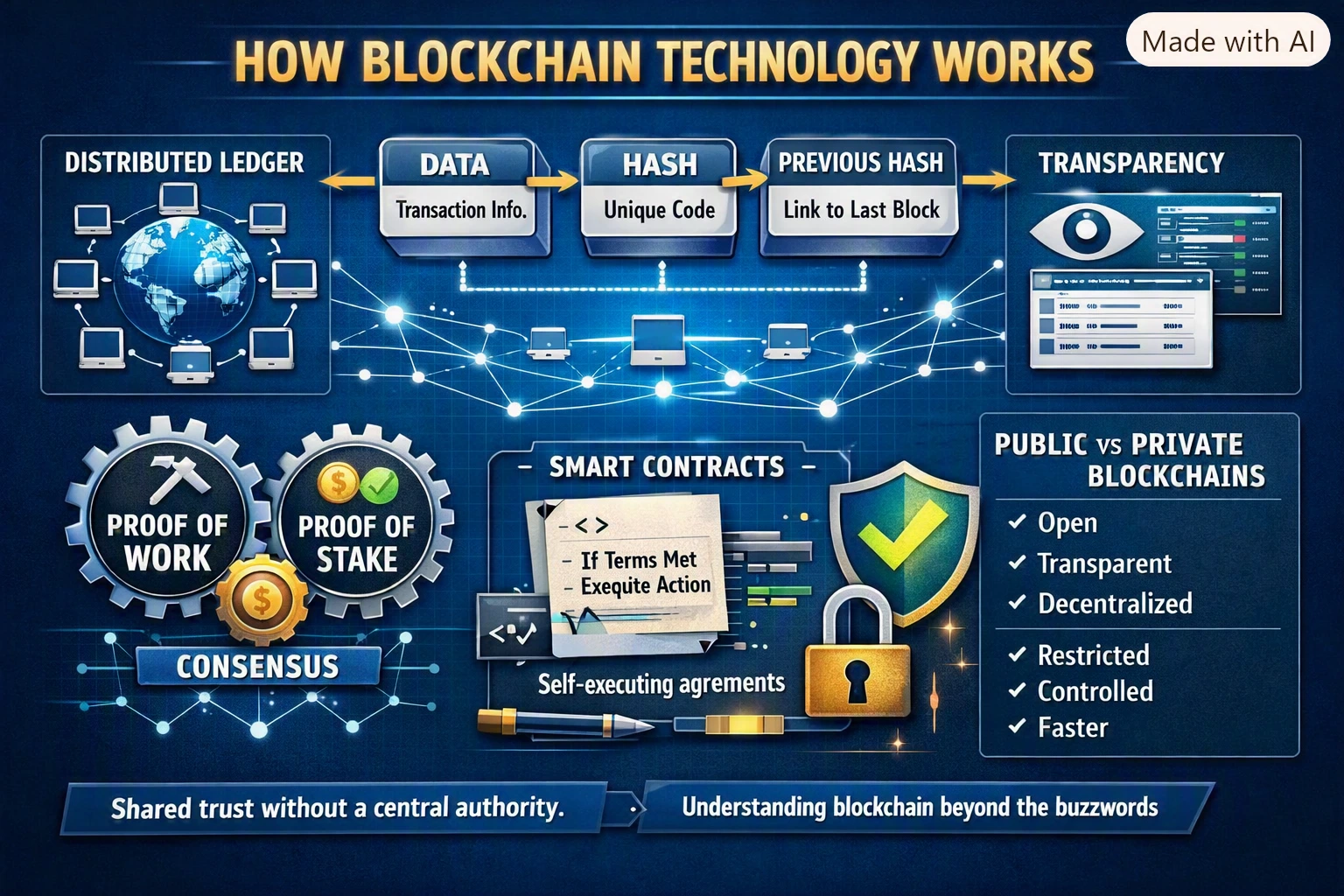
The name is literal. A blockchain is a chain of blocks, and each block carries three things that matter here:
| Component | What it is | Why it matters |
|---|---|---|
| Data | The records themselves, such as “Alice sends 0.5 BTC to Bob” | The substance being agreed on |
| Hash | A fixed-length fingerprint of the block’s contents | Change one character of the data and the fingerprint changes completely |
| Previous hash | The fingerprint of the block before it | This is the chain: every block is anchored to its predecessor |
That third field is what makes tampering impractical. Edit an old transaction and the block’s hash changes, which breaks the reference stored in the next block, which breaks the one after that. To pass the change off as legitimate, an attacker would need to recompute every block from that point forward while simultaneously outrunning the honest network as it keeps adding new ones. On a mature chain, that is not a clever hack — it is an arms race against the entire network at once.
Consensus: How Strangers Agree
Thousands of independent participants still need a way to settle which version of the ledger counts. That is the job of a consensus mechanism — a shared rulebook for reaching agreement without a referee.
Proof of Work
Bitcoin’s approach makes producing a valid block genuinely expensive in electricity and hardware. Cheating means redoing all of that expense and then sustaining it faster than everyone else combined. The security is well tested and the tradeoff is blunt: it consumes real energy by design.
Proof of Stake
Used by Ethereum since 2022 and by most newer networks. Instead of burning energy, validators lock up cryptocurrency as collateral and are chosen to produce blocks in proportion to that stake. Provable misbehavior gets the collateral slashed, so the deterrent is financial rather than thermodynamic. Ethereum’s switch cut its energy use by more than 99.9%.
Everything Else
Dozens of variants trade security, decentralization, and speed against one another: delegated proof of stake, Solana’s proof of history, and proof of authority in the permissioned corporate chains where participants are known and vetted.
Public Versus Private Chains
| Feature | Public blockchain | Private blockchain |
|---|---|---|
| Access | Anyone | Invited participants only |
| Transparency | Fully public | Controlled by the operators |
| Decentralization | High | Low to moderate |
| Speed | Slower | Faster |
| Examples | Bitcoin, Ethereum | Hyperledger, Corda |
The honest question to ask of any private chain is what it does that a well-run shared database could not. Sometimes the answer is real — cryptographic audit trails among competitors, for instance. Often it is not, which is where much of the “blockchain for everything” fatigue came from.
Smart Contracts: When the Ledger Becomes Programmable
Bitcoin’s chain records who paid whom. Ethereum’s stores programs. A smart contract is code that lives on-chain and executes itself when its conditions are met, with no human hand on the lever.
A plain example: a contract holds a payment in escrow and releases it to the seller the moment the buyer confirms delivery — no bank, lawyer, or escrow company involved. Extend that idea and you get decentralized finance, NFTs, DAOs, and most of what is being built in crypto today. The same property that makes contracts trustworthy also makes them unforgiving: a bug deployed on-chain is a bug that executes exactly as written, permanently.
Uses Beyond Cryptocurrency
- Supply chains. Walmart’s produce-tracking work is the standard example, cutting food safety traceback from days to seconds.
- Healthcare. Permissioned chains are used to protect the integrity of clinical trial data and audit access to records.
- Voting. Verifiable tallies are technically attractive, though secure remote voting involves identity and coercion problems that no ledger solves on its own.
- Digital identity. Self-sovereign identity aims to let people hold and present credentials without a corporate intermediary in the middle.
- Real estate. Tokenized ownership could lower transaction costs and make fractional ownership practical, assuming the legal system recognizes the token. More broadly, tokenized real-world assets such as money-market and Treasury funds now account for roughly $38.5 billion of distributed on-chain value, according to rwa.xyz (September 19, 2026).
Honest Limitations
Blockchain is not a general-purpose upgrade for databases, and its constraints are structural rather than temporary inconveniences.
- Throughput. Bitcoin settles roughly seven transactions per second; Visa’s network is built for tens of thousands. Layer 2s and newer chains close the gap, but replication always costs performance.
- Finality takes time. Transactions need confirmations before they can be treated as irreversible.
- Irreversibility. There is no undo. Send funds to the wrong address and they are gone.
- The oracle problem. Chains cannot see the outside world, so any contract depending on real-world data depends on an oracle — and the trust you removed reappears there.
- Key management. Self-custody moves security from institutions to individuals, a burden most people underestimate until the first mistake.
The Bottom Line
Blockchain is best understood narrowly rather than grandly. It is a way to coordinate a shared record among parties with no reason to trust one another, and for that particular problem it offers something that genuinely did not exist before 2009. For most other problems, a database remains the better tool.
Knowing which category a given proposal falls into is the practical skill here — and it is worth having as the technology continues working its way into finance, logistics, identity, and governance.
This content is for informational purposes only and does not constitute financial or legal advice. Crypto assets are highly volatile and you can lose your entire investment. Always do your own research before acting on anything you read here.
Sources and further reading
The explanations above are checked against official regulators, statistical agencies, standards bodies and non-profit financial education organisations. Use these primary sources to verify figures and rules before you act on them.
- NIST — “Blockchain Technology Overview”, NISTIR 8202 (U.S. National Institute of Standards and Technology)
- Satoshi Nakamoto — “Bitcoin: A Peer-to-Peer Electronic Cash System” (2008 white paper)
- Ethereum Foundation — Consensus mechanisms (proof of work and proof of stake)
- W3C — Decentralized Identifiers (DIDs) v1.0 specification
- RWA.xyz — Tokenized real-world assets dashboard