
Guides · 6 min read
Updated September 19, 2026: refreshed with current market data, regulation and network upgrades.
Why Exchange Choice Matters More Than Most People Realize
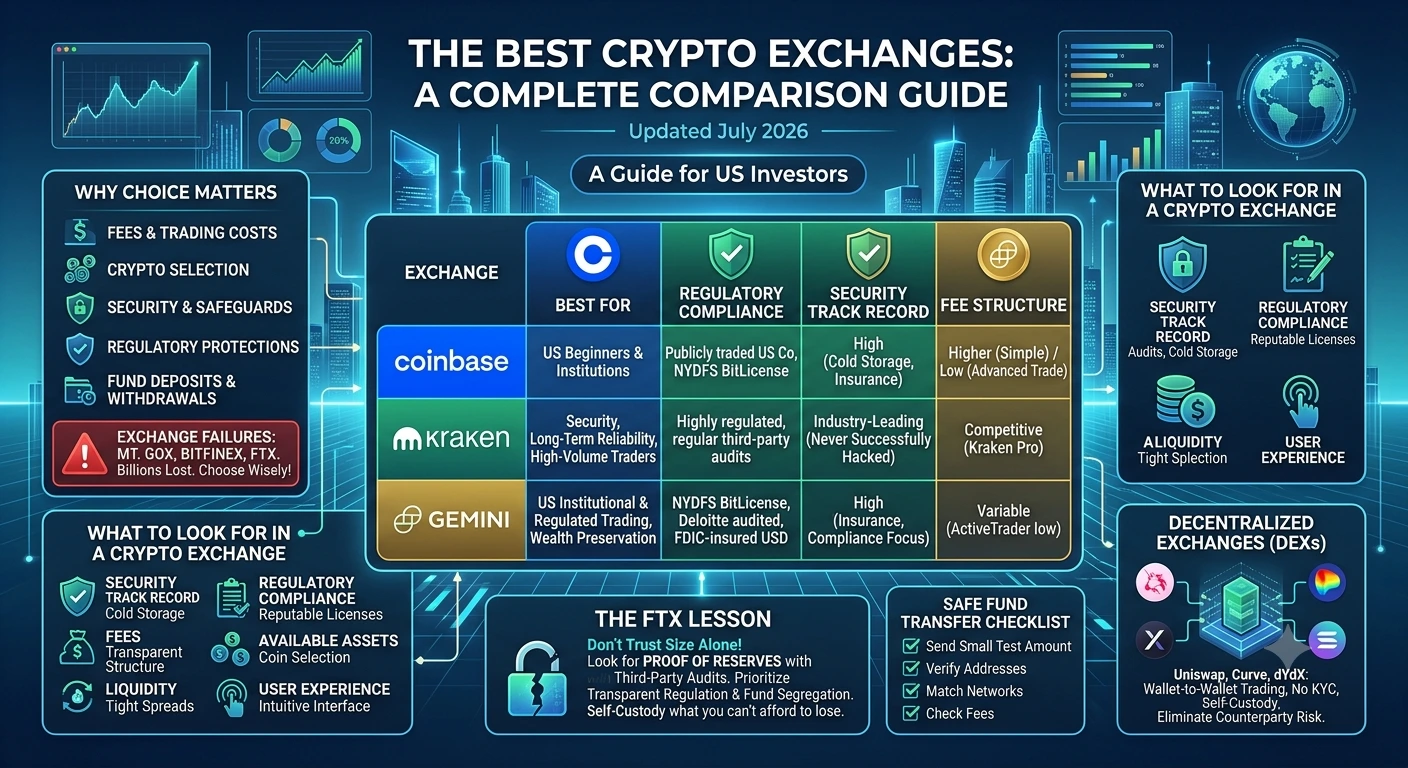
Your choice of exchange affects every trade you make: the fees you pay on every buy and sell, which cryptocurrencies are available to you, the security of potentially large sums of money, the smoothness of depositing and withdrawing funds, and your legal protections if something goes wrong. Given that exchange failures have cost users billions — Mt. Gox’s 2014 collapse (850,000 BTC lost), BitFinex’s 2016 hack ($72M), the February 2025 Bybit hack (about $1.5 billion, the largest crypto theft on record, per Chainalysis), and most dramatically FTX’s 2022 implosion (~$8B in customer funds lost) — choosing the right exchange is not a trivial decision.
What to Look for in a Crypto Exchange
Security track record — Has the exchange ever been hacked? If so, how did they handle it? Do they keep the majority of customer funds in cold storage (offline)? Do they publish proof of reserves audits? Regulatory compliance — Exchanges operating under robust regulatory frameworks (NYDFS BitLicense, FCA authorization, MiCA compliance) face regular audits and must meet standards for customer fund segregation. Under the EU’s MiCA rules, the transitional period for existing providers ended on July 1, 2026, so platforms serving EU customers should now hold a MiCA authorisation (see ESMA). Fees — Trading fees (spot trading typically 0.05–0.50%), withdrawal fees (per-network charges that vary significantly), and spread on simple buy/sell interfaces (often 1.5–2.5% on “simple” purchasing interfaces vs. 0.0–0.5% on advanced trading). Available assets — Large exchanges list hundreds of cryptocurrencies; some specialized exchanges focus on specific assets. Liquidity — Better liquidity means tighter spreads and less price slippage, particularly important for large trades. User experience — Beginners benefit from simpler interfaces; advanced traders need sophisticated charting and order types.
Major Exchanges in 2026: Detailed Breakdown
Coinbase — Best for US Beginners and Institutional Clients
Coinbase is a publicly traded US crypto exchange (Nasdaq: COIN), which means it publishes the audited financial reports and disclosures required of a listed company. Its simple interface is designed for beginners, while its advanced platform (Coinbase Advanced) offers lower fees and professional tools. Fees, supported assets and country availability change often, so compare the current fee schedule on the exchange’s own website before you sign up.
Binance — Largest by Volume Globally
Binance is one of the world’s largest exchanges by trading volume, with an extraordinary breadth of products: spot, futures, options, staking, an NFT marketplace, crypto loans and more. However, it has faced significant regulatory difficulties: in 2023 it agreed to a $4.3 billion settlement with US authorities over anti-money-laundering and sanctions violations, and its founder and then-CEO resigned as part of the deal. US users must use the separate Binance.US platform, which offers fewer assets and features. Because of that regulatory history, risk-averse users may prefer alternatives.
Kraken — Best for Security and Long-Term Reliability
Founded in 2011, Kraken is one of the longest-running exchanges still operating. It offers spot trading, futures, staking and over-the-counter services for larger investors. Whatever the platform, check its current security features (for example, whether it supports hardware security keys for login and withdrawals), its country availability and its fee schedule before depositing funds.
OKX — Best for Advanced Traders (Non-US)
OKX offers deep liquidity, a wide asset selection and sophisticated trading tools, including copy trading, algorithmic trading and derivatives. It is popular in Asia and Europe. Availability differs by country, so check whether you can use it where you live, and confirm that it holds the licence required for your country of residence.
Gemini — Best for US Institutional and Regulated Trading
Founded by Tyler and Cameron Winklevoss, Gemini is a New York-based exchange operating under the NYDFS BitLicense, one of the most demanding state-level crypto regulatory frameworks. It focuses on regulated and institutional clients and lists fewer assets than the largest competitors. Keep in mind that crypto held on any exchange is not covered by FDIC deposit insurance, which protects only eligible bank deposits.
Decentralized Exchanges (DEXs): A Different Model
Decentralized exchanges — Uniswap, Curve, dYdX, Aerodrome — allow direct wallet-to-wallet trading with no account creation, no KYC, no email address required, and no company holding your assets at any point. Trades execute via smart contracts; you maintain complete custody of your funds throughout. This model removes the exchange-as-custodian risk that brought down FTX, although it introduces smart contract and phishing risk and offers access to any ERC-20 token immediately upon launch, without waiting for exchange listings. As a sense of scale, DEXs across all chains processed roughly $10.4 billion in a recent 24-hour window (DefiLlama, September 2026).
Tradeoffs: DEXs are crypto-to-crypto only (no fiat on/off ramp). Effective costs may be higher than CEXs when gas fees are included. They require more technical knowledge — you need a self-custody wallet and understand how to approve token spending. Certain DEX interfaces have blocked users from specific jurisdictions due to regulatory concerns, though the underlying smart contracts remain permissionless.
How to Move Between Exchanges Safely
When transferring crypto between exchanges: always send a small test amount first before a large transfer, verify the destination address character-by-character (malware can swap clipboard addresses), confirm you’re using the correct network (sending ETH on Ethereum vs. BNB chain vs. Arbitrum requires matching network selection on both ends), and double-check withdrawal fees. Many exchange hacks on users happen not through exchange breaches but through user error in transfers or phishing of exchange credentials.
KYC and Privacy Considerations
All major centralized exchanges require Know Your Customer (KYC) verification — typically government ID and a selfie. This is legally required in most jurisdictions to prevent money laundering and tax evasion. Your KYC data is a target for hackers; exchange data breaches have exposed customer identity information in the past. For users who prioritize privacy, decentralized exchanges (no KYC) or peer-to-peer platforms (P2P) offer alternatives for crypto-to-crypto transactions, though fiat on-ramps are difficult without some form of identity verification.
The FTX Lesson: What to Look For
FTX’s 2022 collapse remains the most important cautionary tale in exchange history. Despite being the world’s second-largest exchange with celebrity endorsements and a $32 billion valuation just months before collapse, FTX used customer funds to cover losses at its sister trading firm Alameda Research. Approximately $8 billion in customer deposits vanished. The key lesson: exchange size, brand recognition, and celebrity endorsements are not guarantees of safety. Look for: proof of reserves with third-party verification, clear regulatory oversight from reputable authorities, separation of customer funds from company operations, and transparent financial reporting. Maintain your own custody (hardware wallet) for any amount you cannot afford to lose.
⚠️ Disclaimer: Exchange recommendations can become outdated quickly. Always verify current information directly from exchanges. Nothing here constitutes financial advice. Never leave significant crypto holdings on any exchange if you can safely self-custody.
Sources and further reading
The explanations above are checked against official regulators, statistical agencies, standards bodies and non-profit financial education organisations. Use these primary sources to verify figures and rules before you act on them.
- U.S. Securities and Exchange Commission — Crypto assets
- U.S. Commodity Futures Trading Commission — Digital assets
- CFTC — Customer advisories and articles
- Federal Trade Commission — What to know about cryptocurrency and scams
- Securities Investor Protection Corporation (SIPC) — what brokerage protection does and does not cover
- ESMA — Markets in Crypto-Assets Regulation (MiCA)
- FDIC — Deposit insurance
- Chainalysis — 2026 Crypto Crime Report (introduction)
- DefiLlama — DEX volumes