
Guides · 7 min read
Updated September 19, 2026: refreshed with current market data, regulation and network upgrades.
Predicting the Future in a Fast-Moving Space
Cryptocurrency has consistently surprised both its proponents and critics. Bitcoin was declared dead over 400 times between 2011 and 2024. Ethereum was dismissed as over-complicated before becoming the foundation of the largest DeFi ecosystem (about $52.5 billion locked on Ethereum as of September 2026, per DefiLlama). NFTs were called worthless jpegs both before the boom and after the bust — both times by people who missed the underlying point about digital ownership. Any honest discussion of crypto’s future must begin with this humility: the space routinely defies predictions in both directions.
What follows is not a list of guaranteed outcomes but an analysis of the most consequential trends already underway, grounded in evidence and acknowledging uncertainty. Understanding these trends can help you make better-informed decisions about your engagement with the crypto ecosystem over the next decade.
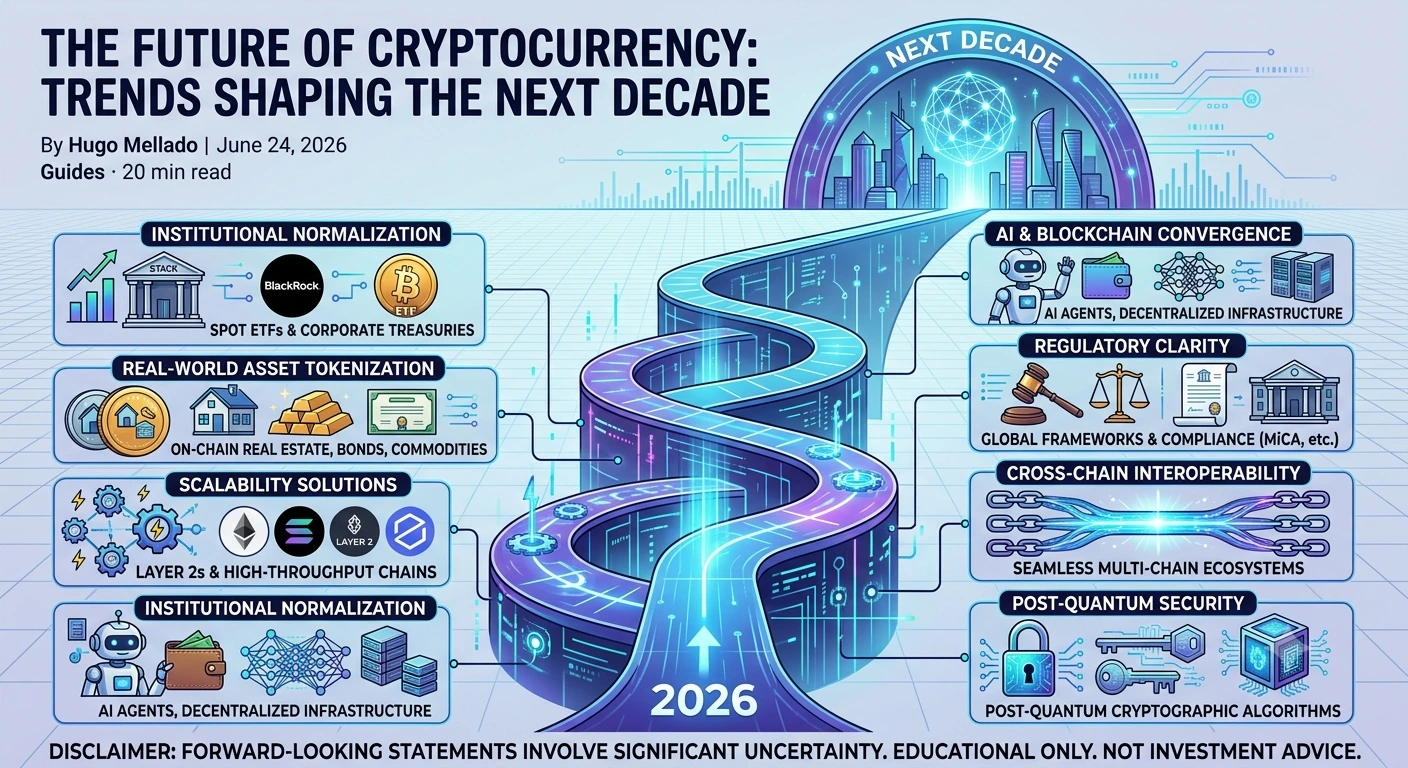
Trend 1: Institutional Normalization — The Point of No Return
The institutionalization of cryptocurrency is well underway and, in the assessment of most observers, structurally irreversible. The January 2024 approval of spot Bitcoin ETFs in the United States was a watershed moment: it opened Bitcoin to the $30+ trillion wealth management industry, allowing financial advisors to allocate client capital to Bitcoin through familiar brokerage accounts without the complexity of custody. Within 90 days, these ETFs accumulated over $50 billion in assets — among the fastest ETF launches in history. BlackRock’s iShares Bitcoin Trust became one of the fastest ETFs ever to reach $10 billion in AUM, and by September 2026 it held more than $60 billion, with U.S. spot Bitcoin ETFs having attracted roughly $64 billion in cumulative net inflows.
The next steps have already begun: BlackRock launched a staked-Ether ETF in March 2026, and the SEC’s September 2025 approval of generic listing standards made it easier to list new crypto ETFs (spot Solana and XRP funds followed in late 2025). Pension funds allocating 0.5–1% to crypto would represent trillions in new capital. Corporate treasury adoption continues beyond early pioneers like MicroStrategy and Tesla. Traditional financial settlement infrastructure is being rebuilt on blockchain — BlackRock’s BUIDL fund tokenized US Treasuries on Ethereum, and JPMorgan’s blockchain division processes trillions in daily transactions. The institutionalization trend brings capital, credibility, and regulatory normalization. It also brings surveillance, compliance requirements, and the gradual reduction in volatility as the investor base broadens beyond early adopters.
Trend 2: Real-World Asset Tokenization — Early but Measurable
The tokenization of real-world assets (RWAs) — representing bonds, real estate, commodities, private equity, and other traditional assets as tokens on a blockchain — may represent the most significant near-term use case for blockchain technology beyond speculation. The potential is large, but today’s numbers are still small: rwa.xyz tracks about $38.5 billion of distributed tokenized real-world assets as of September 19, 2026, including roughly $2.3 billion in BlackRock’s BUIDL fund, against traditional bond and real-estate markets worth hundreds of trillions of dollars.
The practical advantages are genuine: 24/7 global trading of assets currently limited to business hours in specific jurisdictions; fractional ownership of high-value assets previously accessible only to institutional investors; dramatically reduced settlement times (days to seconds); and programmable financial instruments that automatically enforce complex terms. BlackRock’s BUIDL fund demonstrated institutional demand in 2024; Franklin Templeton and several other major asset managers followed with tokenized fund products. The regulatory infrastructure is developing to support this trend.
Trend 3: Scalability — The Problem Is Being Solved
The scalability problem that limited blockchain adoption for the first decade is closer to being solved than at any previous point. Ethereum’s Layer 2 ecosystem — Arbitrum, Base, Optimism, zkSync, Starknet — already processes millions of daily transactions at fraction-of-cent costs. Following the March 2024 Dencun upgrade (EIP-4844), Base saw average transaction costs fall below $0.01. Ethereum has kept upgrading since: Pectra in May 2025 and Fusaka (with PeerDAS) in December 2025. By L2BEAT’s count in September 2026, Base secures about $15.6 billion and Arbitrum One about $11.5 billion. Solana demonstrated that high-throughput base-layer blockchain is technically achievable; its developments including Firedancer (a new validator client targeting 1+ million TPS) continue to push performance boundaries. The next generation of blockchain infrastructure will be capable of handling global-scale transaction volumes. The technological barriers are falling; what remains is user experience, education, and regulatory clarity.
Trend 4: AI and Blockchain Convergence
The intersection of artificial intelligence and blockchain is one of the most genuinely novel developments in the space. Several dimensions: AI Agents with Crypto Wallets — Autonomous AI agents can hold cryptocurrency wallets and make financial decisions based on programmed logic — paying for compute, purchasing data, transacting with other agents — without human intermediation at every step. This creates the potential for machine-to-machine economies. Decentralized AI Infrastructure — Bittensor (TAO) is building a decentralized network where AI models compete for token rewards based on their predictive accuracy, creating a market for intelligence. Render Network uses token incentives to aggregate unused GPU compute for AI and 3D rendering applications. Verifiable AI — Zero-knowledge proofs can mathematically prove that a specific AI model produced a specific output without revealing the model’s weights — enabling AI results to be verified without trusting the AI provider. AI-Powered Blockchain Tools — AI is accelerating smart contract auditing, on-chain data analysis, fraud detection, and user experience simplification throughout the ecosystem.
Trend 5: Regulatory Clarity — The Framework Is Forming
The EU’s MiCA (Markets in Crypto-Assets) regulation, fully applicable since the end of 2024 (with transitional periods for existing providers that ended on July 1, 2026, per ESMA), provides the world’s first comprehensive regulatory framework for crypto assets in a major jurisdiction — covering stablecoin issuers, crypto-asset service providers, and market abuse rules. This created regulatory certainty for the EU crypto market, allowing compliant businesses to operate across all 27 member states with a single license. In the United States, the GENIUS Act (signed July 18, 2025) created a federal framework for payment stablecoins, and Treasury published its proposed implementing rule on August 18, 2026. The broader CLARITY Act, which would set market-structure and digital-asset classification rules, passed the House in July 2025 but fell short of the 60 votes needed in a Senate vote on September 15, 2026, so it is stalled for now. The UK, Singapore, UAE, and Japan have all developed nuanced regulatory approaches. Regulatory clarity, even where specific rules are imperfect, is net positive for legitimate participants: it reduces uncertainty, separates legitimate operators from bad actors, and enables institutional capital that requires regulatory comfort before participating.
Trend 6: Cross-Chain Interoperability
The current crypto ecosystem is fragmented across dozens of separate blockchains — Ethereum, Solana, Bitcoin, Cosmos, Polkadot, and countless Layer 2s — each with its own asset ecosystem and user base. Moving value between them requires bridges, which have been the source of massive hacks. The next phase of development is seamlessly connecting these ecosystems. Cosmos’s IBC (Inter-Blockchain Communication) protocol connects 100+ chains with native message passing. Chainlink’s CCIP (Cross-Chain Interoperability Protocol) brings standardized cross-chain messaging to the EVM ecosystem. Zero-knowledge proofs enable trustless cross-chain verification without the vulnerability of custodial bridges. A more connected multi-chain ecosystem will be more useful and more accessible than today’s fragmented landscape.
Trend 7: The Quantum Computing Threat — And the Response
Quantum computing poses a theoretical long-term threat to the cryptographic foundations of cryptocurrency. Bitcoin and Ethereum’s public-key cryptography (ECDSA) is theoretically vulnerable to sufficiently powerful quantum computers, which could derive private keys from public keys. Most security researchers estimate a cryptographically relevant quantum computer is at least 10–20 years away given current hardware progress. Crucially, the cryptographic community is actively developing post-quantum algorithms: NIST standardized its first post-quantum cryptographic algorithms in August 2024 (FIPS 203, 204 and 205) and selected a further algorithm, HQC, in March 2025 (see the NIST post-quantum cryptography project). Bitcoin and Ethereum can and will migrate to quantum-resistant cryptography well before any practical threat materializes — these networks have governance processes for protocol upgrades, and the incentive to implement quantum-resistant cryptography is overwhelming.
Conclusion: The Long Game
Cryptocurrency’s first seventeen years established that decentralized digital money works at global scale, that programmable blockchains enable genuinely novel financial and organizational structures, and that the technology attracts extraordinary developer talent, capital, and institutional attention. The next decade will determine whether these foundations support a genuine global financial infrastructure that impacts hundreds of millions of people’s economic lives, or whether growth plateaus as specific limitations prove too difficult to overcome. The optimistic case is not guaranteed, and prices have fallen sharply since the October 2025 peak, but the underlying infrastructure, talent and institutional presence in 2026 are deeper than at any previous point in the technology’s history.
“The internet was also supposed to be a financial revolution in the 1990s. It took until the 2000s–2010s for that to actually happen, through companies we barely imagined in 1995. Blockchain may follow the same long arc.”
⚠️ Disclaimer: Forward-looking statements about cryptocurrency technology and markets involve significant uncertainty. This article is for educational purposes only and does not constitute financial or investment advice. Always conduct your own research and consult qualified professionals before making investment decisions.
Sources and further reading
The explanations above are checked against official regulators, statistical agencies, standards bodies and non-profit financial education organisations. Use these primary sources to verify figures and rules before you act on them.
- Federal Reserve Board — “Money and Payments: The U.S. Dollar in the Age of Digital Transformation”
- BIS Innovation Hub — CBDC projects
- U.S. Securities and Exchange Commission — Crypto assets
- Ethereum Foundation — Protocol roadmap
- Atlantic Council — Central Bank Digital Currency Tracker
- RWA.xyz — Tokenized real-world assets dashboard
- L2BEAT — Layer 2 scaling summary
- Forbes — BlackRock launches staked Ethereum ETF (March 13, 2026)
- FXStreet — SEC approves generic listing standards for crypto ETFs (September 18, 2025)
- Federal Register — GENIUS Act regulations on payment stablecoin issuance (August 18, 2026)
- CoinDesk — Senate vote on the CLARITY Act, September 15, 2026
- ESMA — Statement on the end of MiCA transitional periods
- NIST — Post-quantum cryptography project