
Guides · 5 min read
Updated September 19, 2026: refreshed with current market data, regulation and network upgrades.
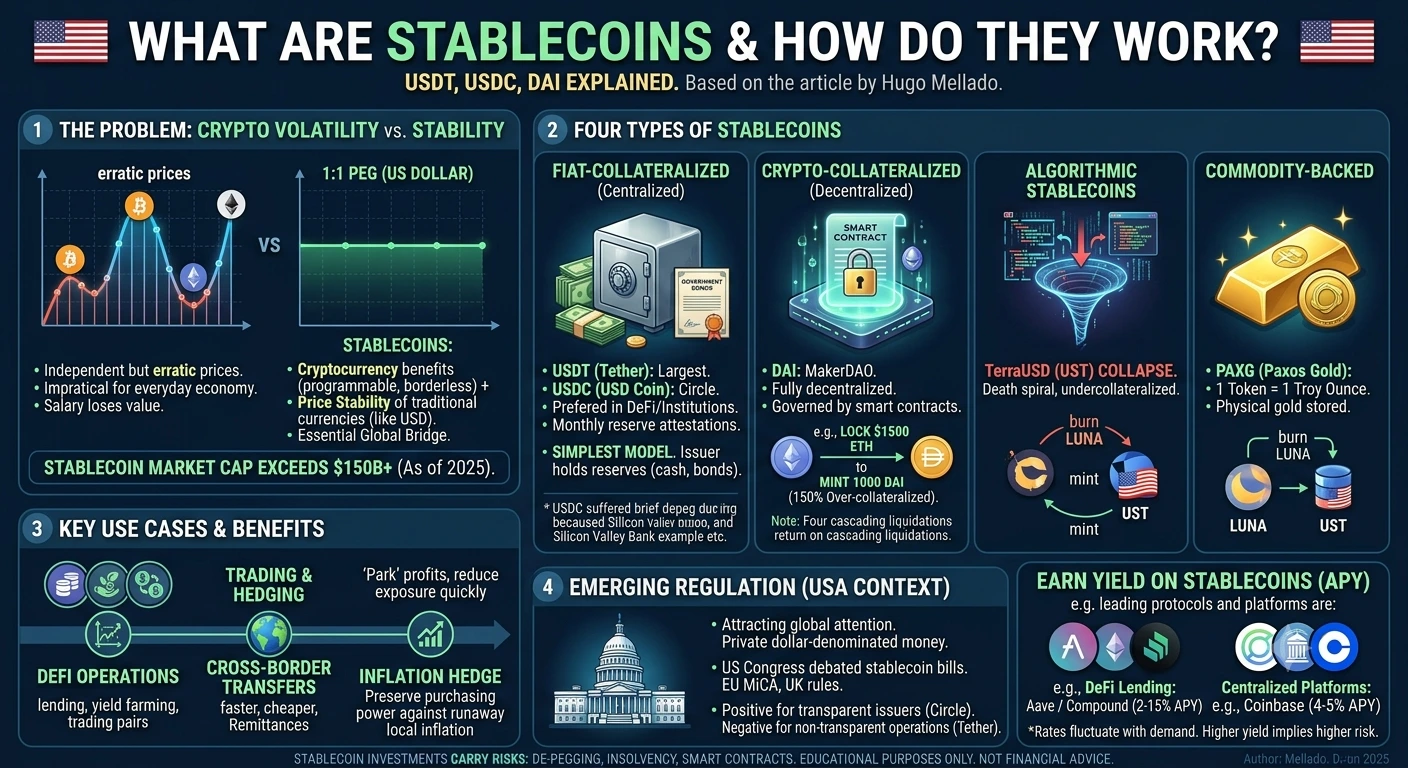
The Volatility Problem
Cryptocurrency’s greatest strength — its independence from government control and traditional financial infrastructure — comes bundled with a significant practical limitation: extreme price volatility. Bitcoin can gain or lose 20% of its value in a single day. This volatility makes it impractical as a unit of account for pricing goods, an instrument for loans, or a medium for payroll. If your employee’s salary can lose 15% of its value before they even spend it, the system doesn’t work for everyday economic activity.
Stablecoins solve this by combining the technological benefits of cryptocurrency (programmable, borderless, 24/7 transferable, no bank account required) with the price stability of traditional currencies, typically the US dollar. They are the essential bridge between crypto and everyday economic activity — and as of September 2026, the combined stablecoin market is worth about $304 billion, with USDT (about $183 billion, roughly 60% of the total) and USDC (about $74 billion) far ahead of the rest, according to DefiLlama.
Types of Stablecoins
1. Fiat-Collateralized (Centralized)
For every stablecoin in circulation, the issuing company holds an equivalent amount in reserve (cash, short-term government bonds, or cash equivalents). This is the simplest model and represents the vast majority of stablecoin market cap. USDT (Tether) is the largest by market cap and daily volume — it regularly exceeds Bitcoin’s trading volume, making it the world’s most-traded cryptocurrency. Launched in 2014, USDT has faced persistent questions about the quality and transparency of its reserves, though it has maintained its peg through multiple market crises. USDC (USD Coin) is issued by Circle and is considered the most transparent fiat-backed stablecoin, with monthly third-party attestations of its reserves (primarily cash and short-term US Treasuries). USDC is the preferred stablecoin in DeFi and institutional contexts where reserve quality matters. USDC suffered a brief depeg to $0.87 in March 2023 when $3.3 billion in reserves were held at Silicon Valley Bank during its collapse, demonstrating that even “safe” stablecoins carry counterparty risk.
2. Crypto-Collateralized (Decentralized)
Backed by other cryptocurrencies locked in smart contracts, and over-collateralized to account for crypto volatility. DAI, issued by MakerDAO (rebranded as Sky, which also issues USDS), is the most prominent example. To mint 1,000 DAI, you deposit ETH worth at least $1,500 (150% collateralization ratio) into a MakerDAO smart contract called a Vault. If your collateral’s value falls below the minimum ratio, the contract automatically liquidates it to repay your DAI. DAI operates with no central issuer — entirely governed by smart contracts and MKR token holders. Its 1:1 USD peg is maintained through collateralization and market arbitrage incentives. The tradeoff: capital-inefficient (you must lock more value than you mint) and exposed to cascading liquidations in sharp market downturns. As of September 2026, DAI’s supply is about $4.8 billion, Sky’s newer USDS about $6.5 billion, and Ethena’s synthetic-dollar USDe about $4.7 billion (DefiLlama).
3. Algorithmic Stablecoins
Attempt to maintain their peg through supply-demand mechanisms rather than explicit collateral — expanding supply when the price rises above $1, contracting when it falls below. The catastrophic collapse of TerraUSD (UST) in May 2022 illustrated the fundamental fragility of undercollateralized algorithmic approaches. UST relied on a “burn LUNA to mint UST” mechanism that was stable during growth but created a death spiral when confidence broke: falling UST price triggered LUNA minting, LUNA price crashed, which further undermined UST confidence, requiring more LUNA minting… Within days, the $40+ billion ecosystem collapsed nearly to zero. UST’s failure has led the industry to largely abandon undercollateralized algorithmic stablecoin models.
4. Commodity-Backed Stablecoins
Backed by physical commodities. Paxos Gold (PAXG) represents one troy ounce of gold per token, with physical gold stored in Brink’s vaults. These allow on-chain exposure to commodities with the portability of cryptocurrency, though they’re stable relative to the commodity price rather than to fiat currencies.
How to Earn Yield on Stablecoins
Stablecoins can be deployed to earn yield in several ways. DeFi lending: depositing USDC or DAI in lending protocols like Aave or Compound earns interest paid by borrowers; rates fluctuate with demand, so check the live rate on the protocol itself before depositing. Liquidity provision: providing USDC/USDT liquidity on DEXs like Curve earns trading fees; stablecoin pairs suffer minimal impermanent loss. Centralized platforms: some platforms advertise rewards on USDC balances, but rates change often and vary by country. Always evaluate the risk of the platform or protocol generating your yield — higher yields typically imply higher risk.
Key Use Cases
DeFi Operations — The DeFi ecosystem depends on stablecoins as lending assets, trading pair bases, and yield farming instruments. Without stablecoins, DeFi would be purely crypto-to-crypto speculation. Cross-Border Transfers — Sending $10,000 USDC internationally takes seconds and costs cents versus 1–5 business days and 3–7% fees for traditional bank wires. For remittances — the $800+ billion annual market of migrant workers sending money home — stablecoins represent a genuinely transformative improvement. Trading and Hedging — Traders use stablecoins to “park” profits or reduce exposure without exiting to fiat (which may trigger taxable events or require bank processing delays). Inflation Hedge — In countries with currency instability (Argentina, Venezuela, Turkey), dollar-denominated stablecoins preserve purchasing power against runaway local inflation.
Stablecoin Regulation: The Emerging Landscape
Stablecoins are attracting significant regulatory attention globally because they effectively create private forms of dollar-denominated money. In the United States, the GENIUS Act was signed into law on July 18, 2025. It creates a federal framework for payment stablecoins with reserve, redemption and disclosure requirements, and it bars issuers from paying interest to holders. The detailed rules are still being written: a first proposed implementing rule appeared in the Federal Register in March 2026, and Treasury’s proposed rule followed on August 18, 2026. Restrictions on offering non-compliant stablecoins in the U.S. begin on July 18, 2028. The EU’s MiCA regulation established clear rules for stablecoin issuers requiring reserve requirements, redemption rights, and operational standards; its transitional period for existing providers ended on July 1, 2026 (ESMA statement). Other jurisdictions, including the UK, are also bringing stablecoins into their payment and financial regulation. Regulatory clarity is generally positive for established issuers like Circle (USDC) and negative for less-transparent operations like Tether’s earlier incarnation.
Choosing the Right Stablecoin
For most users: USDC for DeFi, institutional applications, and wherever reserve transparency matters. USDT where maximum liquidity is needed (particularly on centralized exchanges). DAI for fully decentralized, non-custodial applications where smart contract risk is acceptable. Avoid algorithmic stablecoins without substantial, transparent collateral backing. Always understand the redemption mechanism — who holds reserves, what they consist of, and under what conditions you can redeem for dollars.
⚠️ Disclaimer: Stablecoin investments carry risks including de-pegging events, issuer insolvency, and smart contract vulnerabilities. This article is educational only and does not constitute financial advice.
Sources and further reading
The explanations above are checked against official regulators, statistical agencies, standards bodies and non-profit financial education organisations. Use these primary sources to verify figures and rules before you act on them.
- Ethereum Foundation — Stablecoins
- Bank for International Settlements — Central bank digital currencies: foundational principles and core features
- Federal Reserve Board — “Money and Payments: The U.S. Dollar in the Age of Digital Transformation”
- U.S. Securities and Exchange Commission — Crypto assets
- EIP-20: Token Standard (Ethereum Improvement Proposals)
- DefiLlama — Stablecoins
- Federal Register — GENIUS Act regulations on payment stablecoin issuance (August 18, 2026)
- Federal Register — Implementing the GENIUS Act (March 2, 2026)
- ESMA — Statement on the end of MiCA transitional periods