
Personal Finance · 8 min read
Financial advice arrives as a pile of simultaneous instructions: build an emergency fund, kill your debt, max your retirement accounts, start investing, improve your credit. Doing all of it at once is impossible, and trying is why most plans die in February.
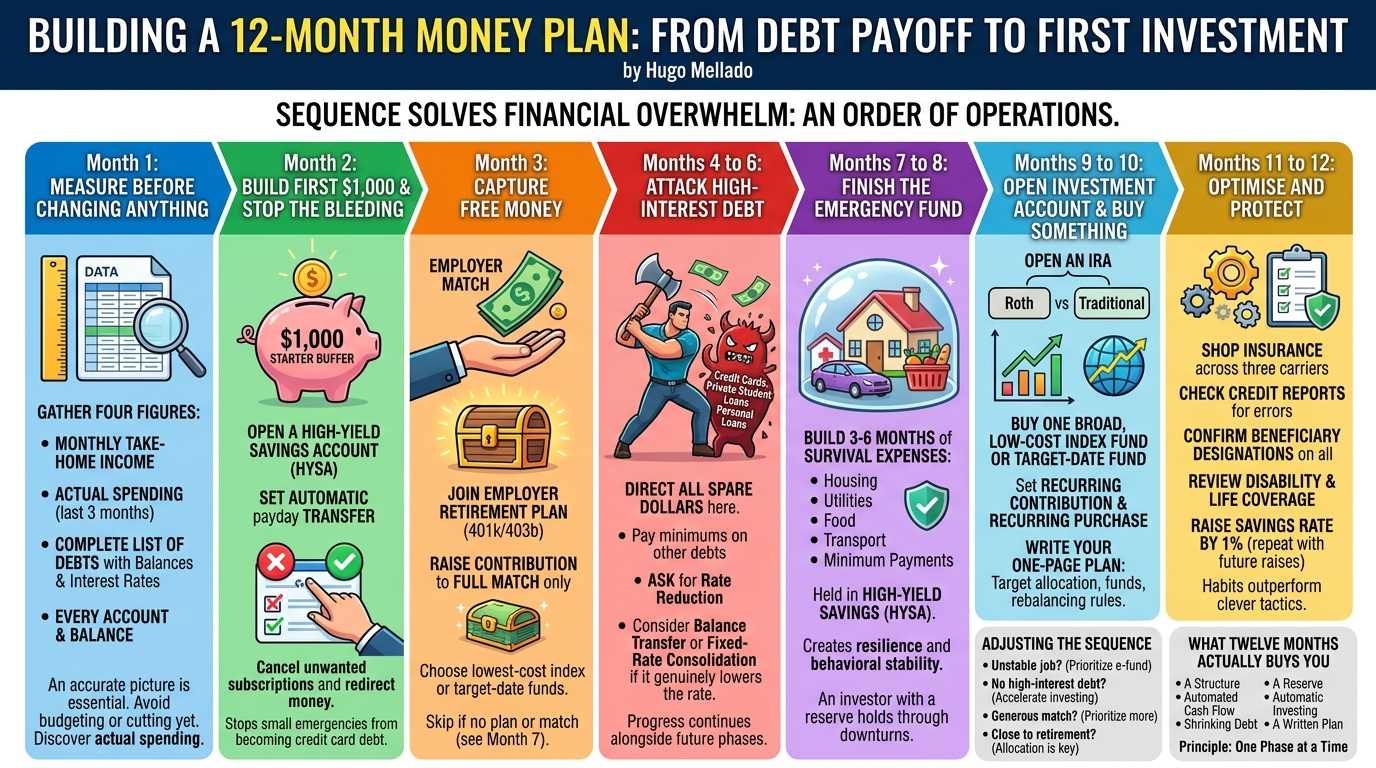
Sequence solves this. What follows is a twelve-month order of operations where each phase makes the next one easier, drawn from the individual pieces covered across this series.
Month 1: Measure Before You Change Anything
You cannot plan around numbers you do not have. Spend the first month gathering four figures: your monthly take-home income, your actual spending over the last three months, a complete list of debts with balances and interest rates, and a list of every account you hold with its balance.
Do not budget yet. Do not cut anything yet. The only goal is an accurate picture, because plans built on estimates fail at the first surprise. Most people discover their spending is 10% to 20% higher than they assumed, and that discovery alone changes their decisions.
Month 2: Build the First $1,000 and Stop the Bleeding
Open a high-yield savings account at a separate institution and set an automatic transfer for payday. Target $1,000, funded by whatever you can spare plus one-time sources — a tax refund, selling unused items, a side gig.
In the same month, run the subscription audit and cancel what fails the test, then redirect exactly that amount into the new savings transfer. This is the phase that stops small emergencies from becoming credit card balances.
Month 3: Capture Free Money
Log into your employer retirement plan and find the match formula. Raise your contribution to capture the full match, and no higher for now. If the plan has no match, or you have no plan, skip to opening an IRA in month seven.
While you are there, check the expense ratios of the funds available and move future contributions into the lowest-cost broad index option or a target-date fund. This single afternoon is usually the highest-value hour in the entire twelve months.
Months 4 to 6: Attack High-Interest Debt
Anything above roughly 8% gets full attention now: credit cards, personal loans, private student loans at high rates. Pay minimums on everything else and direct every spare dollar at the highest rate first.
Two accelerators are worth the phone calls. Ask each card issuer for a rate reduction — approvals are more common than people expect with a good payment history. And consider a balance transfer or a fixed-rate consolidation loan if it genuinely lowers the rate and you will not re-borrow on the cleared card.
If the total is large, three months will not finish it. That is fine — the plan continues alongside the next phases rather than pausing for them.
Months 7 to 8: Finish the Emergency Fund
Now build the real reserve: three to six months of survival expenses, sized to your income stability, held in high-yield savings. Survival expenses means housing, utilities, food, insurance, transport, and minimum payments — not your full normal spending.
This phase is boring and it is what makes everything afterwards possible. An investor with a reserve holds through downturns; an investor without one becomes a forced seller at the worst possible moment.
Months 9 to 10: Open the Investment Account and Buy Something
Open an IRA, choose Roth or traditional based on your current bracket, and fund it with whatever you can. Buy one broad, low-cost index fund or a target-date fund. Then set a recurring monthly contribution and a recurring purchase so the money does not sit in cash.
Before this, write your one-page plan: target allocation, the funds you will use, the monthly amount, when you will rebalance, and what would legitimately justify changing course. Sign it and date it. You are writing instructions for the version of yourself who will read it during the next market decline.
Months 11 to 12: Optimise and Protect
With the structure in place, spend the final two months on the items that quietly cost the most: shop your insurance across three carriers, check your credit reports for errors, confirm your beneficiary designations on every account, and review whether your disability and life coverage matches your obligations.
Then raise your savings rate by one percentage point. Do it again with every future raise. That mechanical habit outperforms nearly every clever tactic available to you.
The Twelve-Month Map
| Phase | Focus | Outcome |
|---|---|---|
| Month 1 | Measurement | An accurate picture of income, spending and debt |
| Month 2 | Starter reserve and subscription audit | $1,000 buffer and freed monthly cash |
| Month 3 | Employer match and fund selection | Free money captured, fees reduced |
| Months 4 to 6 | High-interest debt | Guaranteed high returns, lower fixed costs |
| Months 7 to 8 | Full emergency fund | Resilience and behavioural stability |
| Months 9 to 10 | First investment account | Compounding started, plan written |
| Months 11 to 12 | Insurance, credit, beneficiaries | Downside protected, rate increased |
Adjusting the Sequence
The order is a default, not a rule. If your job is genuinely unstable, extend the emergency fund phase before attacking debt. If you have no high-interest debt at all, move investing forward by three months. If your employer match is unusually generous, prioritise it even more heavily. If you are within ten years of retirement, allocation decisions become more urgent than any of this.
What should not change is the principle: one phase at a time, automated so it continues without attention, with each step making the next easier rather than competing with it.
What Twelve Months Actually Buys You
Not wealth. A structure — money moving automatically, high-interest debt shrinking or gone, a reserve that absorbs surprises, an investment account receiving contributions every month, and a written plan you can follow when markets or life get unpleasant.
From there the work is repetition, which is the part nobody sells courses about and the part that does all the compounding.
A general framework, not personalised advice. Your debts, employer plan and timeline may justify a different order.
Sources and further reading
The explanations above are checked against official regulators, statistical agencies, standards bodies and non-profit financial education organisations. Use these primary sources to verify figures and rules before you act on them.
- CFPB — “Your Money, Your Goals” financial empowerment toolkit
- Federal Reserve — Report on the Economic Well-Being of U.S. Households (SHED)
- Jump$tart Coalition for Personal Financial Literacy
- National Endowment for Financial Education (NEFE)
- U.S. SEC — Beginners’ guide to asset allocation, diversification and rebalancing
Related reading
- How to Save Money in the United States: A System That Actually Works
- Brokerage Accounts, IRAs, and 401(k)s: Which Should You Open First?
- How to Plan a Stock Portfolio: Asset Allocation From Scratch
This content is for informational and educational purposes only and does not constitute financial, investment or tax advice. Always do your own research, and consider speaking with a licensed professional about your specific situation.