
Investing · 9 min read
Most investing conversations focus on what to buy. The account you buy it in often matters more, because it determines how much of your return the tax code lets you keep. Two people holding the identical fund for thirty years can end up with very different amounts based purely on where they held it.
Here is what each of the main American account types does, and a defensible order for opening them.
The 401(k) and Its Cousins
A 401(k) is an employer-sponsored retirement plan, with equivalents such as the 403(b) for nonprofits and schools and the 457(b) for government employees. Contributions come directly from payroll, which is the single biggest behavioural advantage — the money never reaches your checking account.
Traditional contributions reduce your taxable income now, grow tax-deferred, and are taxed as ordinary income when withdrawn. Roth 401(k) contributions, offered by many plans, are made after tax and withdrawn tax-free in retirement.
The feature that makes this account first in line is the employer match. A common structure is 50 cents per dollar up to 6% of salary. Contributing less than the full match means declining part of your compensation. Nothing else in investing offers a comparable immediate return.
The downside is limited choice. You invest in whatever menu the plan offers, and some plans carry high fees. Check the expense ratios in your plan documents — if the options are poor, contribute up to the match and put additional money elsewhere.
The IRA: Traditional and Roth
An individual retirement account is opened by you, at any brokerage, with the entire investment universe available. Contribution limits are lower than a 401(k), and there is no employer match, but the flexibility and typically lower costs are significant.
| Feature | Traditional IRA | Roth IRA |
|---|---|---|
| Tax treatment of contributions | Potentially deductible now | After tax, no deduction |
| Growth | Tax-deferred | Tax-free |
| Withdrawals in retirement | Taxed as ordinary income | Tax-free if qualified |
| Income limits | Deduction phases out at higher incomes with a workplace plan | Direct contributions phase out at higher incomes |
| Required minimum distributions | Yes, starting at the statutory age | None for the original owner |
| Access to contributions | Penalties before 59 and a half with exceptions | Contributions withdrawable at any time |
The Roth versus traditional question reduces to a bet about tax rates: pay tax now at your current rate, or later at an unknown one. Early-career workers in low brackets usually favour Roth. High earners in peak years often favour the immediate deduction. Many people end up with both, which is a reasonable hedge rather than indecision.
One underrated Roth feature: your contributions, though not your earnings, can be withdrawn at any time without tax or penalty. That makes a Roth IRA a partial backstop for people worried about locking money away for decades.
The Health Savings Account
Available only with a qualifying high-deductible health plan, an HSA is the only account offering three tax advantages at once: deductible contributions, tax-free growth, and tax-free withdrawals for qualified medical expenses. After a certain age, non-medical withdrawals are taxed like a traditional IRA rather than penalised.
Used well, an HSA is a stealth retirement account. Pay current medical costs from cash flow where possible, invest the HSA balance rather than leaving it in cash, and let it compound for decades.
The Taxable Brokerage Account
No contribution limits, no withdrawal restrictions, no age rules. You pay tax on dividends and on realised gains, but long-term capital gains — on assets held more than a year — are taxed at preferential rates well below ordinary income for most investors.
This is the right account for anything you might need before retirement: a house down payment, a business, a sabbatical. It is also where money goes after tax-advantaged space is full. Tax-loss harvesting and holding tax-efficient index funds reduce the drag considerably.
A Defensible Order
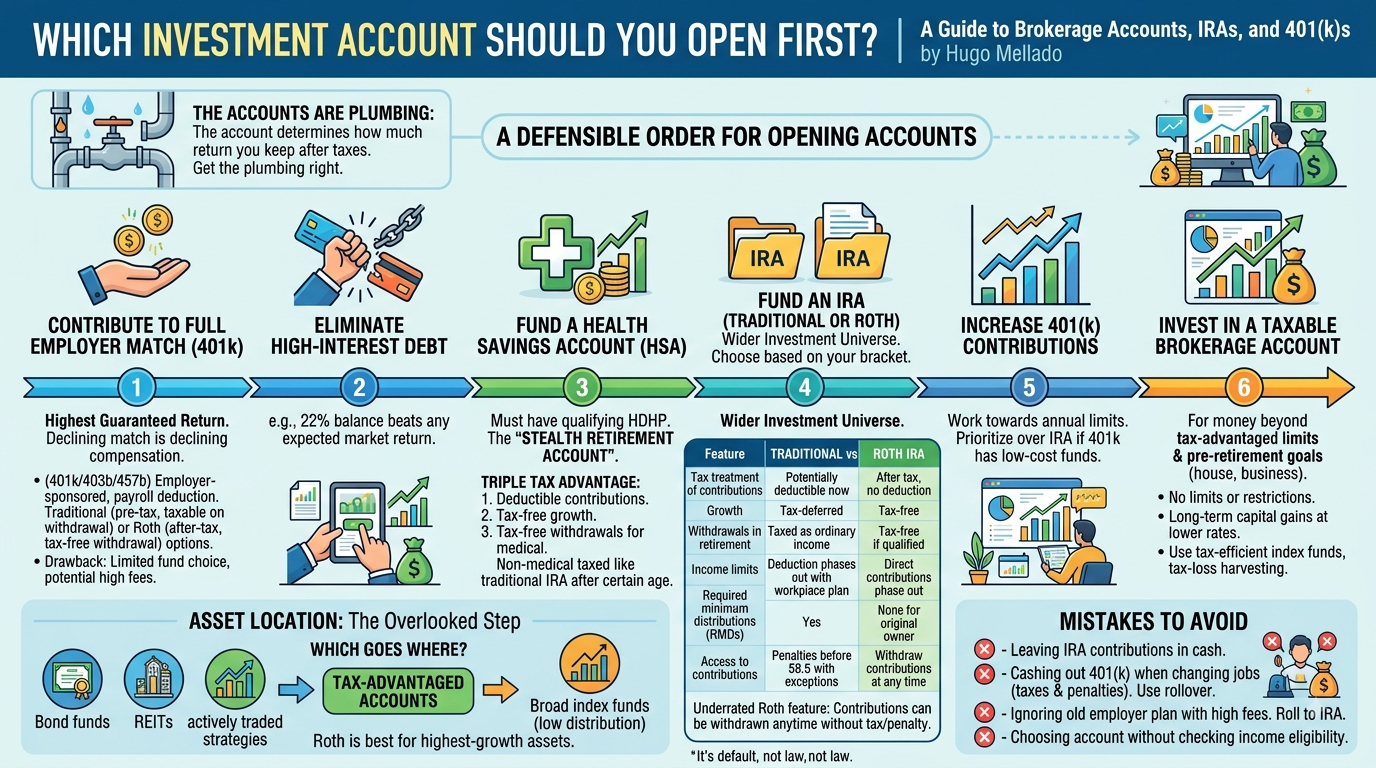
- 1. Contribute to the 401(k) up to the full employer match — the highest guaranteed return available
- 2. Eliminate high-interest debt, since a 22% balance beats any expected market return
- 3. Fund an HSA if you have a qualifying health plan and can invest rather than spend the balance
- 4. Fund an IRA, Roth or traditional depending on your bracket, for the wider investment selection
- 5. Return to the 401(k) and increase contributions toward the annual limit
- 6. Invest in a taxable brokerage account for everything beyond that, and for pre-retirement goals
This ordering is a default, not a law. If your 401(k) has excellent low-cost funds, moving it ahead of the IRA is sensible. If you are self-employed, a SEP-IRA or solo 401(k) changes the picture and allows much larger contributions.
Asset Location: The Overlooked Step
Once several accounts exist, which investments go where starts to matter. Tax-inefficient holdings — bond funds, REITs, actively traded strategies that generate frequent taxable distributions — belong in tax-advantaged accounts. Broad index funds, which distribute little, work well in taxable accounts and receive favourable long-term capital gains treatment when eventually sold.
Holding the highest-growth assets in a Roth also has a logic to it, since that growth is never taxed at all.
Mistakes to Avoid
Leaving IRA contributions in cash after depositing them, which happens constantly and quietly costs years of growth. Cashing out a 401(k) when changing jobs instead of rolling it over, which triggers taxes and penalties. Ignoring an old employer plan with high fees rather than rolling it into an IRA. And choosing the account type before checking whether your income makes you eligible for it.
The accounts are plumbing. Get the plumbing right once, automate the flow, and the interesting decisions turn out to be far less important than they seemed.
Contribution limits, income thresholds and tax rules change annually. Confirm current figures and consider consulting a tax professional.
Sources and further reading
The explanations above are checked against official regulators, statistical agencies, standards bodies and non-profit financial education organisations. Use these primary sources to verify figures and rules before you act on them.
- IRS — 401(k) plans
- IRS — Retirement topics: IRA contribution limits
- Securities Investor Protection Corporation (SIPC) — what brokerage protection does and does not cover
- FINRA — For Investors: education and tools
- U.S. SEC — Beginners’ guide to asset allocation, diversification and rebalancing
Related reading
- How to Start Investing With $100: A Step-by-Step Guide for Beginners
- How to Plan a Stock Portfolio: Asset Allocation From Scratch
- How Crypto Gains Are Taxed in the U.S.: Short-Term vs. Long-Term Capital Gains
This content is for informational and educational purposes only and does not constitute financial, investment or tax advice. Always do your own research, and consider speaking with a licensed professional about your specific situation.