
Investing · 8 min read
The most common reason people do not start investing is the belief that a meaningful amount is required first. That was true decades ago, when trades cost commissions and mutual funds carried minimums of thousands of dollars. It stopped being true some time ago. Fractional shares and zero-commission trading mean $100 buys a genuinely diversified portfolio today.
What follows is the actual sequence, in order, with the decisions that matter and the ones that do not.
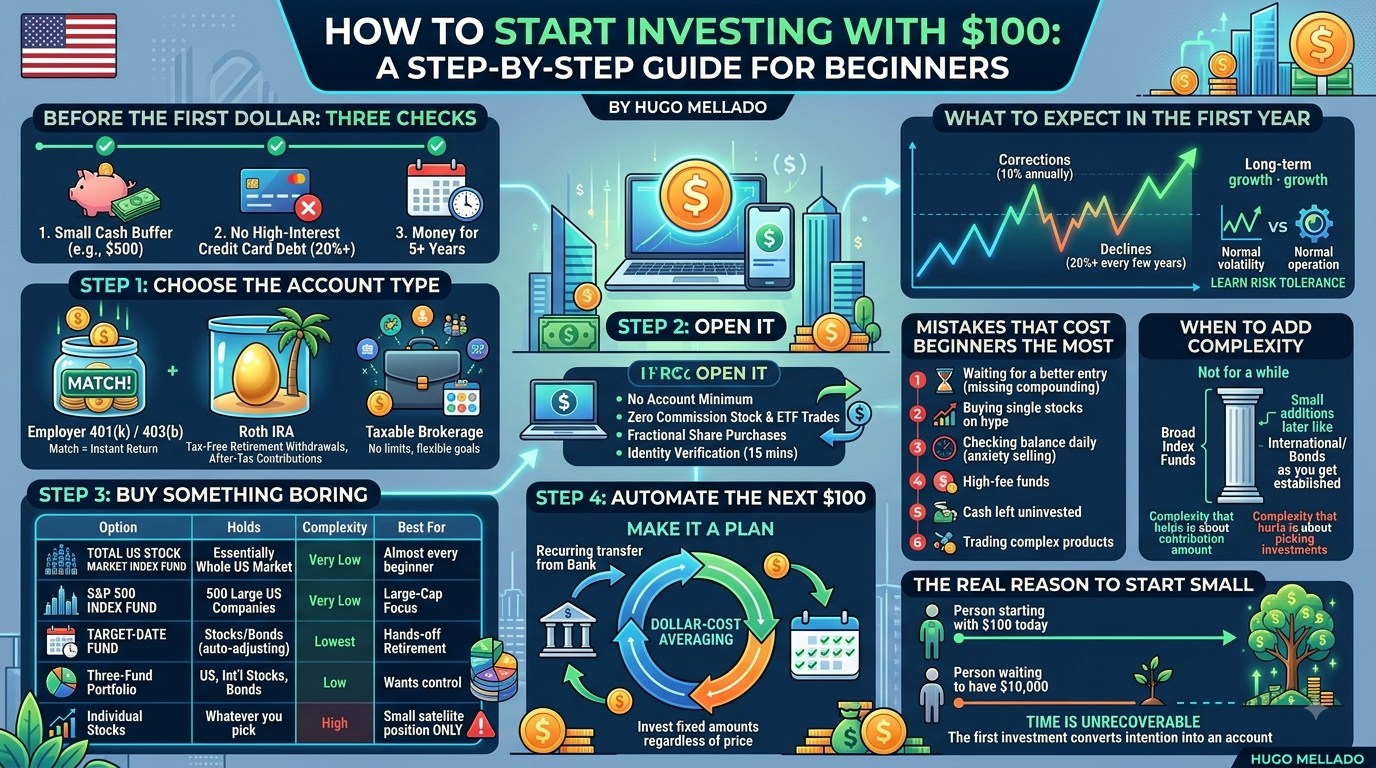
Before the First Dollar: Three Checks
Investing before these are handled is how beginners end up selling at a loss six months later.
- A small cash buffer exists — even $500 — so an unexpected bill does not force you to sell
- No credit card balance is sitting at 20% or more, because paying that down beats any expected market return
- The money you are about to invest is money you will not need for at least five years
If all three are true, the rest is mechanics.
Step 1: Choose the Account Type
The account is the container. The investments go inside it. Beginners often skip straight to picking investments and end up holding good funds in a tax-inefficient place.
If your employer offers a 401(k) with matching contributions, that is where the first dollars belong — a 50% match is an immediate 50% return unavailable anywhere else. If there is no match or no plan, a Roth IRA is the usual starting point for most people early in their careers: contributions go in after tax, and qualified withdrawals in retirement are tax-free. A regular taxable brokerage account has no contribution limits and no withdrawal restrictions, which makes it the right home for goals arriving before retirement.
Step 2: Open It
Any of the major low-cost brokerages will do. The features worth confirming: no account minimum, no commissions on stock and ETF trades, fractional share purchases, and access to broad low-cost index funds. Everything else — research tools, mobile app design, educational content — is secondary and largely interchangeable.
Opening an account requires identity verification and takes fifteen minutes. Funding it by bank transfer takes one to three business days.
Step 3: Buy Something Boring
Here is the part that disappoints people: the correct first investment for almost every beginner is a single broad, low-cost index fund. A total U.S. stock market fund or an S&P 500 fund gives you hundreds or thousands of companies in one purchase, at an expense ratio often below 0.05%.
A target-date fund is an even simpler option inside retirement accounts. You pick the fund matching your approximate retirement year and it holds a diversified mix of stocks and bonds, gradually becoming more conservative as the date approaches. One fund, no rebalancing, no decisions.
| Option | What it holds | Complexity | Good fit for |
|---|---|---|---|
| Total market index fund | Essentially the whole U.S. market | Very low | Almost every beginner |
| S&P 500 index fund | 500 large U.S. companies | Very low | Beginners wanting large-cap focus |
| Target-date fund | Stocks and bonds, auto-adjusting | Lowest | Hands-off retirement investors |
| Three-fund portfolio | U.S. stocks, international stocks, bonds | Low | Those wanting explicit control |
| Individual stocks | Whatever you pick | High | A small satellite position at most |
Step 4: Automate the Next $100
A single $100 investment is a gesture. A $100 monthly contribution is a plan. Set a recurring transfer and, where the brokerage supports it, a recurring purchase, so the money arrives and is invested without you deciding anything each month.
This approach — investing fixed amounts on a schedule regardless of price — is dollar-cost averaging. Its main benefit is not mathematical superiority. It is that it removes the recurring question of whether now is a good time, which is the question that keeps most beginners in cash for years.
What to Expect in the First Year
Your $100 will move up and down by amounts that feel trivial and teach you nothing about your risk tolerance. Then your $2,000 will drop 15% during a normal market correction, and you will learn a great deal about yourself.
Corrections of 10% happen roughly annually. Declines of 20% or more happen every few years. Neither is a malfunction; both are the price of the long-term returns that make investing worthwhile. The investors who capture those returns are the ones who kept buying through the declines rather than the ones who predicted them.
Mistakes That Cost Beginners the Most
- Waiting for a better entry point, which usually means waiting years and missing the compounding
- Buying individual stocks based on social media enthusiasm before owning any diversified base
- Checking the balance daily, which converts normal volatility into anxiety and anxiety into selling
- Choosing high-fee funds when nearly identical low-fee versions exist
- Leaving cash sitting uninvested in the brokerage account after transferring it — a surprisingly common oversight
- Trading options, leverage, or margin before understanding what a bad outcome looks like
When to Add Complexity
Not for a while. A single index fund and consistent contributions is not a beginner compromise — it is what a large share of sophisticated long-term investors actually do. Add international exposure, then bonds as your horizon shortens, then perhaps a small allocation to individual positions or alternative assets once the core is established and you understand why you want them.
The complexity that helps is almost always about the amount you contribute and the accounts you use. The complexity that hurts is almost always about picking investments.
The Real Reason to Start Small
A hundred dollars will not change your retirement. Starting will. The first investment converts an abstract intention into an account you can see, and it begins the only input in compounding you can never recover later: time. Someone who starts with $100 today and contributes steadily ends up far ahead of someone waiting to have $10,000 and the confidence to deploy it perfectly.
Educational information only, not investment advice. All investing involves risk of loss, including loss of principal.
Sources and further reading
The explanations above are checked against official regulators, statistical agencies, standards bodies and non-profit financial education organisations. Use these primary sources to verify figures and rules before you act on them.
- U.S. SEC — Ten things to consider before you make investing decisions
- FINRA — For Investors: education and tools
- Securities Investor Protection Corporation (SIPC) — what brokerage protection does and does not cover
- FINRA Investor Education Foundation — research on financial capability
- Council for Economic Education
Related reading
- Brokerage Accounts, IRAs, and 401(k)s: Which Should You Open First?
- Index Funds and ETFs Explained: Why Boring Usually Wins
- How Compound Interest Works: The Math Behind Every Financial Decision
This content is for informational and educational purposes only and does not constitute financial, investment or tax advice. Always do your own research, and consider speaking with a licensed professional about your specific situation.