
Loans & Credit · 8 min read
Student loans and auto loans are the two debts most American adults carry before they ever think about investing. They look similar — fixed monthly payments over several years — and they behave very differently, because one is secured by a depreciating object and the other is secured by nothing at all.
Understanding those differences is what makes the difference between paying these loans off and being paid off by them.
How Interest Accrues on Student Loans
Federal student loans accrue interest daily using a simple daily interest formula: the balance multiplied by the interest rate divided by 365. Rates are fixed for the life of each loan and set annually by Congress, which means a borrower who took loans across four years typically holds four different rates.
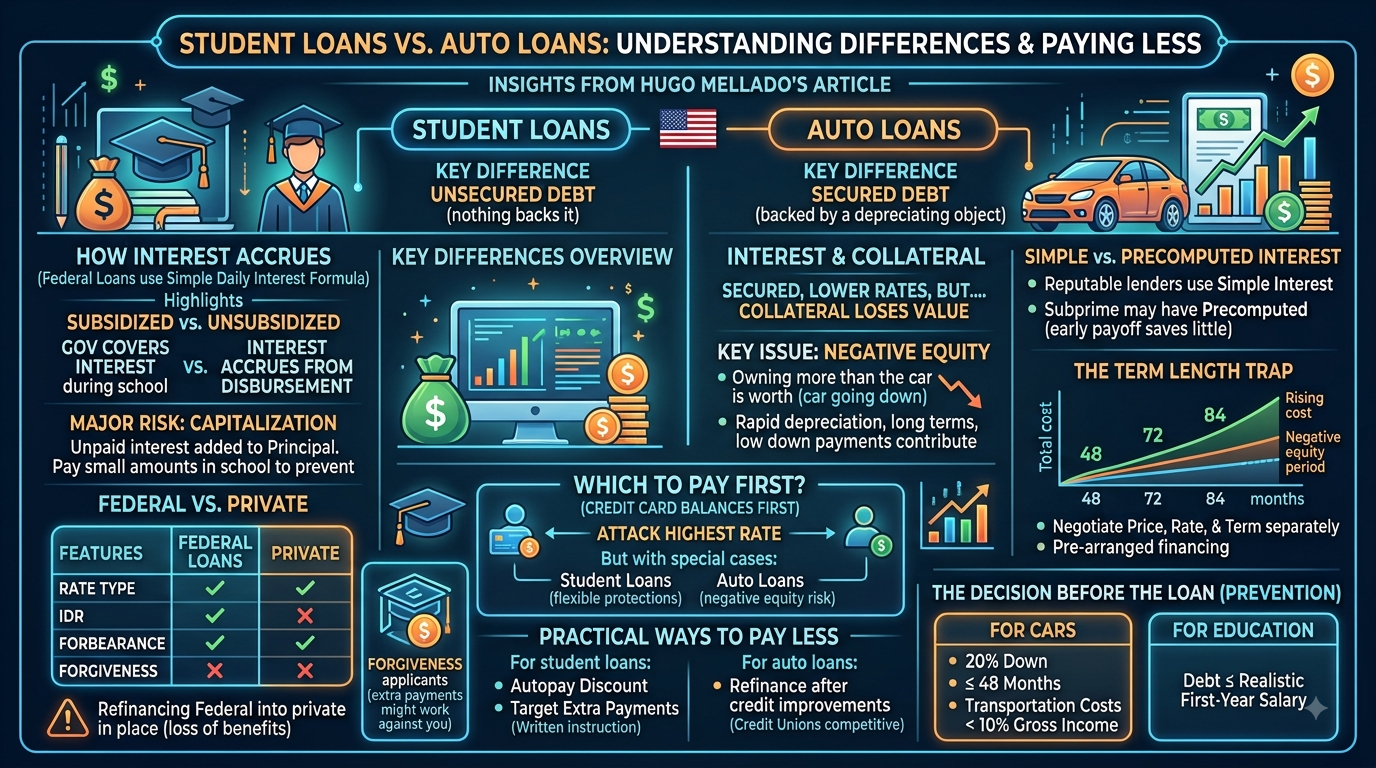
The critical distinction is subsidy. On subsidised loans, the government covers interest during school and certain deferment periods. On unsubsidised loans, interest accrues from disbursement — including throughout school — and unpaid interest may be capitalised, meaning added to the principal so that you then pay interest on interest.
Capitalisation is why a student can graduate owing noticeably more than they borrowed. Paying even small amounts toward interest while in school prevents it.
Federal Versus Private Student Loans
| Feature | Federal loans | Private loans |
|---|---|---|
| Rate type | Fixed, set by statute | Fixed or variable, credit-based |
| Income-driven repayment | Available | Rare or unavailable |
| Deferment and forbearance | Standardised protections | At lender discretion |
| Forgiveness programs | Public service and plan-based options exist | Generally none |
| Cosigner | Not required for most | Frequently required |
This table explains the standard advice to exhaust federal options before private ones, and to be extremely cautious about refinancing federal loans into private ones. Refinancing may lower the rate, but it permanently surrenders income-driven repayment, forbearance protections, and any forgiveness eligibility. That trade can be reasonable for a high earner with stable income, and it is irreversible.
How Auto Loan Interest Differs
Auto loans are secured by the vehicle, which makes rates lower than unsecured debt but introduces a problem student loans do not have: the collateral loses value quickly. A new car commonly loses 20% or more of its value in the first year.
Combine rapid depreciation with a long term and a small down payment and you get negative equity — owing more than the car is worth. That matters if the car is totalled, if you need to sell, or if you roll the shortfall into your next loan, which is how borrowers end up financing two cars in one payment.
Watch for precomputed interest, which still appears in some subprime auto lending. Under it, total interest is calculated upfront, so paying early saves little. Reputable lenders use simple interest that accrues on the outstanding balance.
The Term Length Trap
Auto loan terms have stretched from four years to six, seven, and occasionally eight. Each extension lowers the monthly payment and raises total cost while extending the period of negative equity.
| Loan of $35,000 at 7% | Monthly payment | Total interest |
|---|---|---|
| 48 months | About $838 | About $5,200 |
| 60 months | About $693 | About $6,600 |
| 72 months | About $597 | About $8,000 |
| 84 months | About $528 | About $9,400 |
The 84-month option saves $310 a month and costs roughly $4,200 more. Dealers negotiate on the payment because it is the number that feels affordable. Negotiate on price, rate, and term separately, and arrange financing before you walk in so the dealer offer has to beat something.
Which to Pay First
The general principle is to attack the highest rate first, since a dollar saves the same amount regardless of which loan it came from. But three considerations complicate the picture for these two debts specifically.
- Federal student loans carry protections that make aggressive early payoff less urgent — the flexibility has real value if your income falls
- Auto loans with negative equity carry a risk that has nothing to do with the interest rate, so getting above water can justify prioritising them
- If you are pursuing forgiveness through an income-driven plan or public service employment, extra payments can actively work against you
- Private student loans, with no protections and often higher rates, generally deserve priority over federal loans
- Any credit card balance should be cleared before either of these
Practical Ways to Pay Less
Autopay discounts on federal student loans and many private lenders reduce the rate slightly for enrolling — small, automatic, and worth taking. Targeting extra payments at your highest-rate individual loan requires instructing the servicer in writing, because the default is to spread extra amounts across all loans proportionally or apply them to future installments.
On auto loans, refinancing after a year of on-time payments and an improved credit score is common and often overlooked, especially if the original loan came from a dealer marking up the rate. Credit unions are usually the most competitive option.
The Decision Before the Loan
Every strategy above operates at the margins compared with the decision of how much to borrow in the first place. A rough guideline for cars: put at least 20% down, finance for no longer than 48 months, and keep total transportation costs under 10% of gross income. For education: compare the total borrowed against realistic starting salaries in the field, and treat the first-year salary as an approximate ceiling for total student debt.
Neither loan is inherently a mistake. Both become one when the amount borrowed was set by what the lender would approve rather than by what the purchase is actually worth to you.
Federal loan programs and forgiveness rules change. Confirm current terms with your servicer or the Department of Education before making decisions.
Sources and further reading
The explanations above are checked against official regulators, statistical agencies, standards bodies and non-profit financial education organisations. Use these primary sources to verify figures and rules before you act on them.
- CFPB — Student loans
- CFPB — Auto loans
- Federal Reserve — G.19 Consumer Credit release
- eCFR — Title 12, Part 1026: Truth in Lending (Regulation Z)
Related reading
- How Loan Interest Really Works: APR, Amortization, and the True Cost of Borrowing
- Credit Card Interest: How Daily Compounding Turns Small Balances Into Big Problems
- Building a 12-Month Money Plan: From Debt Payoff to First Investment
This content is for informational and educational purposes only and does not constitute financial, investment or tax advice. Always do your own research, and consider speaking with a licensed professional about your specific situation.