
Loans & Credit · 8 min read
Almost nobody reads a loan agreement closely, which is unfortunate, because the interest structure decides how much of your working life the loan will consume. Two loans with the same monthly payment can differ by thousands of dollars in total cost, and the difference is never in the advertising.
Here is what actually determines what you pay.
Interest Rate Is Not APR
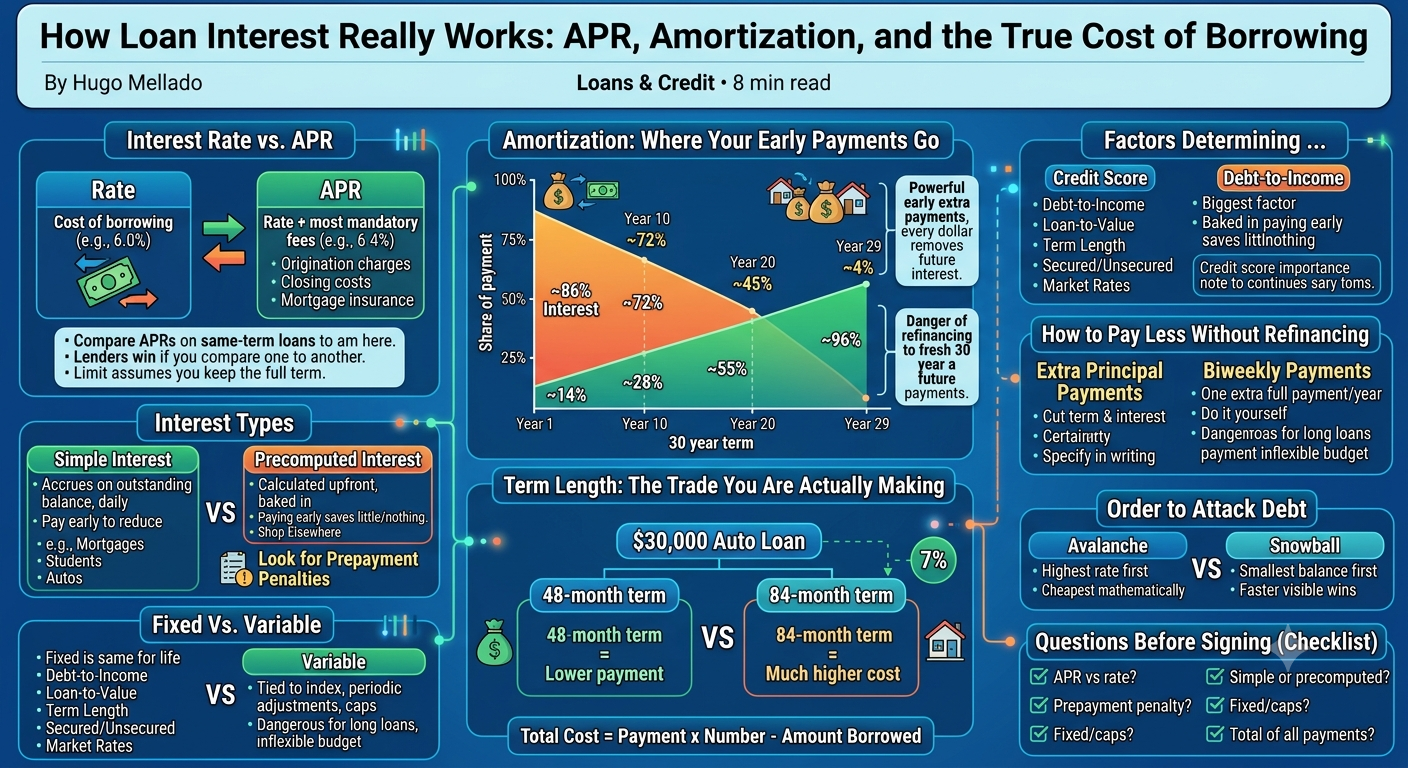
The interest rate is the cost of borrowing the money. The annual percentage rate includes the interest rate plus most mandatory fees — origination charges, certain closing costs, mortgage insurance where applicable — expressed as a single annualised number.
APR exists so that borrowers can compare offers, because a 6.0% loan with a 2% origination fee is more expensive than a 6.4% loan with no fee. When you shop, compare APRs on loans of the same term. Comparing the rate on one and the APR on another is how lenders win.
APR has limits. It assumes you keep the loan for the full term, so a loan with high upfront fees looks better under APR than it will be if you refinance or sell in three years.
Amortization: Where Your Early Payments Go
Most installment loans are amortized. Your payment stays constant, but the split between interest and principal shifts every month. Interest is charged on the remaining balance, so when the balance is large — at the beginning — the interest portion is large.
Take a $300,000 loan at 6.5% over 30 years. The payment is about $1,896. In month one, roughly $1,625 goes to interest and only $271 to principal. It takes about eighteen years before the majority of each payment attacks the principal.
| Year of a 30-year loan | Share of payment going to interest | Share going to principal |
|---|---|---|
| Year 1 | About 86% | About 14% |
| Year 10 | About 72% | About 28% |
| Year 20 | About 45% | About 55% |
| Year 29 | About 4% | About 96% |
This structure explains two things. First, why extra payments early are so powerful — every dollar of principal you remove eliminates all the future interest that dollar would have generated. Second, why refinancing repeatedly into fresh 30-year terms can keep you permanently in the interest-heavy phase.
Simple Interest, Precomputed Interest, and Daily Accrual
Most mortgages, student loans, and reputable auto loans use simple interest that accrues on the outstanding balance, often daily. Pay early or pay extra and you genuinely reduce the interest that accrues.
Precomputed interest is different and worse. The total interest for the whole term is calculated upfront and baked into the balance. Paying early saves you little or nothing, and some agreements refund unearned interest under an unfavourable formula. Precomputed interest still appears in some subprime auto lending and small consumer loans. If a contract mentions it, treat that as a reason to shop elsewhere.
Also look for prepayment penalties, which charge you for paying off the loan ahead of schedule. They are restricted on many mortgages but still exist in commercial and some consumer lending.
Fixed Versus Variable
A fixed rate stays the same for the life of the loan. You accept a slightly higher starting rate in exchange for certainty. A variable rate is tied to an index and adjusts periodically, usually with caps on how much it can move per adjustment and in total.
Variable rates make sense when the loan is short, when you are confident you will pay it off or exit before the adjustment period, or when rates are elevated and expected to fall. They become dangerous when the loan is long and your budget has no room for a payment that rises 30%.
Term Length: The Trade You Are Actually Making
Lengthening a loan lowers the monthly payment and raises the total cost, sometimes dramatically. On a $30,000 auto loan at 7%, the difference between a 48-month and an 84-month term is roughly $300 a month in payment and roughly $3,700 in total interest — plus the additional risk of owing more than the car is worth for years.
Lenders lead with the monthly payment because it is the number that feels affordable. The number that matters is total cost, which is payment multiplied by the number of payments, minus the amount borrowed.
What Determines the Rate You Are Offered
- Credit score, which is the single largest factor for consumer loans
- Debt-to-income ratio, measuring how much of your income already goes to debt
- Loan-to-value ratio, meaning how much you put down relative to what you borrow
- Term length, since longer loans usually carry higher rates
- Whether the loan is secured by collateral or unsecured
- Broad market rates, which are set by forces well outside your control
The first three are the ones you can move. Raising a credit score from the mid-600s to above 740 can change an auto loan rate by several percentage points, which on a typical loan is worth more than any negotiation on the sticker price.
How to Pay Less Without Refinancing
Extra payments applied to principal shorten the term and cut total interest. On the $300,000 mortgage above, adding $200 a month removes roughly six years and a substantial share of lifetime interest. Specify in writing that extra amounts go to principal, because some servicers otherwise treat them as prepaid future installments, which changes nothing about your interest.
Biweekly payments produce a similar effect by squeezing one extra full payment into each year. Avoid paid third-party programs that offer to arrange this for a fee — you can do it yourself.
The Order to Attack Debt
When several loans compete for the same dollars, two approaches dominate. The avalanche method targets the highest interest rate first and minimises total cost mathematically. The snowball method targets the smallest balance first and produces faster visible wins, which keeps some people going long enough to finish.
The avalanche is cheaper. The snowball is sometimes the one that actually gets completed. Choose based on an honest read of your own past behaviour, not on which one looks smarter on paper.
Questions to Ask Before Signing
What is the APR, not just the rate? Is interest simple or precomputed? Is there a prepayment penalty? Is the rate fixed, and if not, when does it adjust and what are the caps? What is the total of all payments over the full term? A lender who is evasive about any of these is telling you something useful about the loan.
Example figures are illustrative. Your actual rate, fees and total cost depend on your credit profile and the specific lender.
Sources and further reading
The explanations above are checked against official regulators, statistical agencies, standards bodies and non-profit financial education organisations. Use these primary sources to verify figures and rules before you act on them.
- Truth in Lending Act, 15 U.S.C. § 1601 (Cornell Legal Information Institute)
- CFPB — Regulation Z (Truth in Lending), 12 CFR Part 1026
- eCFR — Title 12, Part 1026: Truth in Lending (Regulation Z)
- Federal Reserve — G.19 Consumer Credit release
- Consumer Financial Protection Bureau — Ask CFPB
Related reading
- How Compound Interest Works: The Math Behind Every Financial Decision
- Mortgage Interest Explained: Fixed vs. Adjustable, Points, and the 30-Year Question
- Credit Card Interest: How Daily Compounding Turns Small Balances Into Big Problems
This content is for informational and educational purposes only and does not constitute financial, investment or tax advice. Always do your own research, and consider speaking with a licensed professional about your specific situation.