
Loans & Credit · 8 min read
Credit cards are the most expensive borrowing most households will ever do, and the mechanics are deliberately unintuitive. The quoted rate understates the real cost, the minimum payment is engineered to keep you paying, and the grace period that makes cards free disappears the moment you carry a balance.
None of this is a secret. It is simply written in a way almost nobody reads.
Daily Compounding, Not Annual
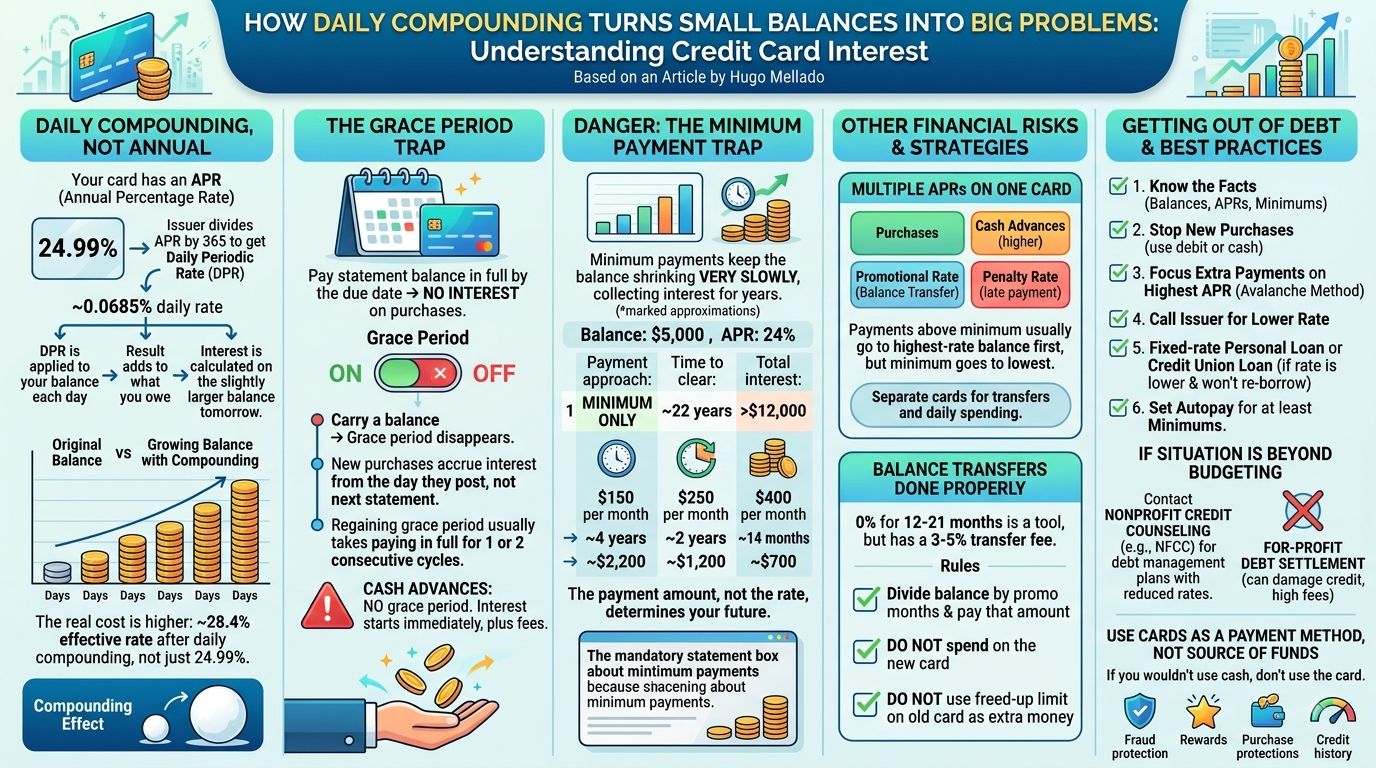
Your card has an APR, but interest is applied daily. The issuer divides the APR by 365 to get a daily periodic rate, multiplies it by your balance each day, and adds the result to what you owe. Tomorrow interest is calculated on that slightly larger figure.
At a 24.99% APR, the daily rate is about 0.0685%. Over a year of daily compounding, the effective cost is roughly 28.4% rather than 24.99%. The compounding does the extra work, quietly.
The Grace Period, and How You Lose It
Pay your statement balance in full by the due date and most cards charge no interest on purchases at all. That grace period is the reason credit cards can be genuinely free to use.
Carry any balance into the next cycle and the grace period generally disappears. New purchases begin accruing interest from the day they post, not from the next statement. Regaining the grace period usually requires paying in full for one or two consecutive cycles. This is why “I’ll just carry a small balance” is far more expensive than it sounds — it converts every future purchase into a loan.
Cash advances have no grace period ever. Interest starts immediately, usually at a higher APR, plus a fee of around 3% to 5% of the amount.
Why the Minimum Payment Is a Trap
Minimum payments are typically calculated as a small percentage of the balance, often 1% to 3% plus accrued interest and fees, with a floor of around $25 to $35. The design keeps the balance shrinking so slowly that interest collects for years.
| Balance | APR | Payment approach | Time to clear | Total interest |
|---|---|---|---|---|
| $5,000 | 24% | Minimum only | About 22 years | More than $12,000 |
| $5,000 | 24% | $150 per month | About 4 years | About $2,200 |
| $5,000 | 24% | $250 per month | About 2 years | About $1,200 |
| $5,000 | 24% | $400 per month | About 14 months | About $700 |
The figures are approximations, but the pattern is exact: the payment amount, not the interest rate, determines whether a balance is a temporary problem or a permanent condition. Every card statement is required to show what happens if you pay only the minimum — that box is the most useful thing on the page.
Multiple APRs on One Card
A single account frequently carries several rates at once: one for purchases, a higher one for cash advances, a promotional rate for balance transfers, and a penalty rate that can apply after a late payment. Payments above the minimum are generally applied to the highest-rate balance first, which is helpful, but the minimum itself is applied to the lowest.
The practical consequence: if you have a 0% balance transfer sitting on the same card you use for groceries, your purchases may accrue interest while your payments chip away at the promotional balance. Keeping transfers and spending on separate cards avoids the problem entirely.
Balance Transfers Done Properly
A 0% introductory offer for twelve to twenty-one months can be a genuine tool. It also comes with a transfer fee, typically 3% to 5% of the amount moved, and a hard deadline after which the standard rate applies to whatever remains.
Three rules make transfers work. Divide the balance by the number of promotional months and pay that amount every month without fail, so the balance hits zero before the offer ends. Do not spend on the new card. And do not treat the freed-up limit on the old card as available money — the most common outcome of a balance transfer is two balances instead of one.
How to Get Out
- List every card with its balance, APR, and minimum payment, so you are working from facts rather than dread
- Stop adding new purchases to any card carrying a balance, switching to debit or cash for daily spending
- Pay the minimum on everything, then direct every spare dollar at the highest APR first
- Call and ask for a lower rate — issuers approve these requests more often than people expect, especially with a solid payment history
- Consider a fixed-rate personal loan or credit union consolidation loan if it genuinely lowers the rate and you will not re-borrow
- Set autopay for at least the minimum to protect against penalty rates and late fees
If the Situation Is Beyond Budgeting
When minimum payments across all cards exceed what you can pay, a nonprofit credit counselling agency affiliated with the National Foundation for Credit Counseling can negotiate a debt management plan with reduced rates. This is different from for-profit debt settlement companies, which typically instruct you to stop paying, damage your credit, charge substantial fees, and cannot guarantee results.
Using Cards Without Paying Interest
Cards are excellent instruments when the balance is cleared monthly: fraud protection stronger than debit, rewards, purchase protections, and credit history. The entire benefit depends on one behaviour — treating the card as a payment method rather than a source of funds.
A practical test: if you would not be comfortable paying for something with money already in your checking account, putting it on a card does not make it affordable. It makes it 28% more expensive.
Card terms vary by issuer and change over time. Read your cardholder agreement for the rules that apply to your account.
Sources and further reading
The explanations above are checked against official regulators, statistical agencies, standards bodies and non-profit financial education organisations. Use these primary sources to verify figures and rules before you act on them.
- CFPB — Credit cards
- CFPB — Regulation Z (Truth in Lending), 12 CFR Part 1026
- Truth in Lending Act, 15 U.S.C. § 1601 (Cornell Legal Information Institute)
- Federal Reserve — G.19 Consumer Credit release
- CFPB — Debt collection
Related reading
- How Loan Interest Really Works: APR, Amortization, and the True Cost of Borrowing
- How Compound Interest Works: The Math Behind Every Financial Decision
- The Emergency Fund: How Much You Really Need and Where to Keep It
This content is for informational and educational purposes only and does not constitute financial, investment or tax advice. Always do your own research, and consider speaking with a licensed professional about your specific situation.