
Personal Finance · 7 min read
An emergency fund is the least exciting part of a financial plan and the part that determines whether the rest of it survives. Without one, every unexpected expense becomes debt, and every market downturn arrives at exactly the moment you need to sell.
The standard advice — three to six months of expenses — is a reasonable starting point and a terrible stopping point, because it ignores the two variables that matter most: how stable your income is and how fast you could replace it.
What Counts as an Emergency
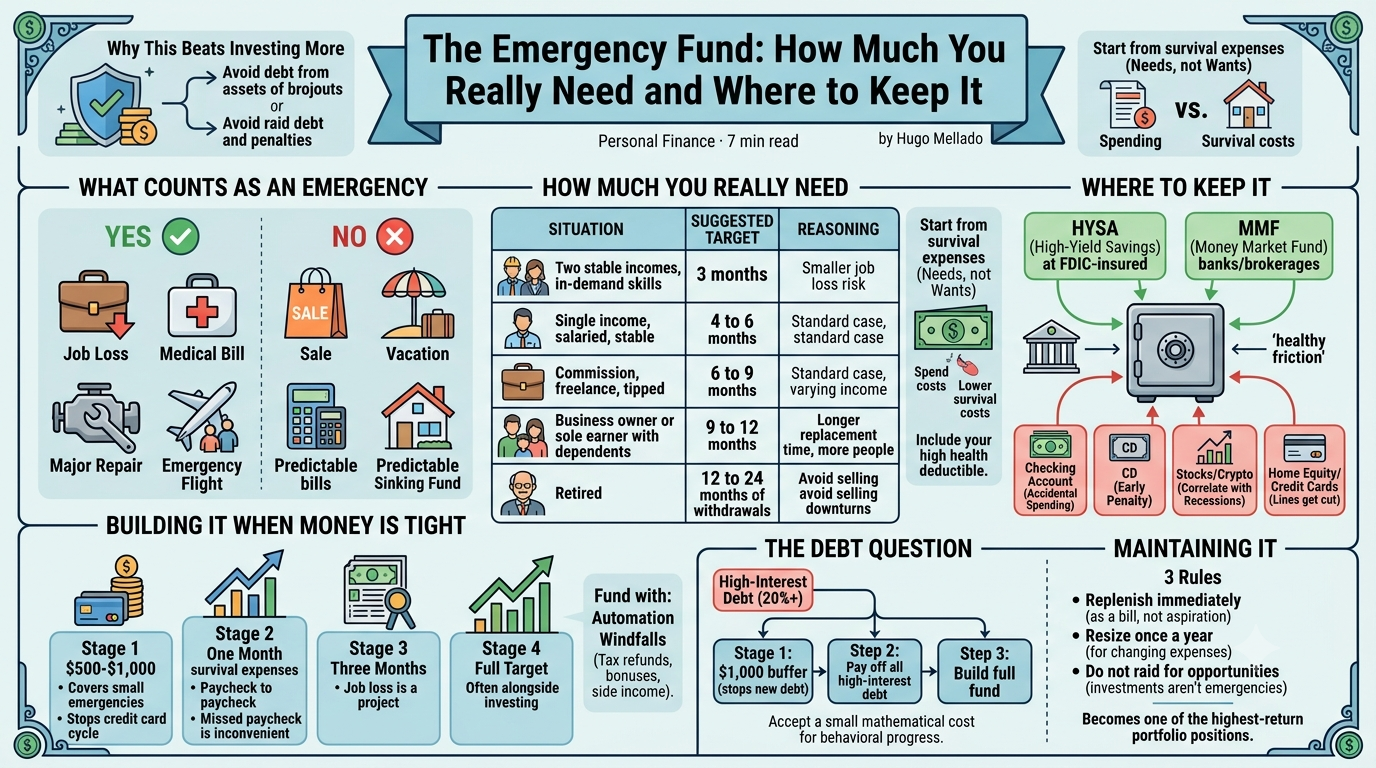
Define this before you need to. An emergency is an unplanned, necessary expense that would otherwise go on a credit card: job loss, a medical bill, a transmission, an emergency flight home, a broken furnace in January. A sale is not an emergency. A vacation is not an emergency. A predictable annual expense such as insurance premiums or property taxes is not an emergency either — those belong in a separate sinking fund, saved monthly toward a known date.
People who blur this line end up rebuilding the fund forever and concluding that emergency funds do not work. The fund works fine. The definition was the problem.
How Much You Actually Need
Start from monthly survival expenses, not monthly spending. Survival means housing, utilities, groceries, insurance, transportation, minimum debt payments, and childcare. It excludes restaurants, travel, and discretionary shopping — the things you would cut in week one of a real crisis. For most households, survival expenses land 20% to 35% below normal spending, which makes the target smaller and more achievable than it first appears.
Then adjust for your situation:
| Situation | Suggested target | Reasoning |
|---|---|---|
| Two stable incomes, in-demand skills | 3 months | Job loss is unlikely to hit both at once |
| Single income, salaried, stable industry | 4 to 6 months | Standard case |
| Commission, freelance, or tipped income | 6 to 9 months | Income varies month to month |
| Business owner or sole earner with dependents | 9 to 12 months | Longer replacement time, more people depending on it |
| Retired or near retirement | 12 to 24 months of withdrawals | Avoids selling investments in a downturn |
Two other factors push the number up: a high deductible on your health plan and a job market where roles in your field take a long time to fill. Add your deductible to the total if a single medical event would otherwise wipe out the fund.
Where to Keep It
The requirements are narrow. Emergency money must be available within a day or two, must not fall in value, and should earn something rather than nothing. That points to a high-yield savings account at an FDIC-insured bank or credit union, or a money market fund at a brokerage.
What it should not be: your checking account, where it gets spent by accident. Not a certificate of deposit with an early withdrawal penalty, unless you build a ladder. Not stocks or crypto, because emergencies correlate with recessions and recessions are exactly when those assets are down 30% or more. Not home equity or a credit card treated as a backup plan — credit lines get cut precisely when everyone needs them.
Keeping it at a different institution from your checking account adds a day of friction, which is a feature rather than a bug.
Building It When Money Is Tight
The full target is intimidating, so break it into stages that each buy you something real.
- Stage 1 — $500 to $1,000: Covers the most common small emergencies and stops the credit card cycle before it starts.
- Stage 2 — One month of survival expenses: Turns a missed paycheck from a crisis into an inconvenience.
- Stage 3 — Three months: The point where a job loss becomes a project rather than an emergency.
- Stage 4 — Your full target: Reached slowly, often alongside investing rather than before it.
Fund it with automation first, then with one-time inflows: tax refunds, bonuses, side income, the proceeds of selling things you no longer use. Windfalls are the fastest path, because they do not require changing your monthly life at all.
The Debt Question
If you are carrying credit card debt at 20% or more, splitting your attention feels wasteful — every dollar in savings earning 4% while debt costs 22% looks like a losing trade. Mathematically it is. Practically, a small buffer keeps the next flat tire from adding to the balance you are trying to eliminate.
The common compromise: build stage one, roughly $1,000, then throw everything at the high-interest debt, then return to building the full fund. You accept a small mathematical cost in exchange for not undoing your own progress.
Maintaining It
Three rules keep a fund healthy. First, replenish immediately after using it — treat rebuilding as a bill, not an aspiration. Second, resize it once a year, because your expenses change and a fund sized for your old rent is no longer three months. Third, do not raid it for opportunities. An investment that appears too good to pass up is not an emergency, and the fund exists specifically so you never have to sell such investments at the worst possible time.
Why This Beats Investing More
The return on an emergency fund is not the interest rate. It is the debt you never take on, the retirement account you never cash out early with penalties and taxes, the job offer you can decline because you are not desperate, and the investments you never have to sell during a downturn. Measured that way, the boring account earning a modest yield is one of the highest-return positions in a portfolio.
It also changes how you behave. Investors with cash reserves tend to hold through volatility, because their bills are not depending on the market. That behavioural benefit alone often exceeds the yield they gave up by keeping the money in cash.
General information only, not personalised financial advice. Your income stability, insurance coverage and dependents change the right target.
Sources and further reading
The explanations above are checked against official regulators, statistical agencies, standards bodies and non-profit financial education organisations. Use these primary sources to verify figures and rules before you act on them.
- Federal Reserve — Report on the Economic Well-Being of U.S. Households (SHED)
- FDIC — Deposit insurance: coverage rules and limits
- Consumer Financial Protection Bureau — Ask CFPB
- National Credit Union Administration — share insurance and credit union supervision
- FINRA Investor Education Foundation — research on financial capability
Related reading
- How to Save Money in the United States: A System That Actually Works
- High-Yield Savings vs. CDs vs. Money Market Funds: Where Should Your Cash Live?
- How Compound Interest Works: The Math Behind Every Financial Decision
This content is for informational and educational purposes only and does not constitute financial, investment or tax advice. Always do your own research, and consider speaking with a licensed professional about your specific situation.