
Personal Finance · 8 min read
Most saving advice in the United States fails for the same reason: it treats saving as an act of willpower. Skip the coffee, clip the coupon, feel virtuous. Then the car needs tires in March and the whole thing collapses. Saving that survives contact with real life is structural — it depends on how your accounts are wired, not on how disciplined you feel on a Tuesday.
What follows is the structure. It works whether you earn $35,000 or $350,000, because the mechanics of cash flow do not change with income. Only the numbers do.
Start With One Number: Your Savings Rate
Forget budgets for a moment. The single number that predicts your financial future is your savings rate — the share of your take-home pay that never gets spent. Someone earning $60,000 who saves 20% is in far better shape than someone earning $120,000 who saves 3%, and the gap widens every year.
Calculate it honestly. Take everything that left your paycheck last month and landed in savings, investments, or extra debt payments beyond the minimum. Divide by your net pay. That is your rate. Most American households sit in the low single digits. Moving from 3% to 15% changes your life far more than picking a better index fund ever will.
Automate Before You Optimize
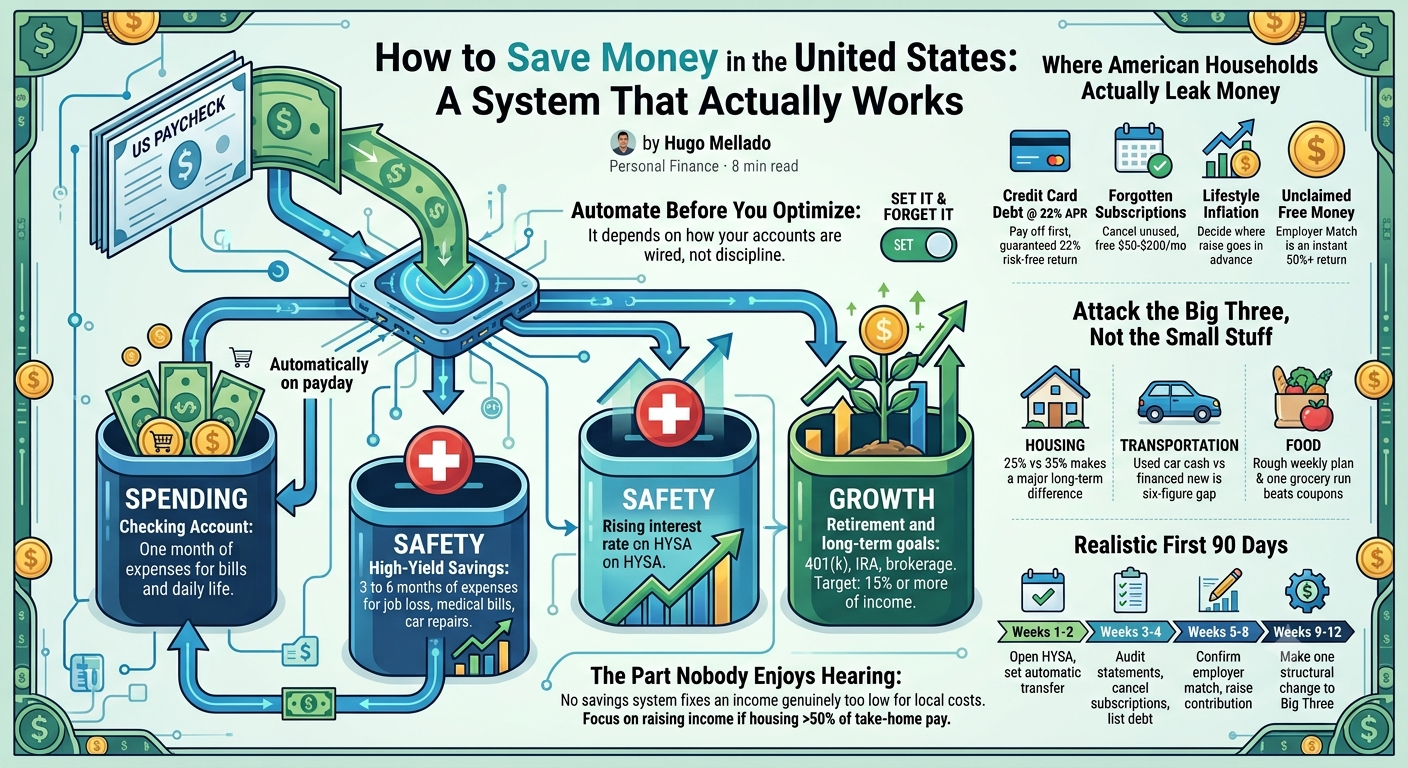
The reason automation works is not psychological trickery. It is sequencing. When money moves to savings on payday, you spend what remains. When you save whatever remains at month end, nothing remains — spending expands to fill whatever space you leave it.
Set up a transfer that fires the same day your direct deposit hits. Start at an amount that feels slightly uncomfortable but not painful, then raise it by one percentage point every time you get a raise. That single habit, repeated for a decade, does more work than any spreadsheet.
The Three-Bucket Structure
Complexity kills systems. Three buckets is enough for almost everyone, and each one has a different job, a different account type, and a different time horizon.
| Bucket | Job | Where it lives | Target |
|---|---|---|---|
| Spending | Bills and daily life | Checking account | One month of expenses |
| Safety | Job loss, medical bills, car repairs | High-yield savings | 3 to 6 months of expenses |
| Growth | Retirement and long-term goals | 401(k), IRA, brokerage | 15% or more of income |
Money does not move backwards between buckets. Growth money is not for a vacation. Safety money is not for a better television. The boundaries are the whole point — the moment they become negotiable, the system stops being a system.
Where American Households Actually Leak Money
Interest You Pay to Other People
A revolving credit card balance at 22% APR is a guaranteed negative return that dwarfs anything you might earn investing. Before you optimize your portfolio, look at what you are paying on debt. Paying off a 22% balance is mathematically equivalent to earning 22% risk-free, and no investment offers that.
Subscriptions and Recurring Charges
The average household carries a dozen or more recurring charges, many forgotten. Pull three months of statements and list every repeating line item. Cancel anything you cannot remember using in the last thirty days. This is a one-hour task that typically frees $50 to $200 a month, permanently.
Lifestyle Inflation After Raises
Raises quietly become new baseline spending within a few months. The fix is to decide in advance where a raise goes — for example, half to savings and half to life — before the larger paycheck arrives and the decision gets made for you.
Unclaimed Free Money
If your employer matches 401(k) contributions and you contribute less than the match, you are declining part of your salary. A typical match of 50 cents per dollar up to 6% of pay is an instant 50% return. Nothing else in personal finance comes close.
Attack the Big Three, Not the Small Stuff
Housing, transportation, and food consume roughly two-thirds of the typical American budget. A single decision on any one of them outweighs years of small sacrifices.
Housing: the difference between spending 25% and 35% of gross income on rent or a mortgage is, over a decade, a down payment or a retirement account. Refinancing, renegotiating a lease, taking on a roommate, or moving one neighborhood out are large-dollar moves.
Transportation: a used car bought with cash and driven for eight years versus a rotating series of financed new cars is often a six-figure difference over a working life, once you include interest, insurance, and depreciation.
Food: the gap is rarely groceries versus restaurants in the abstract. It is unplanned meals. A rough weekly plan and one grocery run beats any coupon strategy.
Use the Accounts the Tax Code Hands You
Saving inside the wrong account means paying taxes you did not have to pay. In rough order of priority for most people: contribute enough to a 401(k) to capture the full employer match, then pay down high-interest debt, then fund a Roth or traditional IRA, then return to the 401(k) up to the annual limit, then use a taxable brokerage account. If you have a high-deductible health plan, an HSA is worth understanding — it is the only account with a triple tax advantage.
The right order depends on your tax bracket, your employer plan, and your goals. The general shape, though, holds: capture free money, kill expensive debt, then fill tax-advantaged space before taxable space.
Make the Savings Work Instead of Sitting Still
Cash sitting in a traditional checking account earning nothing loses purchasing power every year to inflation. Your safety bucket belongs in a high-yield savings account or money market fund where it earns a competitive rate and remains available within a day or two. Your growth bucket belongs in diversified, low-cost investments with a horizon measured in years, not months.
This distinction confuses many beginners. Safety money should be boring and liquid. Growth money should be invested and left alone. Mixing the two produces the worst of both — money you cannot reach when you need it and returns too small to matter when you do not.
A Realistic First 90 Days
- Weeks 1 to 2: Open a high-yield savings account and set an automatic transfer for payday, even if it is only $25.
- Weeks 3 to 4: Audit three months of statements, cancel dead subscriptions, and list every debt with its interest rate.
- Weeks 5 to 8: Confirm your employer match and raise your contribution to capture all of it.
- Weeks 9 to 12: Pick one of the big three expenses and make one structural change to it.
Ninety days will not make you wealthy. It will leave you with a system that keeps working without your attention, which is the only kind that ever compounds.
The Part Nobody Enjoys Hearing
No savings system fixes an income that is genuinely too low for local costs, and pretending otherwise is a form of blame dressed up as advice. If housing alone consumes half your take-home pay, the highest-return project available to you is probably raising your income — skills, credentials, negotiation, or a move — not shaving your grocery bill. Saving strategies work best on top of a foundation that can actually support them.
This article describes general principles, not personalised recommendations. Your tax situation, debt levels and goals change the right answer.
Sources and further reading
The explanations above are checked against official regulators, statistical agencies, standards bodies and non-profit financial education organisations. Use these primary sources to verify figures and rules before you act on them.
- U.S. Bureau of Labor Statistics — Consumer Expenditure Surveys
- U.S. Bureau of Labor Statistics — Consumer Price Index
- Federal Reserve — Report on the Economic Well-Being of U.S. Households (SHED)
- Consumer Financial Protection Bureau — Ask CFPB
- CFPB — “Your Money, Your Goals” financial empowerment toolkit
Related reading
- How Compound Interest Works: The Math Behind Every Financial Decision
- The Emergency Fund: How Much You Really Need and Where to Keep It
- High-Yield Savings vs. CDs vs. Money Market Funds: Where Should Your Cash Live?
This content is for informational and educational purposes only and does not constitute financial, investment or tax advice. Always do your own research, and consider speaking with a licensed professional about your specific situation.