
Investing · 8 min read
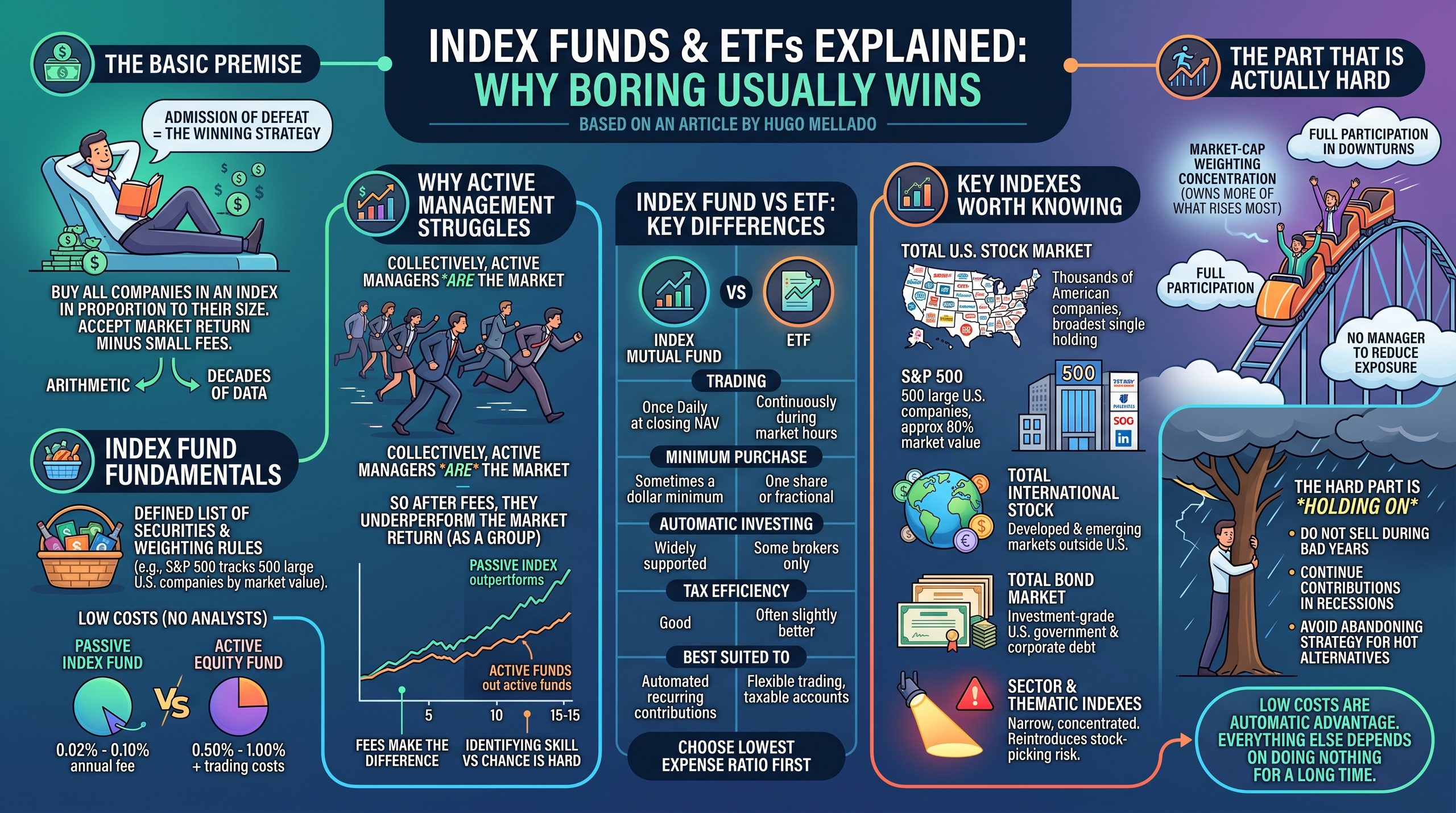
Index funds are an admission of defeat that turns out to be the winning strategy. Instead of trying to identify which companies will outperform, you buy all of them in proportion to their size and accept the market return minus a very small fee.
Decades of data support this approach, and the reason is arithmetic rather than ideology.
What an Index Fund Actually Is
An index is a defined list of securities and a rule for weighting them — the S&P 500 tracks 500 large U.S. companies weighted by market value. An index fund holds those securities in those proportions, with no analyst deciding what looks attractive.
Because there is nothing to research, costs collapse. Broad index funds commonly charge between 0.02% and 0.10% annually. Actively managed equity funds frequently charge 0.50% to 1.00% or more, and many carry additional trading costs invisible in the expense ratio.
Why Active Management Struggles
The market return is the average of all participants before costs. Active managers, collectively, are the market — so as a group they must earn the market return before fees and less than it after fees. This is not a claim about skill. It is subtraction.
The published evidence is consistent: over periods of ten to fifteen years, the large majority of actively managed U.S. equity funds underperform their benchmark index after fees. Some managers do beat the market. Identifying them in advance, and confirming that past outperformance was skill rather than chance, has proven extremely difficult even for institutions with research budgets.
Index Fund Versus ETF
Both can track the same index and hold nearly identical portfolios. The differences are structural.
| Feature | Mutual fund index | ETF |
|---|---|---|
| Trading | Once daily at closing net asset value | Continuously during market hours |
| Minimum purchase | Sometimes a dollar minimum | One share, or fractional at many brokers |
| Automatic investing | Widely supported | Supported at some brokers only |
| Tax efficiency in taxable accounts | Good | Often slightly better |
| Bid-ask spread | None | Small, wider on thinly traded funds |
| Best suited to | Automated recurring contributions | Flexible trading and taxable accounts |
For a long-term investor contributing monthly, either is fine. Mutual funds are marginally more convenient for automation; ETFs are marginally more tax-efficient in taxable accounts. Neither difference should override choosing whichever gives you the lowest expense ratio on the index you want.
Reading the Expense Ratio Correctly
A 1% annual fee sounds negligible and is not. On a portfolio growing at 7% for thirty years, paying 1.00% instead of 0.05% reduces the final balance by roughly a quarter. You never write a cheque for it — it is deducted from the fund daily and appears only as slightly lower performance.
Watch also for sales loads, which charge a percentage on purchase or sale, and 12b-1 marketing fees embedded in the expense ratio. Neither buys you better performance. Both still exist, particularly in some employer plans and advisor-sold products.
The Indexes Worth Knowing
- Total U.S. stock market — thousands of American companies of all sizes, the broadest single domestic holding
- S&P 500 — 500 large U.S. companies, roughly 80% of U.S. market value
- Total international stock — developed and emerging markets outside the United States
- Total bond market — investment-grade U.S. government and corporate debt across maturities
- Sector and thematic indexes — narrow, concentrated, and generally where index investing stops being diversification
The first four can build a complete portfolio. The fifth category is where investors often reintroduce the stock-picking risk they adopted indexing to avoid, simply at the sector level instead of the company level.
Legitimate Criticisms
Index investing is not without genuine weaknesses, and it is worth knowing them rather than treating the approach as beyond question.
Market-cap weighting means you own more of whatever has already risen most. When a handful of very large companies dominate an index, a “diversified” fund can carry substantial concentration — a reasonable concern that has grown more relevant as the largest U.S. companies have taken a bigger share of total market value.
Index funds also guarantee full participation in every downturn. There is no manager reducing exposure before a crash, which is the point, but it means the strategy requires you to actually hold through declines. And in narrow or illiquid markets, indexing works less cleanly than in large, liquid ones.
How to Choose Between Two Similar Funds
When comparing funds tracking the same index, look at the expense ratio first, then tracking difference against the index over several years, then fund size and trading volume for ETFs, and finally the tax treatment of distributions if the account is taxable. If two funds are close on all of these, the choice genuinely does not matter and further analysis is wasted effort.
The Part That Is Actually Hard
Indexing removes the difficulty of security selection and leaves the difficulty that was always the real problem: holding on. An index fund cannot protect you from selling in March of a bad year, from stopping contributions during a recession, or from abandoning the strategy after three years of lagging some hot alternative.
That is why the boring option wins in practice as well as in theory. Low costs are a mathematical advantage you keep automatically. Everything else depends on doing nothing, repeatedly, for a very long time.
Educational content, not a recommendation of any specific fund. Costs, index composition and tax treatment vary — read the prospectus.
Sources and further reading
The explanations above are checked against official regulators, statistical agencies, standards bodies and non-profit financial education organisations. Use these primary sources to verify figures and rules before you act on them.
- FINRA — Exchange-traded funds and products
- U.S. SEC — Beginners’ guide to asset allocation, diversification and rebalancing
- FINRA — For Investors: education and tools
- U.S. SEC — Ten things to consider before you make investing decisions
Related reading
- How to Plan a Stock Portfolio: Asset Allocation From Scratch
- How to Start Investing With $100: A Step-by-Step Guide for Beginners
- How Compound Interest Works: The Math Behind Every Financial Decision
This content is for informational and educational purposes only and does not constitute financial, investment or tax advice. Always do your own research, and consider speaking with a licensed professional about your specific situation.