
Trading · 7 min read
Updated September 19, 2026: refreshed with current market data, regulation and network upgrades.
Why Understanding Market Cycles Is Your Greatest Edge
One of the most powerful advantages an investor can have in cryptocurrency is understanding that the market moves in cycles — predictable patterns of expansion, euphoria, contraction, and despair — and refusing to let crowd psychology override rational decision-making. Most retail investors do the exact opposite of what generates wealth: they buy near peaks when prices are high and headlines are euphoric, and they sell near bottoms when prices are low and sentiment is at its most negative. Understanding market cycles gives you a framework to recognize where you are in the cycle and make more deliberate, less emotionally-driven decisions.
The Four Phases of a Crypto Market Cycle
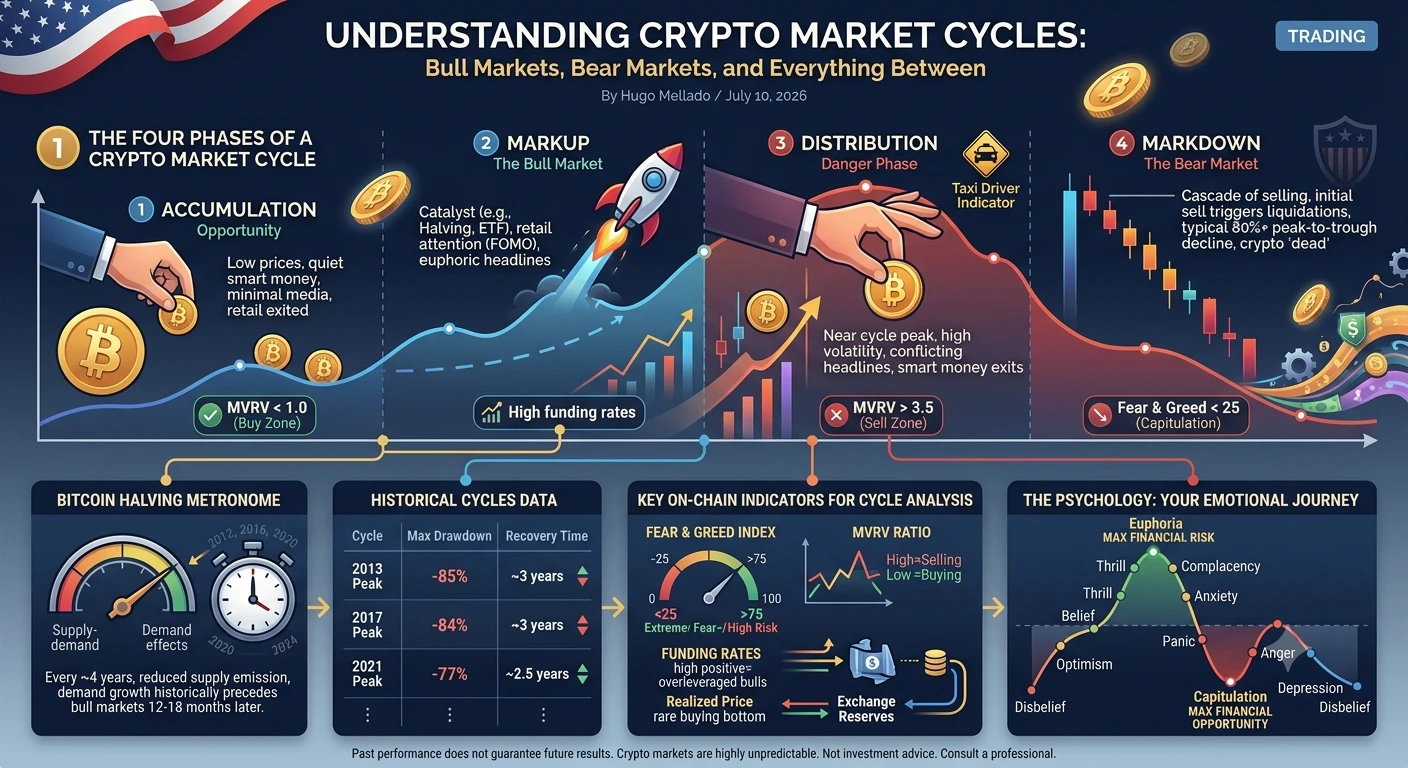
Phase 1: Accumulation (Opportunity Phase)
Following a bear market bottom. Prices are low, volatility has declined, and media coverage is minimal or actively negative. Most retail investors have exited the market in disgust or are publicly declaring crypto “dead.” The phrase “blockchain not Bitcoin” starts appearing as mainstream analysts dismiss speculative assets while acknowledging the underlying technology. “Smart money” — institutional investors, long-term holders, and experienced crypto-native investors — quietly accumulates positions at depressed prices. Trading volumes are low. Only those with genuine conviction and long time horizons can stomach buying during this phase, which is psychologically brutal.
Phase 2: Markup — The Bull Market
A catalyst sparks renewed interest. This has historically been Bitcoin’s halving event, a major regulatory development (like the approval of Bitcoin ETFs), or a macroeconomic shift (like rate cuts increasing risk appetite). Prices begin rising. First, experienced investors recognize the opportunity. Then, as price increases become visible, retail attention returns. FOMO (fear of missing out) drives accelerating purchases, creating a self-reinforcing feedback loop: prices rise → more people notice → more buying → prices rise faster. The late stages of markup are when the market becomes irrational: celebrities shill projects, your relatives start asking how to buy crypto, and mainstream financial media provides breathless coverage of new all-time highs. During this phase, virtually everything goes up — including low-quality projects and outright scams that new money cannot distinguish from legitimate assets.
Phase 3: Distribution (Danger Phase)
Near the cycle peak, smart money sells into the flood of new buyers. Signs include: increasing volatility with sharp intraday swings (distribution is messy — it takes time to exit large positions without crashing the price); conflicting headlines (bullish narratives compete with early warnings); celebrity endorsements and mainstream media saturation; the emergence of obviously speculative assets gaining extreme valuations (dog meme coins, celebrity NFTs); and financial advice from people with no historical crypto interest — the famous “taxi driver indicator.” The peak itself is often only recognizable in retrospect.
Phase 4: Markdown — The Bear Market
Initial selling triggers liquidations of leveraged positions, which triggers more selling, in a self-reinforcing cascade. Historical Bitcoin bear markets have seen 80%+ declines from peak to trough. The 2017 peak of ~$20,000 gave way to a bottom of ~$3,200 (-84%). The 2021 peak of ~$69,000 gave way to ~$15,700 (-77%). Bear markets typically last 12–18 months. Near the bottom, news coverage declares crypto dead. Capitulation — the final exhausted selling by the last holdouts — marks the transition back to accumulation. Each cycle has eventually recovered to new highs, but there is no mathematical guarantee this will continue. The current drawdown began after the October 2025 peak; in August 2026 Bitcoin traded about 49% below it, and one analysis describes it as the mildest bear market in Bitcoin’s history so far.
The Bitcoin Halving and Market Cycles
Bitcoin’s four-year halving schedule has been the metronome of crypto market cycles. Every ~four years, the block reward halves, reducing the rate at which new Bitcoin enters circulation. The four halvings occurred in 2012, 2016, 2020, and April 2024. In each case, a significant bull market followed in the 12–18 months after the halving. The 2024 cycle followed that timing: Bitcoin peaked at about $126,200 on October 6, 2025, roughly 17 months after the April 2024 halving, and had fallen about 38% from that peak by September 18, 2026 (Fortune). If the four-year rhythm holds, the next halving is due around April 2028. The mechanism is supply-demand: with less new Bitcoin created per day, and with demand growing as adoption increases, prices tend to rise. Past performance doesn’t guarantee future results — as markets mature and Bitcoin’s supply emission becomes less significant to overall supply, halving’s effects may diminish.
Historical Cycle Data
| Cycle | Peak Price | Bear Market Low | Max Drawdown | Recovery Time |
|---|---|---|---|---|
| 2013 Peak | ~$1,150 | ~$170 | -85% | ~3 years to new ATH |
| 2017 Peak | ~$19,800 | ~$3,200 | -84% | ~3 years to new ATH |
| 2021 Peak | ~$69,000 | ~$15,700 | -77% | ~2.5 years to new ATH |
| 2025 Peak | ~$126,200 (Oct 6, 2025) | Not yet established (August 2026: ~$63,000–$65,400) | About -49% at the August 2026 lows | Not yet recovered |
Key On-Chain Indicators for Cycle Analysis
Fear and Greed Index — A composite indicator (alternative.me/crypto) measuring market sentiment via volatility, trading volume, social media, surveys, and more. Scale of 0–100: 0–25 is “Extreme Fear” (historically correlates with buying opportunities); 75–100 is “Extreme Greed” (historically correlates with elevated risk of correction). As a contrarian indicator, it has a solid track record when applied at extremes.
MVRV Ratio (Market Value to Realized Value) — Compares Bitcoin’s current market cap to the aggregate cost basis of all Bitcoin holders (what they paid when they last moved their coins). High MVRV (above 3.5) indicates most holders are sitting on large profits and signals elevated risk of selling pressure (historically marks cycle tops). Low MVRV (below 1.0) indicates most holders are sitting on losses — when even long-term holders are losing money, the market is at extreme fear (historically marks cycle bottoms).
Funding Rates — On perpetual futures contracts, funding rates indicate whether longs (bullish bets) or shorts (bearish bets) are dominant. Persistently high positive funding rates indicate overleveraged bull markets prone to sharp corrections as leveraged longs get liquidated. Negative funding indicates short-term bearish sentiment and often precedes relief rallies.
Realized Price — The average price at which all Bitcoin was last transacted. When the market price falls below the realized price, most Bitcoin holders are at a loss — a historically rare condition that has marked major cycle bottoms.
Exchange Reserves — When Bitcoin moves from exchanges to private wallets at scale, it typically indicates long-term holders removing supply from the market — a bullish signal. Increasing exchange deposits (Bitcoin moving onto exchanges) suggests potential selling pressure.
The Psychology of Market Cycles: Your Emotional Journey
Understanding your own psychological state during market cycles is arguably more important than any technical indicator. The Wall Street Cheat Sheet of market emotions maps the emotional journey: Disbelief (price is rising but it won’t last) → Optimism → Belief → Thrill → Euphoria (maximum financial risk — this is the peak) → Complacency → Anxiety → Denial (“it’ll recover”) → Panic → Capitulation (maximum financial opportunity — this is the bottom) → Anger → Depression → Disbelief again. Recognizing where you are in this emotional cycle — and acting contrary to your emotional impulses — is the foundation of intelligent cycle-aware investing.
Practical Applications: How to Use This Knowledge
Cycle awareness doesn’t require perfectly timing tops and bottoms (which is impossible consistently). It informs sizing decisions and risk management. During periods of “Extreme Greed,” consider: reducing speculative altcoin exposure, taking partial profits on significant gains, stopping or reducing new purchases. During periods of “Extreme Fear,” consider: increasing DCA purchase amounts, deploying stablecoin reserves gradually, extending time horizons. The investor who follows a consistent DCA strategy naturally buys more Bitcoin when it’s cheap and less when it’s expensive — automatically aligning with cycle logic without requiring any analysis.
⚠️ Disclaimer: Past market cycles do not guarantee future performance. Crypto markets are highly unpredictable. This article is educational only and does not constitute investment advice. Always consult a qualified financial professional before making investment decisions.
Sources and further reading
The explanations above are checked against official regulators, statistical agencies, standards bodies and non-profit financial education organisations. Use these primary sources to verify figures and rules before you act on them.
- National Bureau of Economic Research — Business cycle dating
- FRED — Federal Reserve Bank of St. Louis economic data
- Federal Reserve Board — Monetary policy
- U.S. SEC — Ten things to consider before you make investing decisions
- Fortune — Price of Bitcoin, September 18, 2026
- Bitcoin.com News — Bitcoin’s 2026 bear market so far