
Investing · 9 min read
A portfolio is not a list of good investments. It is a structure designed around a specific person, a specific timeline, and a specific tolerance for watching money disappear temporarily. Two investors can hold the same funds and only one of them has a portfolio, because only one of them can say why.
This is how to build that structure from nothing, in the order the decisions actually matter.
Step 1: Define the Goal and the Date
Every portfolio decision flows from when you need the money. A retirement thirty years away and a down payment three years away are not the same problem and should not share an allocation.
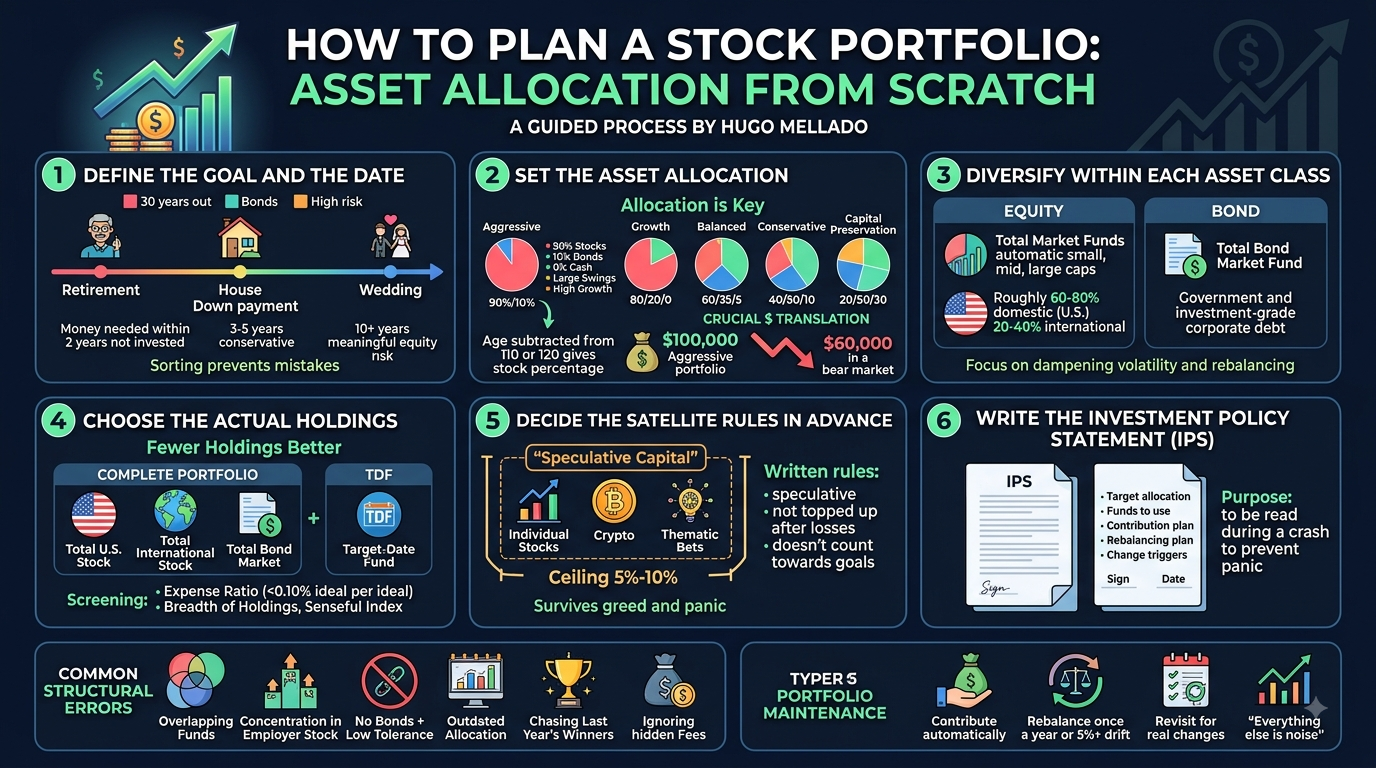
Write each goal down with an approximate amount and a date. Then sort them: money needed within two years should not be invested at all, money needed in three to five years belongs in something conservative, and money needed in ten years or more can carry meaningful equity risk. This single sorting exercise prevents most serious portfolio mistakes.
Step 2: Set the Asset Allocation
Allocation — the split between stocks, bonds, and cash — explains the large majority of the variation in portfolio outcomes. Which specific fund you choose within a category is a rounding error by comparison.
The traditional starting heuristic subtracts your age from 110 or 120 to get a stock percentage. It is crude but useful: a 30-year-old lands around 80% to 90% stocks, a 60-year-old around 50% to 60%. Adjust based on job stability, other income sources, and how you actually behaved during the last market decline.
| Profile | Stocks | Bonds | Cash and short-term | Expected experience |
|---|---|---|---|---|
| Aggressive, 25+ years out | 90% | 10% | 0% | Large swings, highest long-run growth |
| Growth, 15 to 25 years | 80% | 20% | 0% | Meaningful swings, strong growth |
| Balanced, 10 to 15 years | 60% | 35% | 5% | Moderate swings |
| Conservative, 5 to 10 years | 40% | 50% | 10% | Smaller swings, modest growth |
| Capital preservation, under 5 years | 20% | 50% | 30% | Small swings, limited growth |
Before committing, translate the allocation into dollars in a bad year. A 90% stock portfolio of $100,000 can plausibly fall to $60,000 in a severe bear market. If that sentence makes you want to change the number, change it now rather than during the decline.
Step 3: Diversify Within Each Asset Class
Owning stocks is not the same as being diversified. Within equities, the dimensions that matter are geography, company size, and sector.
A workable equity core for a U.S. investor is roughly 60% to 80% domestic and 20% to 40% international. Domestic exposure through a total market fund automatically includes large, mid, and small companies in market-cap proportions. Adding a deliberate tilt toward small-cap or value stocks is defensible but optional, and it introduces long stretches of underperformance you have to be willing to sit through.
Within bonds, a total bond market fund covers government and investment-grade corporate debt across maturities. Bonds serve two purposes: dampening volatility and providing something to sell or rebalance from when stocks fall.
Step 4: Choose the Actual Holdings
Fewer holdings, not more. A complete portfolio can be built with three funds: total U.S. stock market, total international stock market, and total bond market. Add a target-date fund and you are down to one.
Screen candidates on three criteria: expense ratio, breadth of holdings, and tracking of a sensible index. Below 0.10% is readily available for broad index funds. Anything above 0.50% needs to justify itself, and almost nothing does.
Step 5: Decide the Satellite Rules in Advance
If you want to hold individual stocks, crypto, or thematic sector bets, decide the ceiling before you start — commonly 5% to 10% of the total. Write down that this is speculative capital, that it will not be topped up after losses, and that it does not count toward your goals.
The purpose of a written rule is to survive the moment when a position doubles and you want to add more, or halves and you want to average down. Portfolios rarely fail because of a small speculative allocation. They fail when that allocation quietly becomes the portfolio.
Step 6: Write the Investment Policy Statement
One page. Your target allocation, the funds you will use, how much you contribute and how often, when you will rebalance, and what would legitimately cause you to change the plan. Sign and date it.
This document exists for one purpose: to be read during a crash, when your judgement is at its worst and the temptation to act is at its strongest. Investors with a written plan sell in panic less often, and that difference in behaviour is worth more over a lifetime than any fund selection.
Common Structural Errors
- Overlapping funds that all hold the same large U.S. companies, producing the appearance of diversification without the substance
- Concentration in employer stock, where your salary and your savings share a single point of failure
- No bonds at any age combined with no tolerance for volatility, a combination that reliably produces selling at the bottom
- An allocation chosen for a horizon that has since changed, and never revisited
- Chasing last year’s best-performing sector or fund, then rotating again after it lags
- Ignoring fees inside employer plans because the deduction is invisible on the statement
Maintenance
A completed portfolio needs very little. Contribute automatically, rebalance once a year or when an allocation drifts more than five percentage points from target, and revisit the allocation itself when something real changes — a new job, a child, a shifting retirement date.
Everything else is noise. The plan you can leave alone for a decade beats the sophisticated one you keep adjusting, because the adjustments are where the returns leak out.
Allocation examples are illustrative frameworks, not recommendations. Your circumstances determine what is appropriate for you.
Sources and further reading
The explanations above are checked against official regulators, statistical agencies, standards bodies and non-profit financial education organisations. Use these primary sources to verify figures and rules before you act on them.
- U.S. SEC — Beginners’ guide to asset allocation, diversification and rebalancing
- FINRA — Investing basics: understanding risk
- U.S. SEC — Ten things to consider before you make investing decisions
- FINRA — Exchange-traded funds and products
Related reading
- Index Funds and ETFs Explained: Why Boring Usually Wins
- Rebalancing Your Portfolio: When, How Often, and Why It Matters
- Risk Tolerance: How to Measure Yours Before You Invest a Dollar
This content is for informational and educational purposes only and does not constitute financial, investment or tax advice. Always do your own research, and consider speaking with a licensed professional about your specific situation.