
Investing · 8 min read
Every brokerage asks about your risk tolerance in a short questionnaire, and almost every answer is wrong. People answer with the version of themselves who has never watched a portfolio fall 40%. Then the real decline arrives and the questionnaire turns out to have measured optimism rather than tolerance.
Risk tolerance is worth measuring properly, because an allocation you cannot hold is worse than a conservative one you can.
Three Different Things Called Risk Tolerance
Most confusion comes from collapsing three separate concepts into one word.
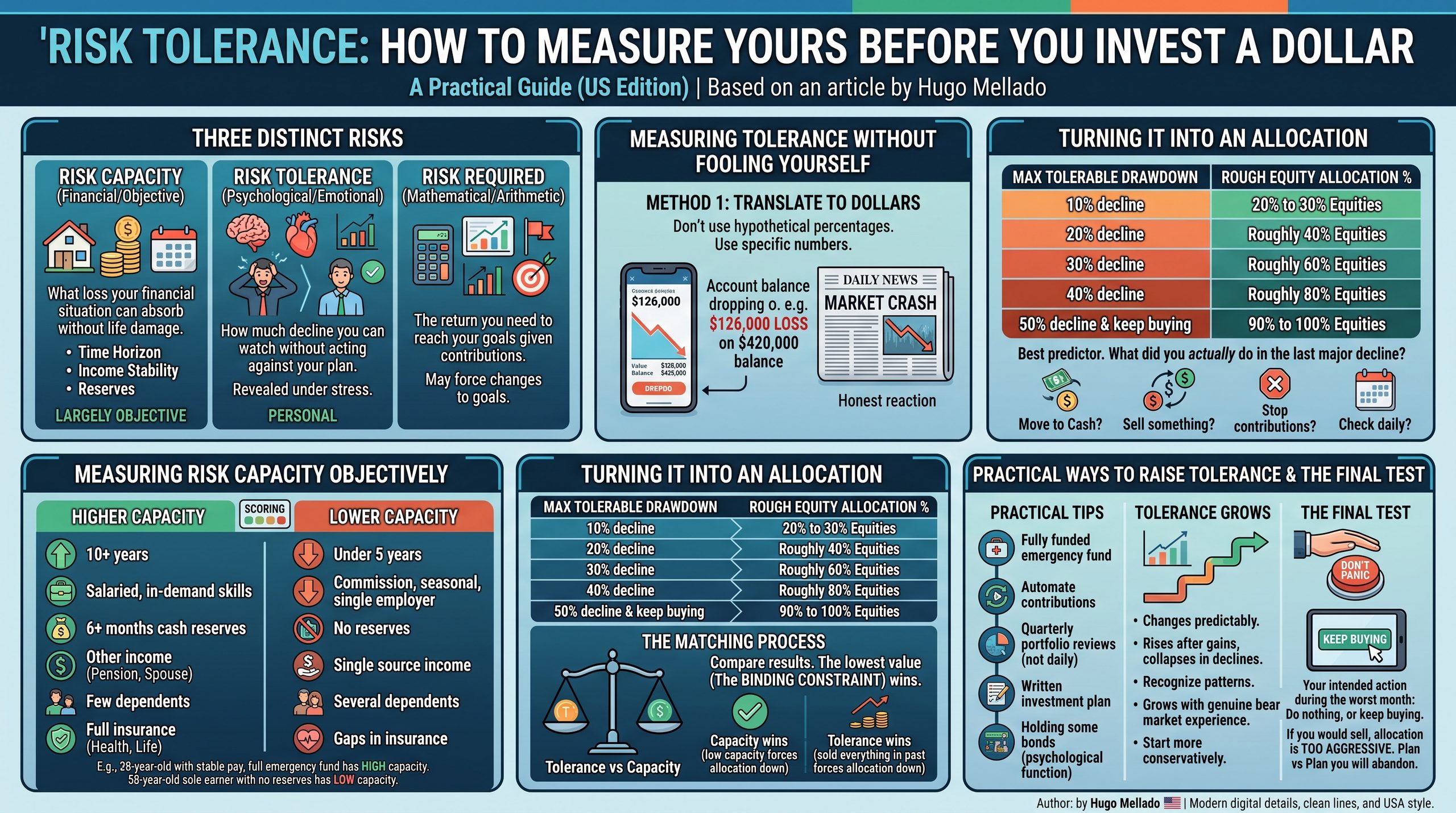
Risk capacity is financial: how much loss your situation can absorb without damaging your actual life. It depends on your time horizon, income stability, emergency reserves, insurance, and dependents. It is largely objective.
Risk tolerance is psychological: how much decline you can watch without acting against your plan. It is personal, hard to self-assess, and only reliably revealed under stress.
Risk required is arithmetic: the return you need to reach your goals given your contributions and timeline. Sometimes this exceeds what you are comfortable with, which means either the goal, the timeline, or the contribution amount has to change.
A workable allocation respects all three. The binding constraint is usually the lowest of the three, not the average.
Measuring Capacity Objectively
| Factor | Raises your capacity | Lowers your capacity |
|---|---|---|
| Time until you need the money | 10+ years | Under 5 years |
| Income stability | Salaried, in-demand skills | Commission, seasonal, single employer town |
| Emergency reserves | 6 months or more in cash | None |
| Other income sources | Pension, rental income, spouse income | Single source |
| Dependents and fixed obligations | Few | Several |
| Insurance coverage | Health, disability, life in place | Gaps |
Score yourself honestly on each row. A 28-year-old with stable pay, a full emergency fund, and no dependents has high capacity almost regardless of temperament. A 58-year-old sole earner with no reserves has low capacity regardless of how confident they feel.
Measuring Tolerance Without Fooling Yourself
Questionnaires ask how you would feel about a hypothetical 20% loss. Everyone overestimates their composure about hypotheticals. Two better methods exist.
The first is translation into dollars. Do not ask whether you could handle a 30% decline. Ask whether you could handle your account showing a $126,000 loss on a $420,000 balance, for eighteen months, while headlines insist it will get worse, and while you continue depositing money into it every month. The specific number produces a much more honest reaction than the percentage.
The second is your own history. What did you actually do in the last significant market decline? Did you stop contributing? Move to cash? Check your balance daily? Sell something? Past behaviour under stress is the single best available predictor, and it beats any questionnaire.
Turning It Into an Allocation
Use maximum tolerable drawdown as the bridge. Equities have historically fallen roughly 50% in severe bear markets, so a rough approximation for a diversified portfolio is that your maximum drawdown will be around half your equity percentage.
- Can tolerate a 10% decline: roughly 20% to 30% equities
- Can tolerate a 20% decline: roughly 40% equities
- Can tolerate a 30% decline: roughly 60% equities
- Can tolerate a 40% decline: roughly 80% equities
- Can tolerate a 50% decline and keep buying: 90% to 100% equities
Then compare that result against your capacity. If tolerance says 80% equities but you need the money in four years, capacity wins and the allocation comes down. If capacity says 90% but you know you sold everything in the last crash, tolerance wins.
Tolerance Is Not Fixed
It changes, and predictably. It rises after years of gains, which is exactly when a higher allocation is most dangerous, and it collapses during declines, which is exactly when selling is most costly. Recognising this pattern in yourself is more useful than any precise measurement.
It also grows with genuine experience. Investors who have lived through two or three real bear markets while continuing to contribute typically hold higher allocations calmly than beginners can. This argues for starting somewhat more conservatively than the theoretical optimum and increasing exposure as you accumulate actual experience rather than confidence.
Practical Ways to Raise Your Effective Tolerance
Several structural changes make volatility easier to hold without changing your personality. A fully funded emergency fund means market declines do not threaten your bills. Automating contributions removes the recurring decision to keep investing. Checking your portfolio quarterly rather than daily substantially reduces the number of unpleasant moments you experience. A written investment plan gives your calmer self a way to instruct your panicked self.
Holding some bonds helps too, and not only mathematically. The psychological function of a bond allocation is to make the worst quarters survivable enough that you never sell the equities.
The Test That Matters
A portfolio is correctly sized for you if, during the worst month you can imagine, your intended action is to do nothing — or better, to keep buying on schedule. If your honest answer is that you would probably sell, the allocation is too aggressive no matter what the questionnaire concluded, and reducing it is not timidity. It is the difference between a plan and a plan you will abandon.
Illustrative frameworks only. Consider discussing your specific situation with a licensed financial professional.
Sources and further reading
The explanations above are checked against official regulators, statistical agencies, standards bodies and non-profit financial education organisations. Use these primary sources to verify figures and rules before you act on them.
- FINRA — Investing basics: understanding risk
- U.S. SEC — Beginners’ guide to asset allocation, diversification and rebalancing
- Federal Reserve — Report on the Economic Well-Being of U.S. Households (SHED)
- National Endowment for Financial Education (NEFE)
Related reading
- How to Plan a Stock Portfolio: Asset Allocation From Scratch
- The Emergency Fund: How Much You Really Need and Where to Keep It
- Short-Term vs. Long-Term Investing: A Side-by-Side Comparison
This content is for informational and educational purposes only and does not constitute financial, investment or tax advice. Always do your own research, and consider speaking with a licensed professional about your specific situation.