
Investing · 8 min read
“Short term” and “long term” get used as personality types — the trader versus the investor — when they are really just two different products with different costs, different tax treatment, and different odds. Comparing them properly means comparing what each one demands of you and what it statistically delivers.
The Definitions That Actually Matter
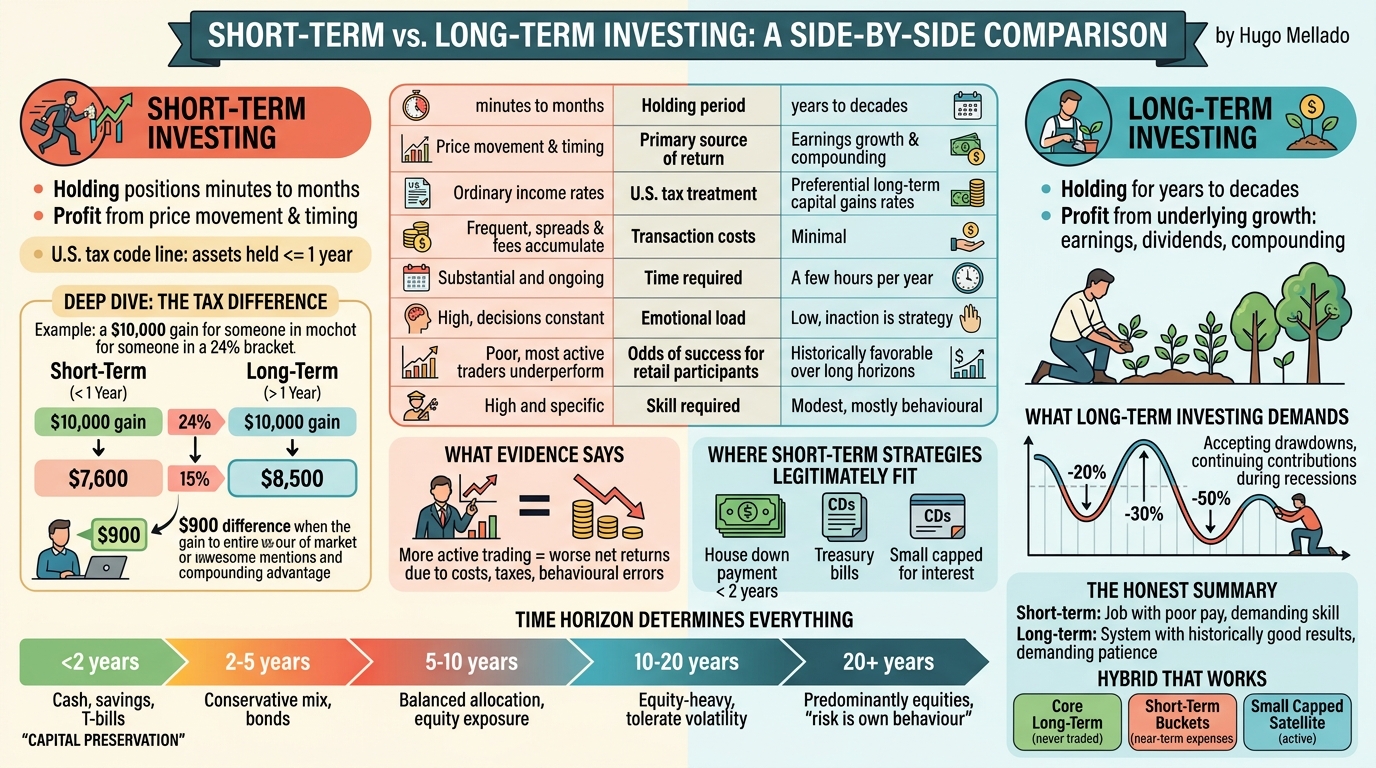
In the U.S. tax code, the line is precise: an asset held one year or less produces a short-term gain taxed as ordinary income, while an asset held more than one year produces a long-term gain taxed at preferential rates. That single boundary changes the arithmetic of every strategy.
Practically, short-term investing means holding positions from minutes to months with the intention of profiting from price movement. Long-term investing means holding for years with the intention of profiting from underlying growth — earnings, dividends, adoption, productivity.
Side by Side
| Dimension | Short term | Long term |
|---|---|---|
| Holding period | Minutes to months | Years to decades |
| Primary source of return | Price movement and timing | Earnings growth and compounding |
| U.S. tax treatment | Ordinary income rates | Preferential long-term capital gains rates |
| Transaction costs | Frequent, spreads and fees accumulate | Minimal |
| Time required | Substantial and ongoing | A few hours per year |
| Emotional load | High, decisions are constant | Low, inaction is the strategy |
| Odds of success for retail participants | Poor, most active traders underperform | Historically favourable over long horizons |
| Skill required | High and specific | Modest, mostly behavioural |
Why the Tax Difference Is Larger Than It Looks
Consider $10,000 of gain for someone in a 24% federal bracket. Held under a year, that gain is taxed as ordinary income at 24%, leaving $7,600. Held over a year, it likely falls into the 15% long-term rate, leaving $8,500. Same gain, $900 difference, before state taxes.
Now compound the effect. A short-term trader realising gains repeatedly pays tax every year and compounds on the after-tax remainder. A long-term holder compounds on the full amount and pays once at the end, at a lower rate. Over decades, this structural advantage often exceeds whatever edge the trader was pursuing.
What the Evidence Says About Frequent Trading
Research on retail brokerage data has been consistent for decades: the more actively individual investors trade, the worse their net returns. The gap comes from transaction costs, taxes, bid-ask spreads, and behavioural errors such as selling winners early and holding losers too long.
Studies of day trading populations, notably in markets where individual results have been tracked at scale, find that only a very small minority are persistently profitable after costs, and that the majority lose money and eventually stop. This is not a claim that short-term trading is impossible — it is a claim about base rates that anyone entering should know.
Where Short-Term Strategies Legitimately Fit
Short horizons are appropriate when the money genuinely has a short horizon. Cash for a house down payment in eighteen months should not be in equities, and choosing Treasury bills or a CD maturing on your timeline is a short-term decision made correctly.
Active trading also has a defensible place as a small, deliberately capped allocation for someone who finds it genuinely interesting, has the time, and treats losses as the cost of the activity. The failure mode is not having a trading position — it is funding it from money that had a job.
What Long-Term Investing Demands
The long horizon is not free either. It requires accepting drawdowns of 20%, 30%, and occasionally 50% without selling. It requires continuing to contribute during recessions, when your job feels least secure. It requires ignoring years when your boring portfolio badly lags whatever is popular.
The historical record for broad, diversified equity exposure over twenty-year periods has been strongly positive, but that record is only available to people who were actually still invested at the end of the period. Most of the return comes from not interrupting the process.
Time Horizon Determines Everything
- Under 2 years: cash, high-yield savings, T-bills — capital preservation, no equity risk
- 2 to 5 years: conservative mix, mostly bonds and short-duration instruments
- 5 to 10 years: balanced allocation, meaningful equity exposure with a bond cushion
- 10 to 20 years: equity-heavy, volatility is tolerable because you have time to recover
- 20+ years: predominantly equities, with the main risk being your own behaviour rather than the market
Notice that the answer is never a judgement about your temperament first. It starts with the date you need the money. Temperament determines how much of the theoretically appropriate risk you can actually hold without abandoning the plan.
The Hybrid That Works
Most sensible portfolios contain both horizons deliberately: a core of long-term, diversified, low-cost holdings that is never traded, plus separate short-term buckets matched to specific near-term expenses, plus optionally a small capped satellite for active positions.
The structure prevents the most damaging cross-contamination — using long-term money for short-term speculation, or leaving short-term money exposed to a market that could fall the month before you need it.
The Honest Summary
Short-term trading is a job with poor average pay and a demanding skill requirement. Long-term investing is a system with historically good average results and a demanding patience requirement. Both involve risk. Only one of them gets easier the longer you do it, and only one of them is compatible with having other things to do with your life.
Historical patterns do not guarantee future outcomes. Tax rates and brackets change; figures here are illustrative.
Sources and further reading
The explanations above are checked against official regulators, statistical agencies, standards bodies and non-profit financial education organisations. Use these primary sources to verify figures and rules before you act on them.
- IRS Topic no. 409 — Capital gains and losses
- U.S. SEC — Ten things to consider before you make investing decisions
- FINRA — Investing basics: understanding risk
- FRED — Federal Reserve Bank of St. Louis economic data
Related reading
- Dollar-Cost Averaging vs. Lump Sum Investing: What the Evidence Says
- How Crypto Gains Are Taxed in the U.S.: Short-Term vs. Long-Term Capital Gains
- How to Plan a Stock Portfolio: Asset Allocation From Scratch
This content is for informational and educational purposes only and does not constitute financial, investment or tax advice. Always do your own research, and consider speaking with a licensed professional about your specific situation.