
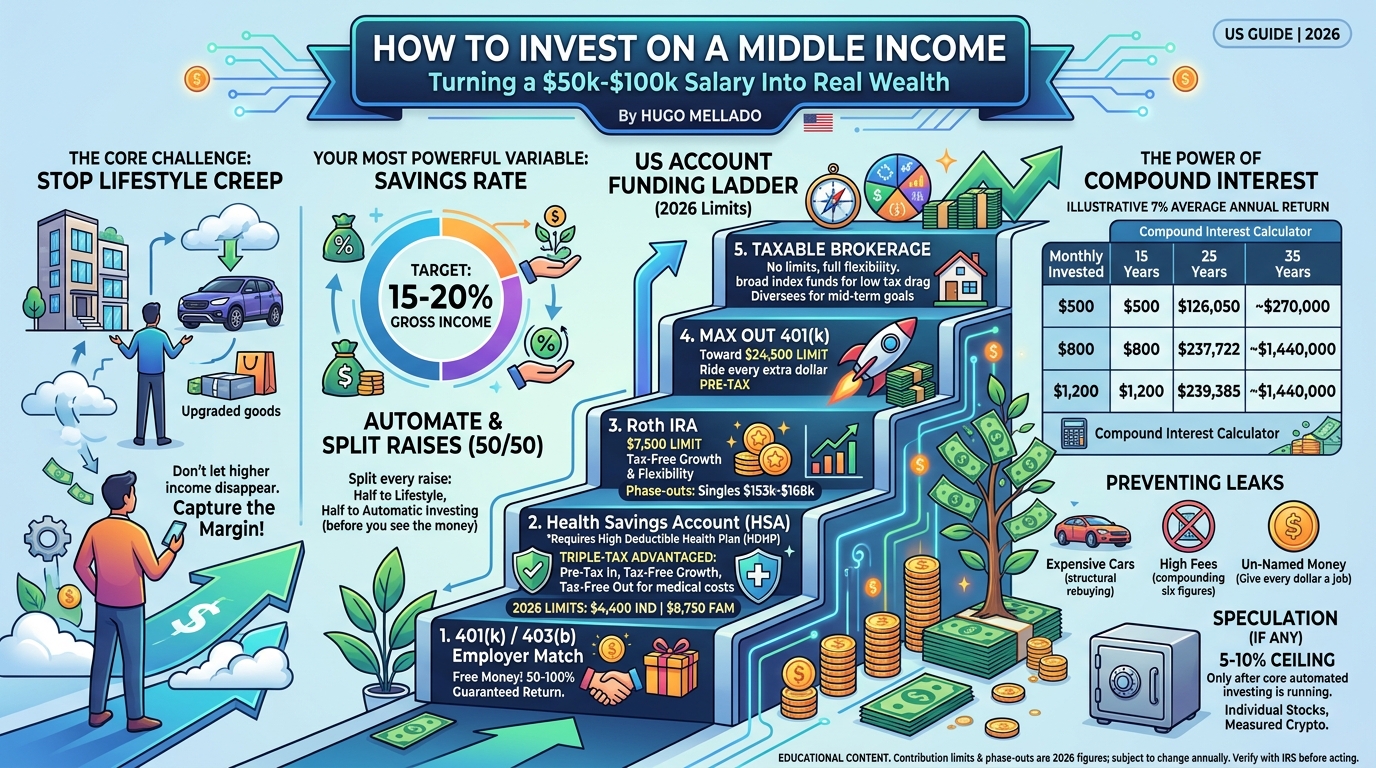
The middle of the American income range — roughly $50,000 to $100,000 a year — is where wealth is either built or quietly leaked. You finally have margin, and the economy is engineered to absorb it: the bigger apartment, the newer car, the upgraded everything. Economists call it lifestyle creep; your future self calls it the missing $400,000. This guide is about capturing that margin deliberately, using the account order that squeezes the most out of every dollar in the US system.
The number that matters: your savings rate
At this income the single most powerful variable is not fund selection — it is the percentage of gross income you invest. Fifteen percent is the standard long-term target; up to 20% if you started late. On $75,000, fifteen percent is $937 a month, which sounds impossible until you notice it usually hides in three places: the raise you absorbed last year, the car payment that could have been a used car, and the tax-advantaged accounts you are not filling. The trick that works: every time your pay rises, split the raise — half to lifestyle, half to the automatic investment, before you meet the money.
The account ladder for 2026
US tax law rewards a specific filling order. Climb it top to bottom each year:
- 1. 401(k) up to the full employer match. The match is a guaranteed 50 to 100% return. Never leave it on the table.
- 2. HSA, if you have a high-deductible health plan. The only triple-advantaged account in the code: deductible going in, growing tax-free, tax-free out for medical costs. 2026 limits: $4,400 individual / $8,750 family.
- 3. Roth IRA, up to $7,500. Tax-free growth and full flexibility of providers and funds. Singles phase out between $153,000 and $168,000 of income in 2026.
- 4. Back to the 401(k), toward its $24,500 limit. Most people never max it — every extra dollar rides pre-tax.
- 5. Taxable brokerage. No limits, no lock-up; broad index funds keep the tax drag low. This is also where medium-term goals (a house in 7 years) can live.
What the middle years are worth
| Monthly invested | 15 years | 25 years | 35 years |
|---|---|---|---|
| $500 | ~$158,000 | ~$405,000 | ~$900,000 |
| $800 | ~$253,000 | ~$648,000 | ~$1,440,000 |
| $1,200 | ~$380,000 | ~$972,000 | ~$2,160,000 |
Two honest caveats about that table. Returns are an average, not a promise — some decades deliver 11%, others 4%, and the sequence is not yours to choose. And inflation means the 35-year numbers buy less than they suggest. Neither caveat changes the ranking: the person who automates $800 a month beats the person who waits for clarity, in almost every version of the future.
Keep the middle from leaking
Three leaks do most of the damage at this income. Cars: the average new-car payment structurally rebought every five years can consume a full percentage point of net worth growth — our loan interest guide shows what long terms really cost. Fees: a 1% advisory fee on index funds you could hold directly compounds into six figures over a career. And un-named money: margin without a job assigned to it evaporates; give every surplus dollar a destination the day it arrives. Your risk allocation itself should come from your actual capacity to hold through a crash — take the honest measure in our risk tolerance guide rather than from a bull-market mood.
Where speculation fits, if anywhere
With the ladder funded, a small speculative slice — individual stocks you believe in, a measured crypto position — is a choice, not a sin. The rule that keeps it safe is sizing: nothing in that slice should be capable of moving your retirement date. Five to ten percent of the portfolio is the ceiling we use across this site, and it goes in only after the boring machine is running by itself.
Educational content, not personalised financial advice. Contribution limits and phase-out ranges cited are the announced 2026 figures and change annually; verify with the IRS before acting.