
Investing · 7 min read
Someone inherits $50,000, or gets a bonus, or finally clears their debt and has cash to deploy. The question arrives immediately: invest it all now, or spread it over the next year? The answer the data gives and the answer most people can live with are not the same, and both deserve explaining.
Defining the Two Strategies
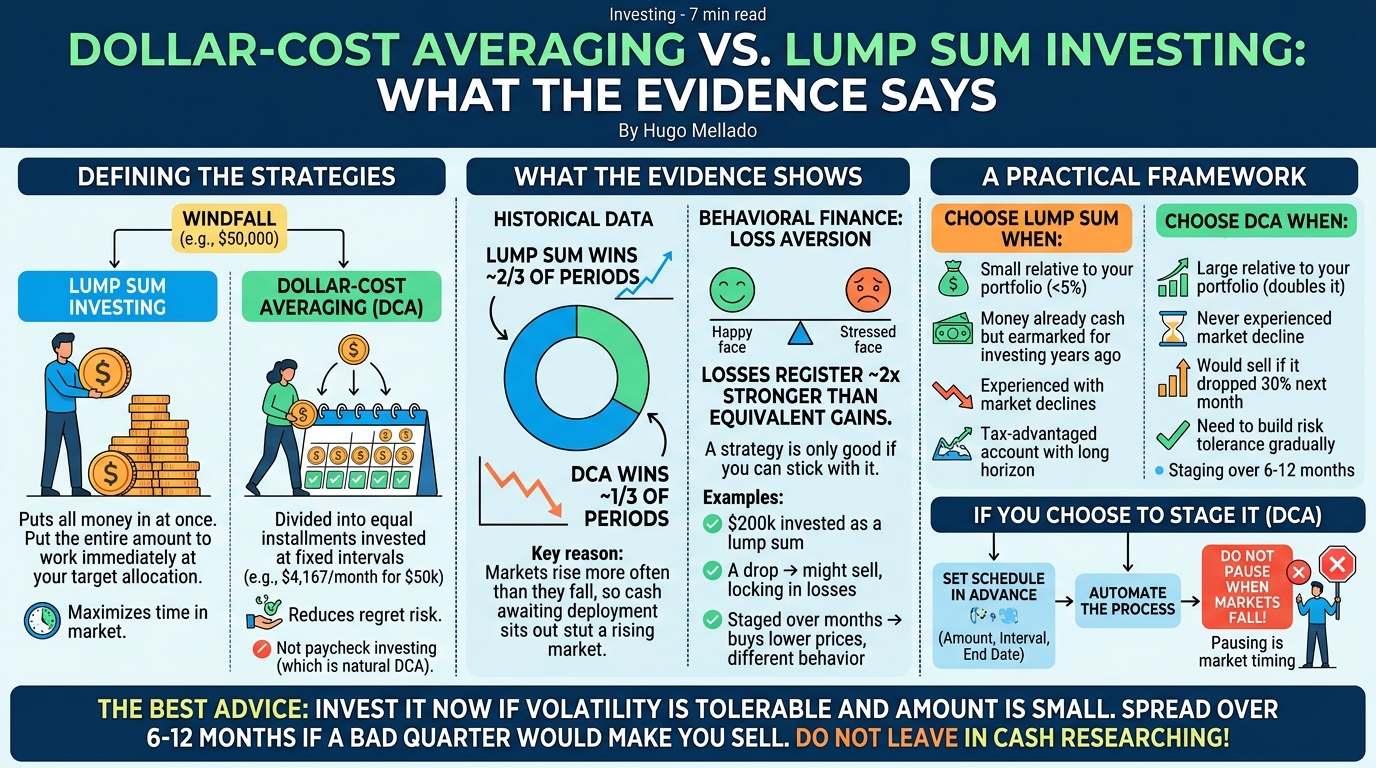
Lump sum investing puts the entire amount to work immediately at your target allocation. Dollar-cost averaging divides it into equal instalments invested at fixed intervals — for example, $50,000 split into twelve monthly purchases of about $4,167.
An important distinction first: if you are investing from each paycheque, you are not choosing between these strategies. You are dollar-cost averaging by necessity, because the money does not exist yet. The debate only applies to a sum you already hold.
What the Evidence Shows
Studies covering long historical periods across multiple markets reach a consistent conclusion: lump sum investing produces higher final balances more often than not, typically in roughly two-thirds of rolling periods.
The reason is unglamorous. Markets rise more often than they fall, so cash awaiting deployment is, on average, sitting out of a rising market. Spreading purchases over twelve months means that, on average, half the money misses roughly half a year of returns.
That average conceals real dispersion. In the one-third of periods where markets fell during the deployment window, dollar-cost averaging came out ahead, sometimes substantially. The strategy that wins on average is not the strategy that wins every time.
The Comparison Table
| Consideration | Lump sum | Dollar-cost averaging |
|---|---|---|
| Historical frequency of higher returns | Wins about two-thirds of periods | Wins about one-third |
| Performance if the market falls early | Worse | Better |
| Time in the market | Maximum immediately | Builds gradually |
| Regret risk | High if a crash follows | High if the market rallies |
| Emotional difficulty | Harder to execute | Easier to execute |
| Requires a market view | No | No, though it often implies one |
The Case for Dollar-Cost Averaging Anyway
The mathematically inferior option is often the practically correct one, for a reason the studies do not capture: a strategy is only as good as your ability to stick with it.
Invest $200,000 as a lump sum, watch a 25% decline over the following three months, and there is a real chance you sell — locking in a loss and, in many cases, staying out of markets for years. Invest it over twelve months, experience the same decline, and your remaining instalments are now buying at lower prices. The second experience produces very different behaviour from the same market.
Behavioural finance has a name for the asymmetry driving this: loss aversion. Losses register roughly twice as strongly as equivalent gains. Paying a small expected return cost to avoid a decision you might not survive is a rational trade, not a failure of nerve.
A Practical Framework
Rather than treating this as ideological, decide based on the specifics.
- Small relative to your portfolio — a bonus worth 5% of your investments — lump sum, since the volatility is barely noticeable
- Large relative to your portfolio — an inheritance that doubles it — consider staging over 6 to 12 months
- Money currently in cash but earmarked for investing years ago — lump sum, since you already accepted this risk
- You have never experienced a market decline with real money invested — staging builds tolerance gradually
- You would sell if it dropped 30% next month — stage it, or reduce your target equity allocation, or both
- Inside a tax-advantaged account with a decades-long horizon — lump sum is the straightforward choice
If You Choose to Stage It
Set the schedule in advance and automate it: the amount, the interval, and the end date. Six to twelve months is the common range, and longer periods increasingly resemble simply holding cash.
The rule that matters most: do not pause the schedule when markets fall. That is precisely when the strategy earns its keep, and pausing converts a disciplined plan into market timing. A staged plan that gets suspended during a decline delivers the worst of both approaches.
What This Is Not
Neither strategy is market timing, and neither requires an opinion about valuations. Waiting for a correction before investing is a third, different choice, and it is the one with the worst historical record — cash held while waiting for a better entry has generally cost investors more than the declines they were avoiding.
Dollar-cost averaging also does not reduce risk in the long run. Once fully invested, both portfolios are identical and carry identical exposure. The strategy only shapes the experience of getting there.
The Answer Most People Should Hear
If you can genuinely tolerate volatility and the amount is not life-changing, invest it now and stop thinking about it. If the amount is large enough that a bad first quarter would rattle you into selling, spread it over the next six to twelve months on a fixed automated schedule.
Either choice beats the option most people actually take, which is leaving it in cash for two years while researching. That is not a strategy — it is a decision being postponed, and it has a cost that compounds like everything else.
Historical frequencies are not predictions. Neither approach eliminates the risk of loss.
Sources and further reading
The explanations above are checked against official regulators, statistical agencies, standards bodies and non-profit financial education organisations. Use these primary sources to verify figures and rules before you act on them.
- U.S. SEC — Beginners’ guide to asset allocation, diversification and rebalancing
- U.S. SEC — Ten things to consider before you make investing decisions
- FRED — Federal Reserve Bank of St. Louis economic data
- OpenStax — “Principles of Economics” (open-access university textbook)
Related reading
- Short-Term vs. Long-Term Investing: A Side-by-Side Comparison
- How to Start Investing With $100: A Step-by-Step Guide for Beginners
- Risk Tolerance: How to Measure Yours Before You Invest a Dollar
This content is for informational and educational purposes only and does not constitute financial, investment or tax advice. Always do your own research, and consider speaking with a licensed professional about your specific situation.