
DeFi · 9 min read
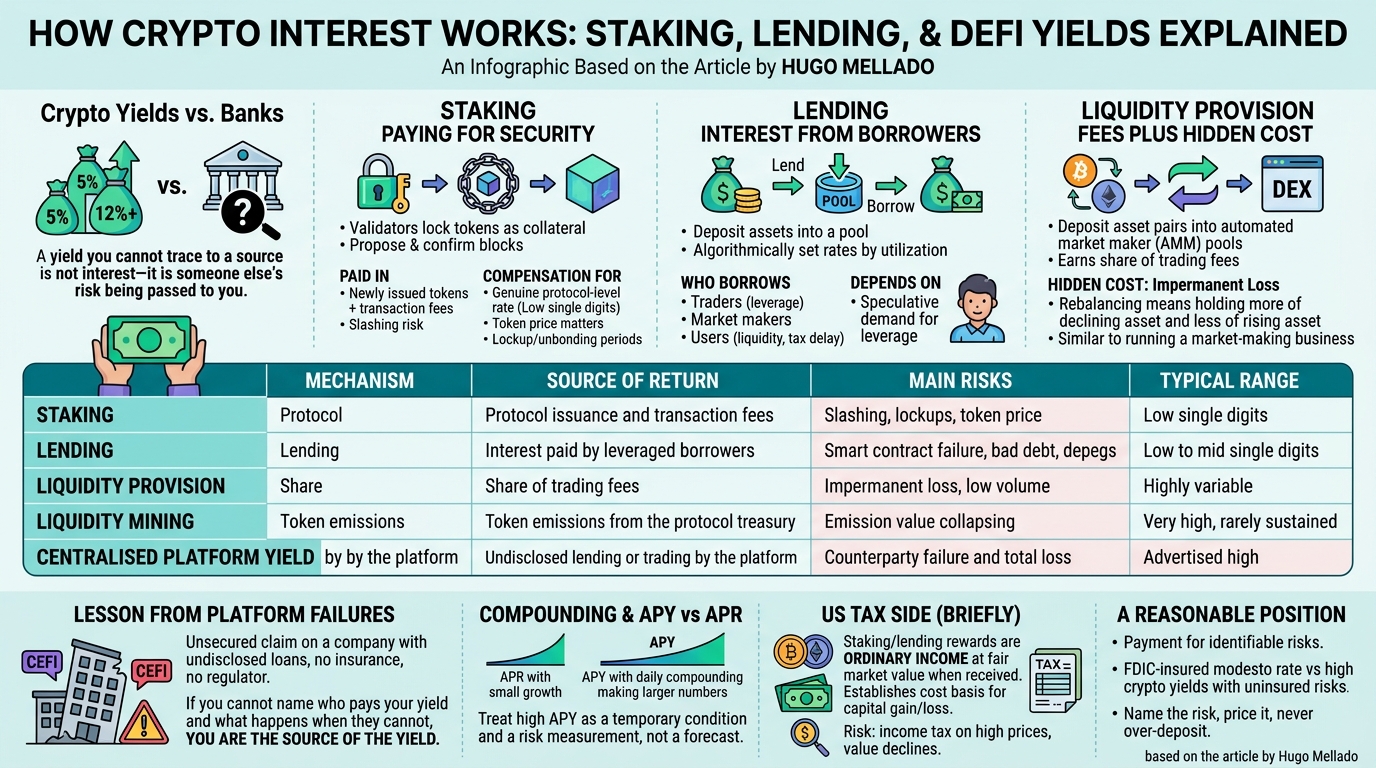
Crypto platforms advertise yields that would be impossible in a bank: 5%, 12%, sometimes far more. The rates are often real. What is rarely explained is where the money comes from, because a yield you cannot trace to a source is not interest — it is someone else’s risk being passed to you.
Here is how each of the main mechanisms actually generates a return, and what breaks in each one.
Staking: Payment for Securing a Network
Proof-of-stake blockchains such as Ethereum require validators to lock up tokens as collateral. Validators propose and confirm blocks, and the protocol pays them in newly issued tokens plus a share of transaction fees. If a validator misbehaves or goes offline, part of the stake can be destroyed — a penalty known as slashing.
Staking yield is therefore compensation for two things: providing capital as security and accepting slashing risk. It is the closest thing in crypto to a genuine protocol-level interest rate, and it typically sits in the low single digits for large networks.
Two caveats matter. The yield is paid in the token, so a 4% staking return on an asset that falls 30% is still a 30% loss in dollar terms. And staked assets are often subject to lockup or unbonding periods during which you cannot sell.
Lending: Interest From Borrowers
On lending protocols, you deposit assets into a pool and borrowers draw from it, posting collateral worth more than they borrow. Rates are set algorithmically by utilisation — the more of the pool is borrowed, the higher the rate paid to suppliers.
This is recognisable interest with an identifiable payer. Who is borrowing, and why? Predominantly traders seeking leverage, market makers, and users who want liquidity without selling a position and triggering a tax event.
That tells you something important about the yield: it depends on speculative demand for leverage. When markets are quiet, borrowing demand falls and yields compress toward nothing. High lending yields are a signal of high leverage appetite, not of a robust business.
Liquidity Provision: Fees Plus a Hidden Cost
Decentralised exchanges pay liquidity providers a share of trading fees for depositing pairs of assets into pools. The advertised annual percentage rate can look extraordinary during periods of heavy volume.
The cost that offsets it is impermanent loss. Because automated market makers rebalance your position mechanically as prices move, you end up holding more of whichever asset declined and less of whichever rose. Compared with simply holding both assets, divergence in their prices produces a shortfall. Fees may exceed it, or may not.
Liquidity provision is closer to running a market-making business than to earning interest. It can be profitable, and it is not passive income in any meaningful sense.
Where the Yield Actually Comes From
| Mechanism | Source of the return | Main risk | Typical range |
|---|---|---|---|
| Staking | Protocol issuance and transaction fees | Slashing, lockups, token price | Low single digits |
| Lending | Interest paid by leveraged borrowers | Smart contract failure, bad debt, depegs | Low to mid single digits |
| Liquidity provision | Share of trading fees | Impermanent loss, low volume | Highly variable |
| Liquidity mining | Token emissions from the protocol treasury | Emission value collapsing | Very high, rarely sustained |
| Centralised platform yield | Undisclosed lending or trading by the platform | Counterparty failure and total loss | Advertised high |
The last two rows deserve attention. Liquidity mining pays you in a protocol’s own newly issued token to attract capital. That is a marketing expense, not a business return, and the headline rate assumes the emitted token holds its value — which frequently it does not once emissions stop.
The Lesson From Platform Failures
Several large centralised crypto lenders offering attractive fixed yields collapsed in 2022, and retail depositors lost access to funds. The mechanism was consistent: platforms took customer deposits, lent them to leveraged trading firms or deployed them into risky strategies, and kept the details private.
Depositors believed they held something like a savings account. They actually held an unsecured claim on a company with an undisclosed loan book, no deposit insurance, and no regulator. When the borrowers failed, so did the platform.
The practical rule that follows: if you cannot name who pays your yield and what happens when they cannot, you are the source of the yield.
Compounding and Autocompounding
Crypto yields often compound frequently, and platforms quote both APR, the simple annualised rate, and APY, which assumes reinvestment. A 100% APR compounded daily becomes roughly 171% APY — mathematically correct and almost never realised, because it assumes the rate persists for a full year, which these rates rarely do.
Treat any APY above ordinary market rates as a temporary condition and a risk measurement rather than a forecast.
Questions to Ask Before Depositing
- Who is the counterparty, and is the arrangement custodial or non-custodial?
- What specific activity generates the yield, described in one sentence?
- Is the yield paid in the asset deposited or in a newly issued token?
- Has the smart contract been audited, and how long has it operated with significant value locked?
- What is the lockup or unbonding period, and what happens if everyone withdraws at once?
- Would a total loss of this deposit change your financial situation materially?
The Tax Side, Briefly
In the United States, staking and lending rewards are generally treated as ordinary income at their fair market value when received, and they then establish a cost basis for a later capital gain or loss when sold. This creates a common and unpleasant surprise: income tax owed on rewards received at high prices, followed by a decline in the value of the tokens used to pay it.
A Reasonable Position
Crypto yields are not fake, and they are not interest in the banking sense. They are payment for specific, identifiable risks — protocol failure, counterparty failure, code exploitation, impermanent loss, and token depreciation. Compared with an FDIC-insured account earning a modest rate, the yield is higher because the risks are real and uninsured.
Judged that way, some of these opportunities are reasonably priced and some are not, but the analysis is always the same: name the risk, price it, and never deposit more than you would accept losing entirely.
Crypto yields carry substantial risk including total loss of deposits. This is educational content, not investment advice, and no platform or protocol is endorsed here.
Sources and further reading
The explanations above are checked against official regulators, statistical agencies, standards bodies and non-profit financial education organisations. Use these primary sources to verify figures and rules before you act on them.
- Ethereum Foundation — Decentralised finance (DeFi)
- Ethereum Foundation — Consensus mechanisms (proof of work and proof of stake)
- U.S. Securities and Exchange Commission — Crypto assets
- Internal Revenue Service — Digital assets
- CFTC — Customer advisories and articles
Related reading
- Understanding DeFi: How Decentralized Finance Is Reinventing Banking
- How Crypto Gains Are Taxed in the U.S.: Short-Term vs. Long-Term Capital Gains
- How Compound Interest Works: The Math Behind Every Financial Decision
This content is for informational and educational purposes only and does not constitute financial, investment or tax advice. Always do your own research, and consider speaking with a licensed professional about your specific situation.