
Guides · 6 min read
Updated September 19, 2026: refreshed with current market data, regulation and network upgrades.
Being right about crypto and still losing money is entirely possible, and portfolio construction is usually the reason. An investor bullish on the asset class in 2021 who happened to concentrate in Terra (LUNA) watched their holdings go to essentially zero while Bitcoin and Ethereum went on to recover. The directional call was fine. The construction was not.
This piece walks through how allocation frameworks are put together and what each decision actually controls. The goal is not to eliminate risk — that is not available here — but to make sure the risk you carry is the risk you chose.
First Decision: How Much Crypto at All
Before arguing about which coins, the more consequential question is what share of total investable assets belongs in the asset class. Three inputs drive that answer.
- Tolerance for drawdown. Could you hold through a 70-80% decline without selling? That is not a hypothetical scenario; it has happened repeatedly.
- Time horizon. Volatility becomes more survivable across five years or more. Short horizons remove your ability to wait out a bad cycle.
- Financial position. Money earmarked for near-term expenses, obligations, or an emergency fund does not belong here at all.
As for the number itself, traditional advisors often discuss single-digit percentages of a broader portfolio, while crypto-native investors frequently hold far more. There is no correct figure in the abstract — only one that fits a specific situation, which is a conversation worth having with a professional rather than a forum.
A Tiered Way to Think About Holdings
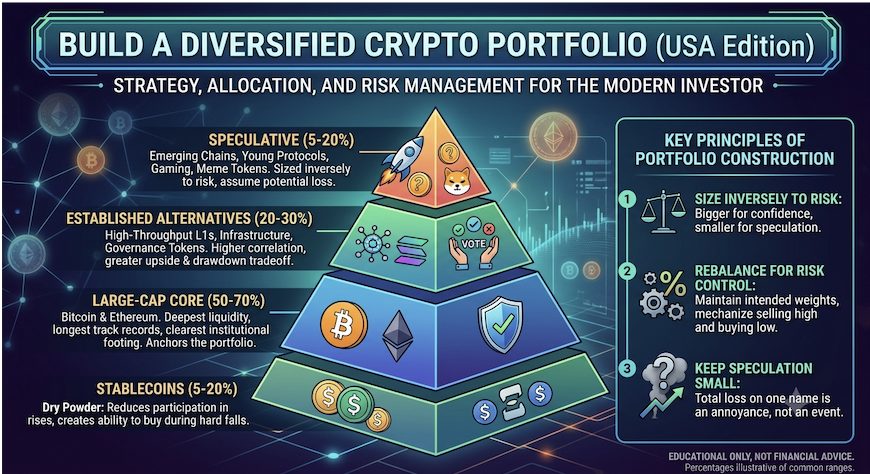
Most structured approaches sort holdings into tiers by role rather than by enthusiasm. The weights below are the ranges that circulate most commonly, shown to illustrate the logic rather than to prescribe an allocation.
Tier 1: Large-Cap Core (roughly 50-70%)
Bitcoin and Ethereum anchor most deliberate portfolios for unglamorous reasons: the deepest liquidity, so positions can be exited without moving the market; the longest track records; the clearest institutional and regulatory footing; and the highest likelihood of simply still existing in ten years. Exchange-traded products now also exist for some larger alternatives: after the SEC approved generic listing standards in September 2025, spot Solana and XRP funds launched in late 2025.
How the tier splits between the two depends on the thesis. Weighting toward Bitcoin expresses a store-of-value view; weighting toward Ethereum expresses a bet on the applications built on top of it. Something near a 60/40 split is a common starting point precisely because it commits to neither view exclusively.
Tier 2: Established Alternatives (roughly 20-30%)
This tier holds large networks with real usage beyond the top two — high-throughput Layer 1s such as Solana, infrastructure like Chainlink, and governance assets of major protocols such as Uniswap and Aave. The tradeoff is consistent: more upside in expansions, deeper drawdowns in contractions, and high correlation to Bitcoin exactly when correlation hurts most.
Tier 3: Speculative (roughly 5-20%)
Emerging chains, young DeFi protocols, gaming tokens, memecoins, whatever narrative is forming. The honest framing is that each individual position may go to zero, and many will. The tier earns its place only if the sizing assumes that outcome: small enough that a total loss on any single name is an annoyance rather than an event, while leaving room for one or two outliers to matter.
Illustrative Profiles
Putting the tiers together produces something like the following. Read these as worked examples of how risk appetite changes the shape of a portfolio, not as recommendations:
| Profile | BTC | ETH | Alt L1s / DeFi | Speculative | Stablecoins |
|---|---|---|---|---|---|
| Conservative | 55% | 30% | 10% | 0% | 5% |
| Balanced | 40% | 25% | 20% | 5% | 10% |
| Aggressive | 25% | 25% | 25% | 15% | 10% |
| Speculative | 15% | 20% | 30% | 25% | 10% |
Rebalancing: The Step Everyone Skips
Assets appreciate at different rates, so a portfolio drifts away from its targets on its own. Restoring the intended weights — trimming what ran, adding to what lagged — does two things that are hard to do by instinct.
First, it mechanizes selling high and buying low, which is the opposite of what emotion suggests during both euphoria and panic. Second, it keeps your risk where you put it: a portfolio that starts at 70% large caps can quietly become 40% after a strong altcoin run, which is a substantial change in risk profile that nobody actually decided to make.
Frequency is a tradeoff rather than a rule. Quarterly or semiannual checks capture most of the benefit while limiting trading costs and the taxable events that every trim creates.
The Tax Dimension
In most jurisdictions every disposal is taxable, and that includes swapping one token for another — selling ETH to buy SOL is a sale, not a reshuffle. Practical consequences: holding periods matter, since long-term gains are typically taxed more lightly than short-term ones; harvesting losses on depreciated positions can offset gains elsewhere; and none of it works without records kept as you go. In the United States, custodial brokers now report digital-asset sales on Form 1099-DA (see the IRS digital assets page for current rules).
Sizing Positions Properly
Equal-sized positions across unequal risks is the most common structural mistake. Three principles usually fix it.
- Size inversely to risk: bigger allocations to the assets you are most confident survive, smaller ones to the speculative tail.
- Count correlation, not names. Most altcoins move with Bitcoin, so adding a tenth altcoin diversifies far less than the position count suggests.
- Keep every speculative position small enough that its complete loss changes nothing important, financially or psychologically.
Holding Stablecoins on Purpose
Keeping a slice of the portfolio in stablecoins — the 5-20% range is typical — is a deliberate tradeoff rather than idle cash. It reduces participation when markets rise, and it creates the ability to buy when they fall hard.
The 2022 decline from roughly $47,000 to $16,000 illustrates the mechanics: the same dollars deployed near the lows bought close to three times as many bitcoin as they would have at the top. Anyone fully invested simply did not have that option. The 2025–26 drawdown makes the same point: from a record near $126,000 in October 2025, Bitcoin fell to a range of $63,000–$65,400 in August 2026 before bouncing to about $78,000 by September 18 (Fortune). Worth noting that stablecoins carry their own risks — issuer, reserve, and regulatory — and are not the same thing as dollars in a bank. The U.S. GENIUS Act (signed July 18, 2025) created a federal framework for payment stablecoins, and Treasury’s proposed implementing rule was published on August 18, 2026, but that does not make them insured like bank deposits.
The Bottom Line
A portfolio is a set of decisions made in advance so that fewer decisions have to be made under pressure. Choose the exposure, define the tiers, size positions against their real risk, decide when you will rebalance, and write it down. What separates durable portfolios from wreckage is rarely asset selection — it is whether the structure was chosen deliberately or arrived at by accident.
This content is for informational and educational purposes only and does not constitute financial or investment advice. Crypto assets are highly volatile and you can lose your entire investment. Consult a qualified professional about your own circumstances.
Sources and further reading
The explanations above are checked against official regulators, statistical agencies, standards bodies and non-profit financial education organisations. Use these primary sources to verify figures and rules before you act on them.
- U.S. SEC — Beginners’ guide to asset allocation, diversification and rebalancing
- FINRA — Investing basics: understanding risk
- U.S. Securities and Exchange Commission — Crypto assets
- U.S. SEC — Ten things to consider before you make investing decisions
- FXStreet — SEC approves generic listing standards for crypto ETFs (September 18, 2025)
- Federal Register — GENIUS Act regulations on payment stablecoin issuance (August 18, 2026)
- IRS — About Form 1099-DA
- Fortune — Price of Bitcoin, September 18, 2026
Related reading
- Bitcoin vs. Ethereum: Which Is the Better Long-Term Investment?
- Understanding Crypto Market Cycles: Bull Markets, Bear Markets, and Everything Between
- The Best Crypto Exchanges: A Complete Comparison Guide
This content is for informational purposes only and does not constitute financial advice. Cryptocurrency investments carry high risk — always do your own research.