
Loans & Credit · 9 min read
A mortgage is the largest interest calculation most Americans will ever participate in. On a 30-year loan, the interest paid over the full term frequently approaches or exceeds the amount borrowed. Small differences in structure are therefore not small at all.
This is a plain-language walk through how mortgage interest is calculated, what the options actually cost, and which decisions deserve real attention.
How the Payment Is Built
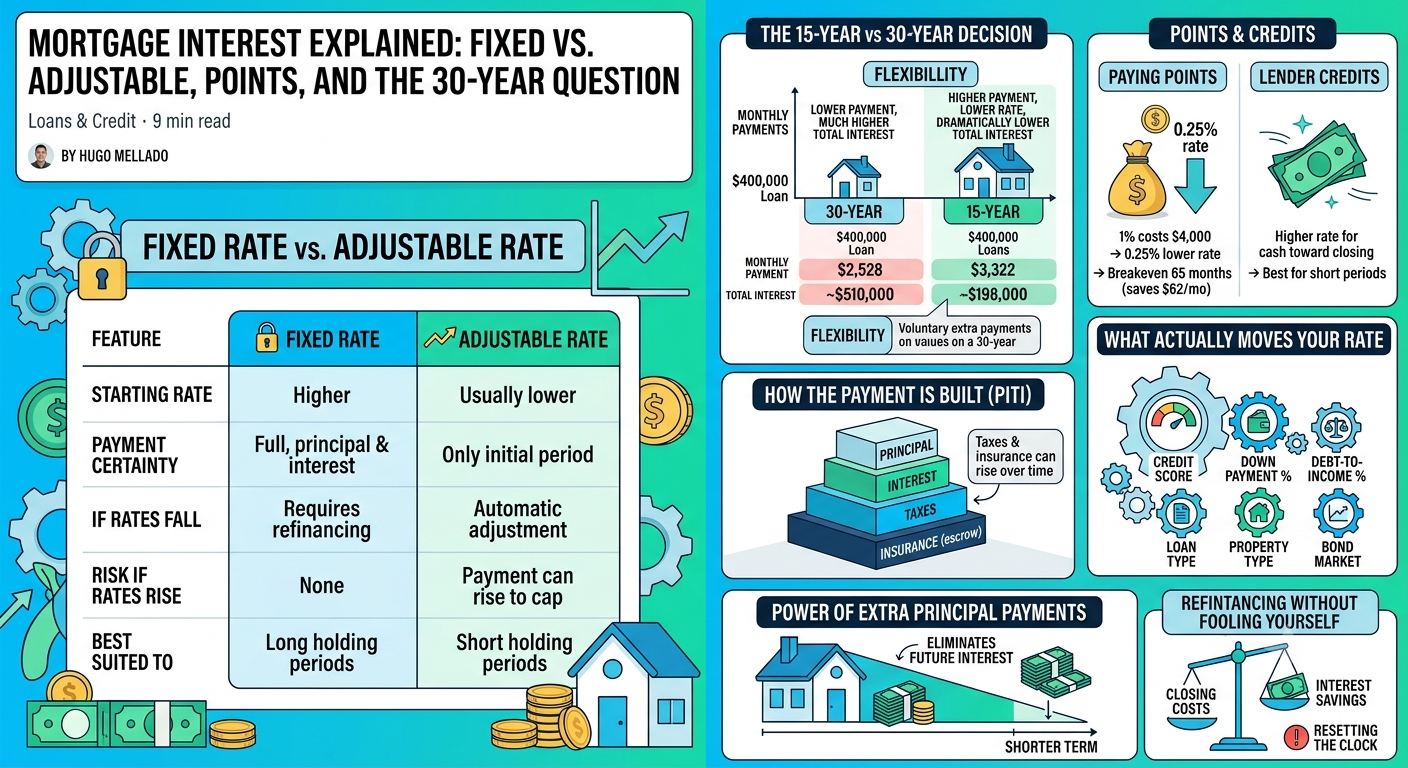
A standard monthly payment has four parts, often abbreviated PITI: principal, interest, taxes, and insurance. Only the first two repay the loan. Property taxes and homeowners insurance are usually collected into an escrow account and paid out on your behalf, and they rise over time even on a fixed-rate loan — which is why “fixed payment” is never quite fixed.
Interest is calculated on the outstanding balance. Because the balance starts high, early payments are overwhelmingly interest. On a $400,000 loan at 6.5%, the payment is about $2,528 and the first month sends roughly $2,167 to interest.
Fixed Rate Versus Adjustable Rate
A fixed-rate mortgage locks your rate for the entire term. You pay slightly more at the outset for the certainty that no rate environment can raise your payment.
An adjustable-rate mortgage, commonly written as 5/1, 7/1, or 10/1, holds an introductory rate for the first period and then adjusts periodically against an index plus a margin. Adjustments are bounded by caps: an initial cap on the first change, a periodic cap on each subsequent change, and a lifetime cap on the total move.
| Feature | Fixed rate | Adjustable rate |
|---|---|---|
| Starting rate | Higher | Usually lower |
| Payment certainty | Full, for principal and interest | Only during the initial period |
| Benefit if rates fall | Requires refinancing | Automatic at adjustment |
| Risk if rates rise | None | Payment can rise to the cap |
| Best suited to | Long holding periods | Short holding periods or expected payoff |
The honest way to evaluate an ARM is to calculate the payment at the lifetime cap and ask whether your budget survives it. If the answer is no, the lower introductory rate is a risk you cannot afford, regardless of how likely the bad scenario seems.
Discount Points
One point costs 1% of the loan amount and buys a permanently lower rate, typically around 0.25% per point though it varies. On a $400,000 loan, one point costs $4,000.
Evaluate points with a breakeven calculation: divide the upfront cost by the monthly payment savings. If a point saves $62 a month, breakeven arrives in about 65 months. Keep the loan longer than that and points paid off. Sell or refinance sooner and you donated the money.
Lender credits work in reverse — you accept a higher rate in exchange for cash toward closing costs. That trade favours people who expect to move or refinance within a few years.
The 15-Year Versus 30-Year Decision
Shorter terms carry lower rates and dramatically lower total interest, at the cost of a much higher required payment. On $400,000, a 15-year loan at 5.75% costs about $3,322 a month, while a 30-year at 6.5% costs about $2,528. The 15-year total interest is roughly $198,000 against roughly $510,000 for the 30-year.
That comparison makes the 15-year look obvious, and for many households it is. The counterargument is flexibility: a 30-year mortgage with voluntary extra principal payments achieves much of the same result while leaving you the option to pay only the minimum in a bad year. The 15-year removes that option permanently in exchange for a lower rate.
Private Mortgage Insurance
With a conventional loan and less than 20% down, lenders generally require private mortgage insurance, which protects the lender and does nothing for you. It typically costs between 0.3% and 1.5% of the loan amount annually.
PMI on conventional loans can usually be removed once you reach roughly 20% equity, either automatically as the balance amortizes or by request, sometimes with a new appraisal. FHA loans handle mortgage insurance differently, and on many FHA loans the premium lasts for the life of the loan, which changes the math on choosing FHA over conventional.
What Actually Moves Your Rate
- Credit score, where the difference between 680 and 780 can be a meaningful fraction of a percentage point
- Down payment size, which lowers the loan-to-value ratio and the lender risk
- Debt-to-income ratio, generally scrutinised heavily above roughly 43%
- Loan type and size, since conforming, jumbo, FHA and VA loans price differently
- Property type and occupancy, as investment properties and second homes carry premiums
- Broad bond market conditions, which set the baseline for everyone
Extra Principal Payments
Because interest accrues on the balance, principal reductions early in the loan eliminate decades of future interest. On the $400,000 example, an extra $300 a month removes roughly seven years from the term and a large share of lifetime interest.
Two practical notes. Tell the servicer in writing to apply extra funds to principal, not to the next scheduled payment. And weigh the guaranteed savings against alternatives: prepaying a 6.5% mortgage is a guaranteed 6.5% return, which is attractive but not automatically better than maxing tax-advantaged retirement accounts or clearing a 22% credit card first.
Refinancing Without Fooling Yourself
Refinancing makes sense when the interest savings outweigh the closing costs within a period you will realistically stay in the home. The trap is resetting a loan you have been paying for eight years back to a fresh 30-year term — the monthly payment falls, the total cost often rises, and you return to the interest-heavy start of the schedule.
Cash-out refinancing converts home equity into spendable money and into a larger loan. It is occasionally sensible, for example to eliminate far more expensive debt, and frequently a way to finance consumption over thirty years at the cost of your house.
The Number to Focus On
Lenders quote monthly payments because that is the number that determines whether you say yes. The numbers that determine whether the loan was a good idea are the total of all payments, the interest paid over the years you will actually hold the loan, and whether the payment still works if your income drops. Ask for all three before signing anything.
Illustrative examples only. Loan programs, insurance rules and rates vary by lender, state and borrower profile.
Sources and further reading
The explanations above are checked against official regulators, statistical agencies, standards bodies and non-profit financial education organisations. Use these primary sources to verify figures and rules before you act on them.
- CFPB — Mortgages
- CFPB — Owning a Home: mortgage process and rate tools
- Freddie Mac — Primary Mortgage Market Survey
- eCFR — Title 12, Part 1026: Truth in Lending (Regulation Z)
- Federal Reserve — H.15 Selected Interest Rates
Related reading
- How Loan Interest Really Works: APR, Amortization, and the True Cost of Borrowing
- How Compound Interest Works: The Math Behind Every Financial Decision
- How to Save Money in the United States: A System That Actually Works
This content is for informational and educational purposes only and does not constitute financial, investment or tax advice. Always do your own research, and consider speaking with a licensed professional about your specific situation.