
Investing · 7 min read
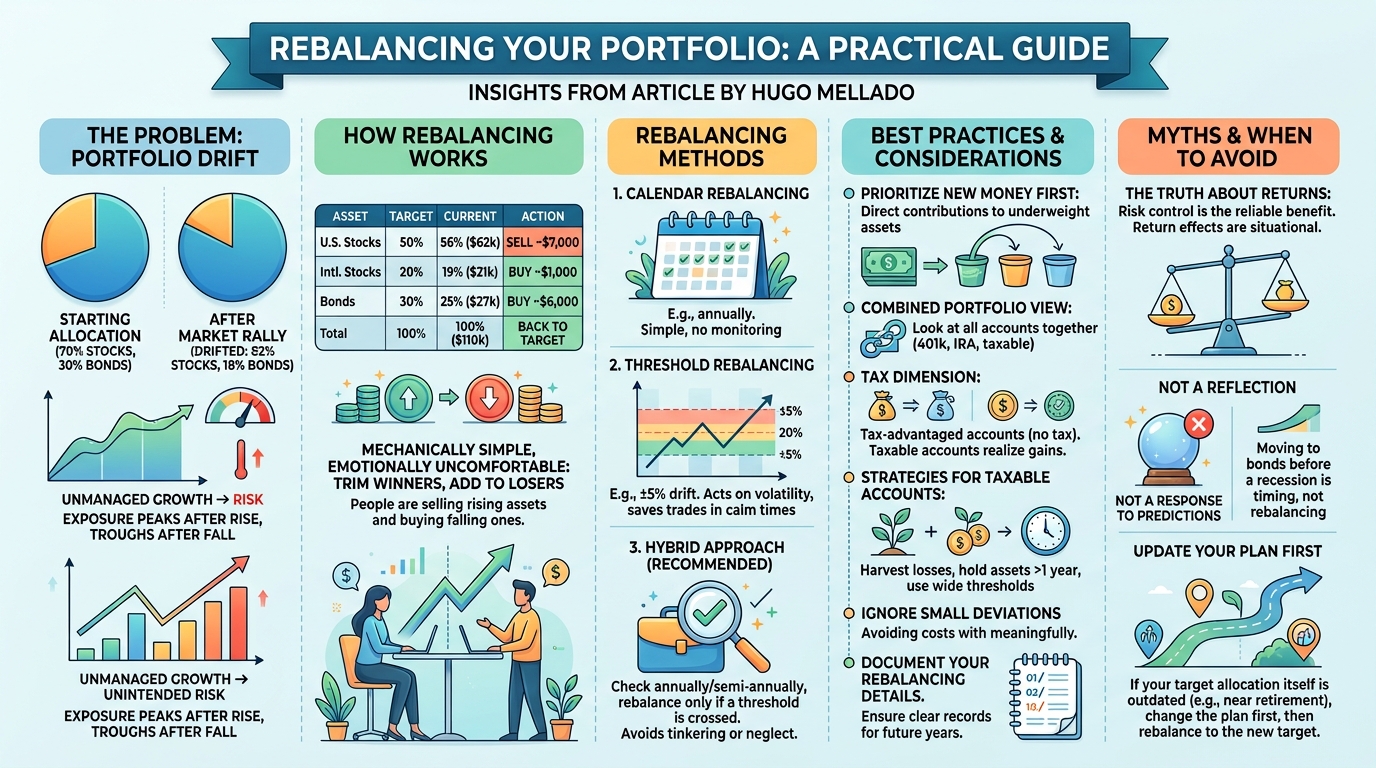
You choose an allocation of 70% stocks and 30% bonds. Two years later, stocks have run and you are holding 82% stocks. You did not decide to take more risk — the market decided for you. Rebalancing is the act of taking that decision back.
Why Drift Is a Problem
Drift is not a technicality. It systematically increases risk precisely when risk is most expensive. Portfolios drift toward whatever has performed best, meaning your exposure to an asset class peaks after it has already risen and troughs after it has already fallen.
An investor who chose a 60/40 split a decade ago and never rebalanced would have entered subsequent downturns with a considerably higher equity weight than intended, and taken losses larger than the plan called for. The allocation you wrote down stops describing the portfolio you own within a year or two.
How Rebalancing Works
Sell some of what has grown beyond its target, buy what has fallen below it, and return to the intended weights. Mechanically simple. Emotionally uncomfortable, because it always means trimming your winners and adding to your losers.
| Asset | Target | Current value | Current weight | Action |
|---|---|---|---|---|
| U.S. stocks | 50% | $62,000 | 56% | Sell about $7,000 |
| International stocks | 20% | $21,000 | 19% | Buy about $1,000 |
| Bonds | 30% | $27,000 | 25% | Buy about $6,000 |
| Total | 100% | $110,000 | 100% | Back to target |
Note what this accomplishes without any forecast: it sold high and bought low, entirely as a byproduct of following a rule.
Two Approaches
Calendar rebalancing checks the portfolio on a fixed schedule — annually is the most common and generally sufficient. It is simple, requires no monitoring, and works well for anyone who would rather not think about it.
Threshold rebalancing acts when any asset class drifts more than a set amount from target, commonly five percentage points in absolute terms or 25% in relative terms. It responds to actual market movement rather than the calendar, which means it acts during volatile periods when rebalancing has the most value and stays quiet during calm ones.
The hybrid most practitioners settle on: check once or twice a year, and rebalance only if something has drifted past your threshold. This avoids both constant tinkering and years of neglect.
Rebalance With New Money First
If you are still contributing, most rebalancing can happen without selling anything. Direct new contributions toward whichever asset class is underweight. In a growing portfolio, this alone often keeps allocations close to target for years.
In retirement, the reverse applies: take withdrawals from whatever is overweight. Both approaches avoid transaction friction and, in taxable accounts, avoid triggering gains.
The Tax Dimension
Inside a 401(k), IRA, or other tax-advantaged account, rebalancing has no tax consequences. Sell and buy as your rule dictates.
In a taxable account, selling appreciated assets realises capital gains. Several tactics reduce the cost: rebalance primarily inside tax-advantaged accounts while treating all your holdings as one combined portfolio, direct dividends and new contributions to underweight assets, harvest losses when available to offset gains, and prefer selling lots held more than a year to qualify for long-term rates.
If a rebalance in a taxable account would trigger a large gain, widening your threshold is often the better answer. The tax bill is certain; the benefit of a precise allocation is not.
Does Rebalancing Increase Returns?
This is frequently oversold. The primary and reliable benefit of rebalancing is risk control — keeping the portfolio volatility and drawdown profile close to what you signed up for. Return effects are situational.
In markets that oscillate, rebalancing can add modest return by systematically buying declines. In markets with long sustained trends, rebalancing away from the winning asset reduces return compared with letting it ride. Over long periods with mixed conditions the return effect is small and can go either way. The risk effect, by contrast, is consistent, and it is the real reason to do it.
Practical Rules Worth Adopting
- Pick one method — annual, threshold, or the hybrid — and write it into your plan so the decision is already made
- Use new contributions as the first rebalancing tool before selling anything
- Look at all accounts together as a single portfolio rather than balancing each one separately
- Keep the underlying funds broad, since rebalancing cannot fix a portfolio built from overlapping narrow bets
- Ignore small deviations, because rebalancing for a two-point drift creates costs without meaningful benefit
- Record the date and the resulting weights each time, so next year starts from facts
When Not to Rebalance
If your target allocation itself no longer fits — you are five years from retirement holding a portfolio built for a thirty-year horizon — the answer is to change the target, not to rebalance back to an outdated one. Rebalancing enforces a plan; it does not evaluate whether the plan is still right.
Equally, do not rebalance in response to predictions. Moving to bonds because you expect a recession is not rebalancing, it is market timing wearing a respectable name. The entire value of the discipline comes from following the rule regardless of your opinion about what happens next.
General educational information. Tax consequences depend on your accounts and jurisdiction — consider professional advice before selling appreciated assets.
Sources and further reading
The explanations above are checked against official regulators, statistical agencies, standards bodies and non-profit financial education organisations. Use these primary sources to verify figures and rules before you act on them.
- U.S. SEC — Beginners’ guide to asset allocation, diversification and rebalancing
- FINRA — Investing basics: understanding risk
- FINRA — Exchange-traded funds and products
- FRED — Federal Reserve Bank of St. Louis economic data
Related reading
- How to Plan a Stock Portfolio: Asset Allocation From Scratch
- Risk Tolerance: How to Measure Yours Before You Invest a Dollar
- Brokerage Accounts, IRAs, and 401(k)s: Which Should You Open First?
This content is for informational and educational purposes only and does not constitute financial, investment or tax advice. Always do your own research, and consider speaking with a licensed professional about your specific situation.