
Regulation · 8 min read
Published September 19, 2026. Covers Form 1099-DA as it applies to 2025 transactions and the first phase-in of cost-basis reporting in 2026.
If you sold, swapped or spent crypto through a U.S. exchange in 2025, you may have received a new tax form early in 2026: Form 1099-DA. It is the first IRS information return built specifically for digital assets, and it changes one thing that used to be entirely on you. The IRS now receives a copy of what your broker says you sold. It does not change what is taxable, and it does not fill in your tax return for you.
What Form 1099-DA Is
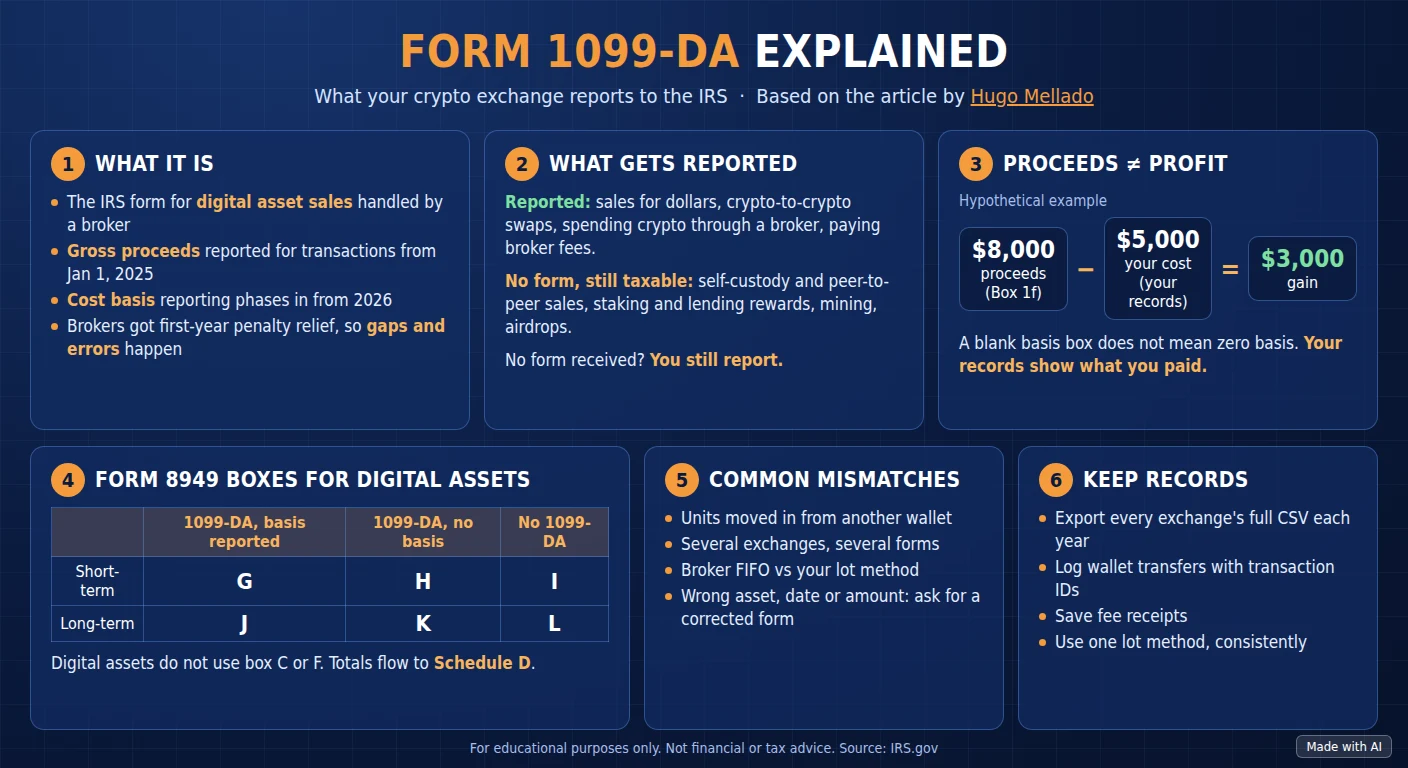
Form 1099-DA, titled Digital Asset Proceeds From Broker Transactions, is the digital-asset counterpart of the Form 1099-B that stock brokers send. Under the IRS final broker-reporting regulations, brokers report gross proceeds for transactions on or after January 1, 2025, and begin reporting cost basis for certain transactions in 2026. In practice, that means many forms you received for 2025 show what you sold and what you received for it, but leave the cost basis blank or incomplete.
The IRS also gave brokers good-faith penalty relief for the first reporting year, so it is reasonable to expect some forms to contain gaps or errors. Treat the form as one input to your return, not as the final word on it.
Which Transactions Get Reported
According to the IRS broker reporting FAQs, a broker reports sales it effects for its customers. That covers more than selling for dollars:
- Selling digital assets for U.S. dollars or another currency.
- Exchanging one digital asset for another, including swaps into stablecoins.
- Using digital assets to pay for goods or services through a broker.
- Using digital assets to pay the broker’s own transaction costs.
Several things do not produce a Form 1099-DA. Buying crypto with dollars is an acquisition, not a disposal, so nothing is reported. A custodial transfer between platforms that is not a sale is not a reportable sale either. Activity in your own wallet or on decentralized protocols generally involves no broker, so no form arrives, and the IRS has temporarily exempted certain activity such as staking, lending and wrapping from broker reporting while it works on further guidance. None of that makes those transactions tax-free. The IRS states plainly that whether or not you receive a Form 1099-DA, you must report all income, gains and losses from digital asset transactions on your return.
Reading the Form, Box by Box
The layout below follows the IRS instructions for Form 1099-DA. Each sale or disposal appears on its own line, so an active trader can receive a long form.
| Box | What it shows | What to check |
|---|---|---|
| 1a | Code identifying the digital asset | That it matches the asset you actually sold |
| 1b | Name of the digital asset | Ticker or name is what you expect |
| 1c | Number of units | Matches the exact units in your own records |
| 1d | Date acquired | May be blank or incomplete if the units came from another platform or wallet |
| 1e | Date sold | Determines whether the gain is short-term or long-term |
| 1f | Proceeds | Gross amount; fees may or may not already be netted out |
| 1g | Cost or other basis | Only filled in when the broker knows and reports it |
| 2 | Whether basis was reported to the IRS | Decides which Form 8949 box you use |
| 4 | Federal income tax withheld | Backup withholding, if any, that you can credit on your return |
Proceeds Are Not Profit
The most common misreading is treating Box 1f as your gain. Proceeds are only one side of the calculation. Consider this hypothetical example: your Form 1099-DA shows a sale with proceeds of $8,000 and no cost basis. Your own records show you paid $5,000 for those units, fees included, fourteen months before the sale. Your gain is $3,000 and it is long-term. If you entered $8,000 as the gain because the basis box was empty, you would be reporting $5,000 of gain that never existed.
This is why the records you keep matter more, not less, now that brokers report. The form tells the IRS what you received. Only your records show what you paid. For how gains and holding periods are taxed once you have the numbers, see our guide to how crypto gains are taxed in the U.S..
From the Form to Form 8949
Sales and exchanges are reported on Form 8949 and then summarized on Schedule D. For 2025, the Form 8949 instructions added separate checkboxes for digital assets, and they say digital asset transactions should not be reported using box C or F. Which box you use depends on the holding period and on what the broker reported.
| Holding period | Form 1099-DA received, basis reported to the IRS | Form 1099-DA received, basis not reported | No Form 1099-DA received |
|---|---|---|---|
| Short-term (Part I) | Box G | Box H | Box I |
| Long-term (Part II) | Box J | Box K | Box L |
For each transaction, column (a) asks for the name or symbol of the digital asset and the exact units sold, along with the transaction ID when available.
What Is Not on the Form but Is Still Reportable
A Form 1099-DA covers dispositions handled by a broker. Other digital asset events can still create taxable income or gains that you report yourself: staking and lending rewards, mining income, airdrops, crypto received as payment, and sales made outside a broker, such as peer-to-peer trades. Our article on how interest works in crypto explains how reward income is generally treated. Sales through a foreign platform may not produce a Form 1099-DA at all, since the IRS notes that for 2025 the filing requirements generally apply to U.S. brokers.
Common Mismatches and What They Usually Mean
- Units moved in from another platform or wallet. The broker often cannot know what you originally paid, so basis may be blank even though you have it in your records.
- Several exchanges, several forms. Each broker sees only its own activity, so no single form shows your full picture for the year.
- A different lot method. If a broker applies its default (first-in, first-out) while your records use specific identification, the lots and gains will not match. The IRS FAQs say brokers apply FIFO when units are not specifically identified, and that customers can request that particular lots be sold.
- A form that looks wrong. If the asset, date or amount does not match your records, ask the broker for a corrected form rather than ignoring the difference.
- No form at all. You still report the transactions. The absence of a form is not the absence of a tax obligation.
A Simple Record-Keeping Routine
- Download the full transaction history (CSV) from every exchange each year, before the tax season, since platforms change formats and some shut down.
- Log transfers between your own wallets and exchanges with dates, amounts and transaction IDs, so you can show that a transfer was not a sale.
- Save fee receipts and note which lot method you use, and apply it consistently.
- Keep everything with your return for as long as the return could be examined; the IRS record-keeping guidance explains the time periods.
The Practical Takeaway
Form 1099-DA makes crypto reporting look more like stock reporting: the broker sends the IRS its version of your sales, and your return should be able to reconcile with it. The parts that remain your responsibility are the parts that were always yours: knowing what you paid, knowing when you acquired it, and keeping the evidence. A tax professional can help if your activity spans several platforms, wallets or years.
Tax rules change and depend on your individual circumstances. This is general information, not tax advice — consult a qualified tax professional.
Sources and further reading
The explanations above are checked against official regulators, statistical agencies, standards bodies and non-profit financial education organisations. Use these primary sources to verify figures and rules before you act on them.
- Internal Revenue Service — Understanding your Form 1099-DA
- Internal Revenue Service — About Form 1099-DA, Digital Asset Proceeds From Broker Transactions
- Internal Revenue Service — Instructions for Form 1099-DA
- Internal Revenue Service — Frequently asked questions about broker reporting
- Internal Revenue Service — Final regulations and related guidance for reporting by brokers on sales and exchanges of digital assets
- Internal Revenue Service — Instructions for Form 8949
- Internal Revenue Service — Digital assets
Related reading
- How Crypto Gains Are Taxed in the U.S.: Short-Term vs. Long-Term Capital Gains
- Cryptocurrency Taxes: What Every Investor Needs to Know
- How Interest Works in Crypto: Staking, Lending, and DeFi Yields Explained
This content is for informational and educational purposes only and does not constitute financial, investment or tax advice. Always do your own research, and consider speaking with a licensed professional about your specific situation.