
A six-figure salary in the United States solves the problem of not having money and quietly introduces a new one: not converting it. High earners routinely arrive at 40 with impressive incomes, expensive fixed costs, a pile of unvested stock, and surprisingly little that works without them. Income is not wealth; it is the raw material. This guide covers the conversion — and the mistakes that are specific to earning a lot.
Why high earners fall behind
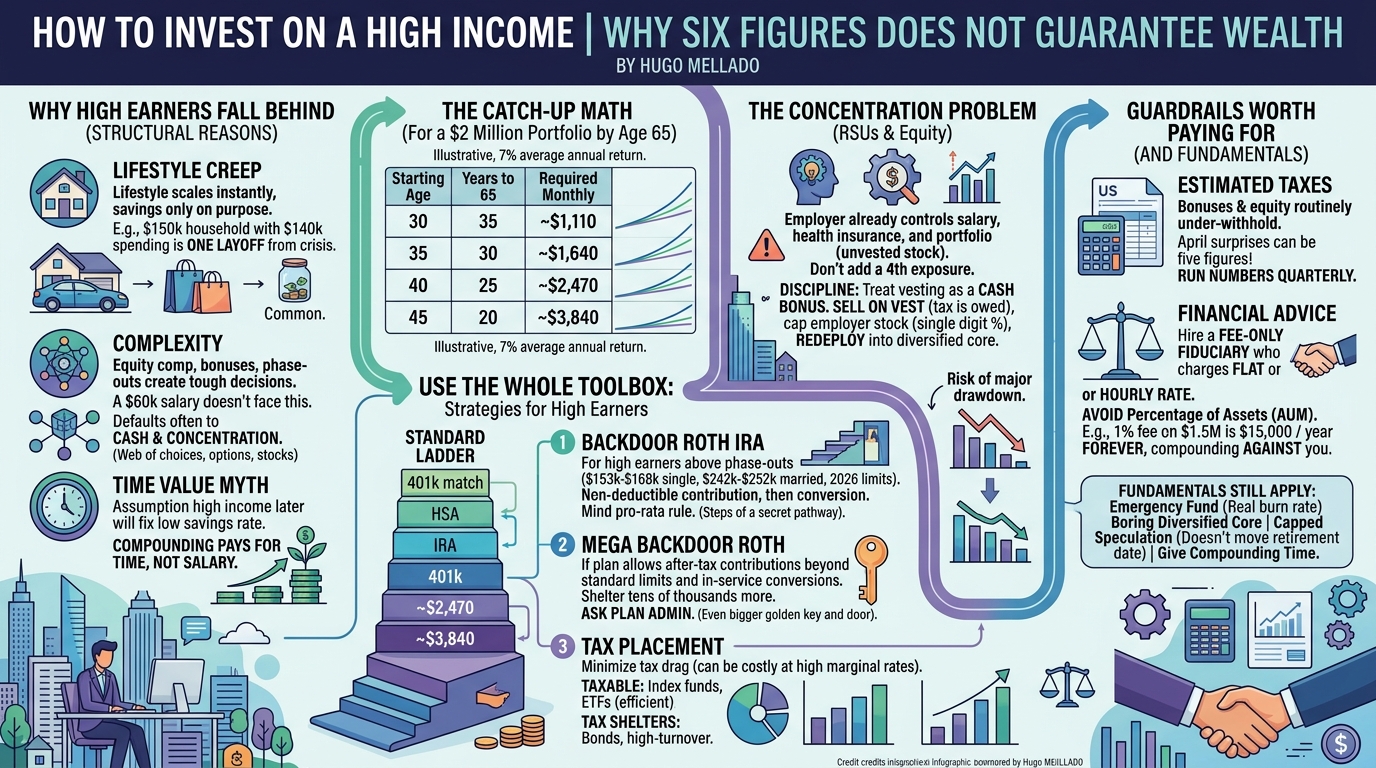
Three structural reasons. First, lifestyle scales instantly and savings only scale on purpose — the $150,000 household with $140,000 of annual spending is one layoff from crisis, and it is common. Second, complexity: equity compensation, bonuses and phase-outs create decisions that a $60,000 salary never faces, and unmade decisions default to cash and concentration. Third, the quiet assumption that a high income later will fix a low savings rate now — but compounding pays for time, not for salary, as the catch-up table below shows.
The catch-up math
Suppose the goal is a $2 million portfolio by 65 — roughly $80,000 a year of sustainable withdrawals under the classic 4% guideline. At a 7% average return, the required monthly investment depends brutally on when you start:
| Starting age | Years to 65 | Required monthly |
|---|---|---|
| 30 | 35 | ~$1,110 |
| 35 | 30 | ~$1,640 |
| 40 | 25 | ~$2,470 |
| 45 | 20 | ~$3,840 |
Use the whole toolbox
At this income the standard ladder — 401(k) match, HSA, IRA, max 401(k), taxable — still applies, with three additions:
- The backdoor Roth IRA. Above the 2026 phase-out ($153,000 to $168,000 single; $242,000 to $252,000 married filing jointly) you cannot contribute to a Roth directly — but a non-deductible traditional IRA contribution followed by a conversion is a long-established, IRS-reported route. Mind the pro-rata rule if you hold pre-tax IRA balances, and consider professional help the first time.
- The mega backdoor Roth, if your plan allows it. Some 401(k) plans accept after-tax contributions beyond the $24,500 employee limit with in-plan conversion; it can shelter tens of thousands more per year. Ask your plan administrator two questions: after-tax contributions, and in-service conversions.
- Tax placement. In the taxable account, broad index funds and ETFs are naturally tax-efficient; bonds and high-turnover strategies belong inside the tax shelters. At a 35% marginal rate, tax drag is a real expense line.
The concentration problem
If part of your pay arrives as RSUs or options, your employer already controls your salary, your health insurance and a slice of your portfolio. Letting vested shares accumulate adds a fourth exposure to the same company. The discipline used by most advisors: treat vesting shares as a cash bonus — sell on vest (RSU tax is owed at vest anyway), keep at most a capped single-digit percentage of your portfolio in employer stock, and redeploy into the diversified core. It will feel disloyal exactly until the first 40% drawdown in your sector.
Guardrails worth paying for
Two boring items protect everything above. Estimated taxes: bonuses and equity events routinely under-withhold; an April surprise at this income is a five-figure surprise, so run the numbers quarterly. And advice: if you want help, hire a fee-only fiduciary who charges a flat or hourly rate — not a percentage of assets wrapped around index funds you could hold yourself. A 1% fee on a $1.5 million portfolio is $15,000 a year, forever, compounding against you. Meanwhile the fundamentals from the rest of this site do not change with income: an emergency fund sized to your real burn rate, a boring diversified core, speculation capped at a size that cannot move your retirement date, and compounding given the years it needs.
Educational content, not personalised financial or tax advice. Backdoor and mega backdoor strategies have plan-specific and situation-specific pitfalls; the figures cited are announced 2026 limits. Consult a qualified professional for your case.