
Personal Finance · 8 min read
Cutting expenses has a bad reputation because most advice targets the wrong things. Skipping coffee saves a few dollars and costs you a small pleasure every day, which is why nobody sustains it. Renegotiating an insurance policy takes one afternoon, saves several hundred dollars a year, and costs you nothing at all afterwards.
The distinction is between recurring effort and one-time structural changes. What follows focuses on the second kind, roughly in order of dollars saved per hour spent.
Insurance: The Largest Overlooked Line
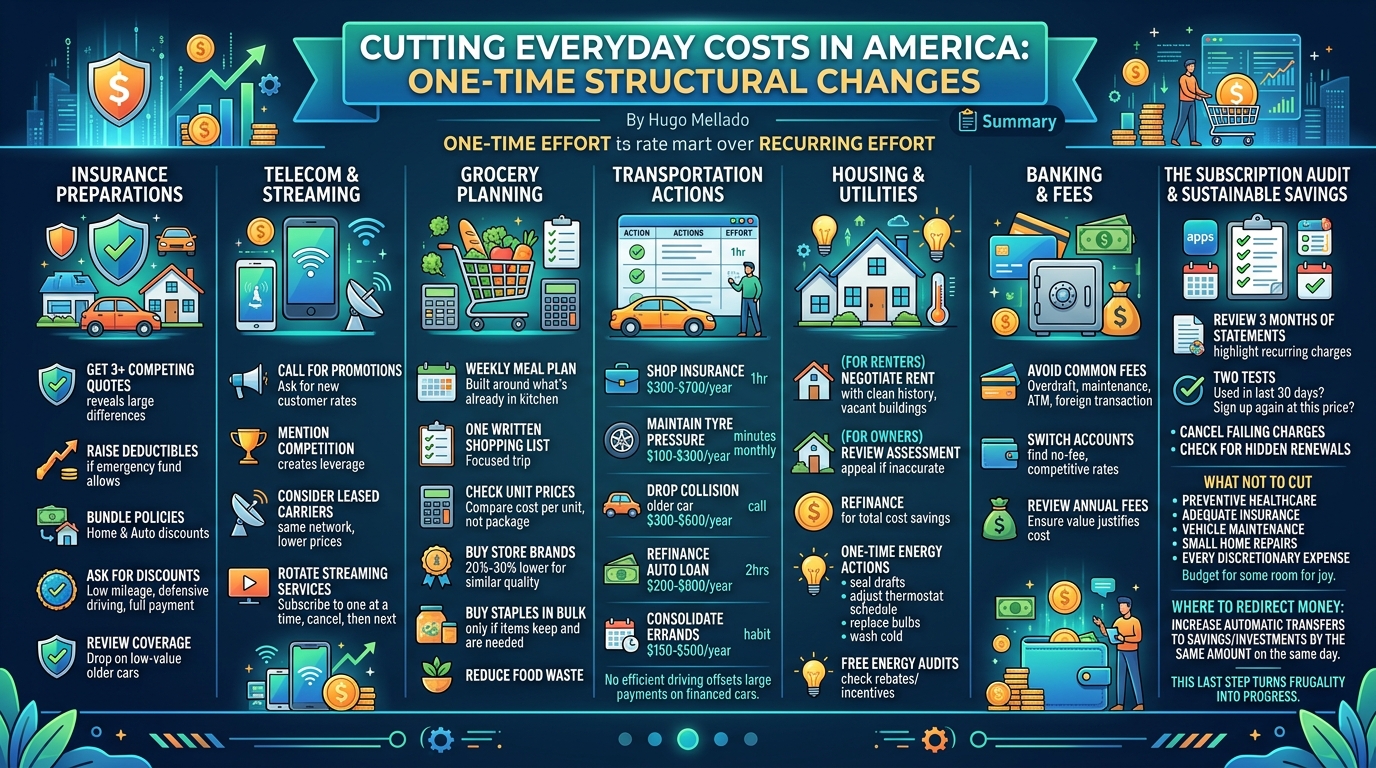
Auto and home insurance premiums drift upward year after year, and loyalty is rarely rewarded. Getting three competing quotes on identical coverage is a one-hour task that commonly reveals differences of several hundred dollars annually for the same protection.
Other levers on the same bill: raise deductibles if you have an emergency fund that can absorb them, since a higher deductible lowers the premium and you are self-insuring the small claims you would not file anyway. Bundle policies if the combined quote genuinely beats separate ones. Ask directly about discounts for low mileage, defensive driving courses, professional associations, and payment in full rather than monthly instalments, which often carries a fee.
Review coverage on older vehicles too. Comprehensive and collision coverage on a car worth $3,000 can cost more over a few years than the payout would ever be.
Telecom and Streaming
Internet and mobile bills are among the most negotiable expenses in an American household because providers price on inertia. Call, ask what promotional rate is available to new customers, and request to be moved to it. Mentioning that you are comparing options is usually enough. Mobile carriers that lease network capacity from the major networks frequently deliver the same coverage at a fraction of the price.
On streaming: rotate rather than accumulate. Subscribe to one service at a time, watch what you wanted, cancel, and move to the next. The annual difference between four permanent subscriptions and one rotating subscription is several hundred dollars for a nearly identical viewing experience.
Groceries
The savings here come from planning, not from coupons. A rough weekly meal plan built around what is already in the kitchen, one shopping trip against a written list, and a habit of checking unit prices rather than package prices captures most of the available benefit.
Store brands are typically produced to similar specifications as name brands and priced 20% to 30% lower. Buying staples in bulk works when the item genuinely keeps and you have space; it fails when bulk purchasing simply accelerates consumption.
Food waste is the quiet leak. Households discard a meaningful share of what they buy, which is money thrown away twice — once at purchase and again in the replacement.
Transportation
| Change | Typical annual saving | Effort required |
|---|---|---|
| Shop auto insurance across three carriers | $300 to $700 | One hour |
| Maintain tyre pressure and follow service schedule | $100 to $300 | Minutes monthly |
| Drop collision coverage on a low-value car | $300 to $600 | One phone call |
| Refinance an auto loan after credit improves | $200 to $800 | Two hours |
| Consolidate errands and reduce weekly mileage | $150 to $500 | Ongoing habit |
Beyond these, the structural decision remains what car you own and how you financed it. No amount of efficient driving offsets a payment that consumes 15% of your take-home pay.
Housing
Housing is the largest expense and the hardest to change, which means the changes that are available are worth real effort. Renters can negotiate at renewal, particularly with a clean payment history in a building with vacancies — landlords weigh turnover costs heavily. Owners should check whether their property assessment is accurate and whether an appeal is warranted, and whether refinancing genuinely lowers total cost rather than just the payment.
Energy costs respond to a handful of one-time actions: sealing drafts, adjusting the thermostat schedule, replacing the most-used bulbs, and washing in cold water. Many utilities offer a free energy audit, and many states run rebate programs for insulation and efficient appliances that substantially change the payback period.
Banking and Card Fees
Overdraft fees, monthly maintenance fees, out-of-network ATM charges, and foreign transaction fees are entirely avoidable, and paying any of them is a signal to change accounts rather than change behaviour. Accounts with no monthly fee, no overdraft charges, and competitive interest are widely available.
If you carry a credit card annual fee, calculate what you actually receive from it against the cost. Cards justify their fees for some spending patterns and not for others, and the honest answer usually becomes obvious once written down.
The Subscription Audit
Pull three months of statements and highlight every recurring charge. Then apply one test to each: have I used this in the last thirty days, and would I sign up for it again today at this price? Cancel everything that fails both. Then check for the ones you did not spot — annual renewals hide easily, as do charges billed through app stores.
This exercise takes about an hour, typically frees $50 to $200 per month permanently, and requires no ongoing discipline whatsoever, which is exactly what makes it worth doing before anything else.
What Not to Cut
Some economising costs more than it saves. Skipping preventive healthcare, dropping disability or liability coverage to inadequate levels, deferring vehicle maintenance, ignoring a small home repair until it becomes structural, or eliminating every discretionary expense until the whole plan collapses in a month of resentment.
A budget that leaves no room for anything enjoyable has the same failure rate as a crash diet, and for the same reason. Aim for a version of your life that is 10% cheaper and still recognisably yours.
Where the Money Should Go
Cutting expenses only builds wealth if the freed cash is captured. Otherwise it quietly funds something else within two months. The moment you cancel a $40 subscription or lower an insurance premium, increase your automatic transfer to savings or investments by the same amount on the same day.
That last step is the one people skip, and it is the only one that turns frugality into progress.
Savings figures are typical ranges, not guarantees. Your results depend on your location, providers and current terms.
Sources and further reading
The explanations above are checked against official regulators, statistical agencies, standards bodies and non-profit financial education organisations. Use these primary sources to verify figures and rules before you act on them.
- U.S. Bureau of Labor Statistics — Consumer Expenditure Surveys
- U.S. Bureau of Labor Statistics — Consumer Price Index
- National Association of Insurance Commissioners — Consumer resources
- ENERGY STAR (U.S. EPA) — home energy saving guidance
- Consumer Financial Protection Bureau — Ask CFPB
Related reading
- How to Save Money in the United States: A System That Actually Works
- Building a 12-Month Money Plan: From Debt Payoff to First Investment
- High-Yield Savings vs. CDs vs. Money Market Funds: Where Should Your Cash Live?
This content is for informational and educational purposes only and does not constitute financial, investment or tax advice. Always do your own research, and consider speaking with a licensed professional about your specific situation.