
Regulation · 9 min read
In the United States, crypto is treated as property for tax purposes, not as currency. That single classification produces almost every rule that follows, and it means the holding period — whether you held for one year or one year and a day — can change your tax bill by tens of percentage points on the same gain.
The One-Year Line
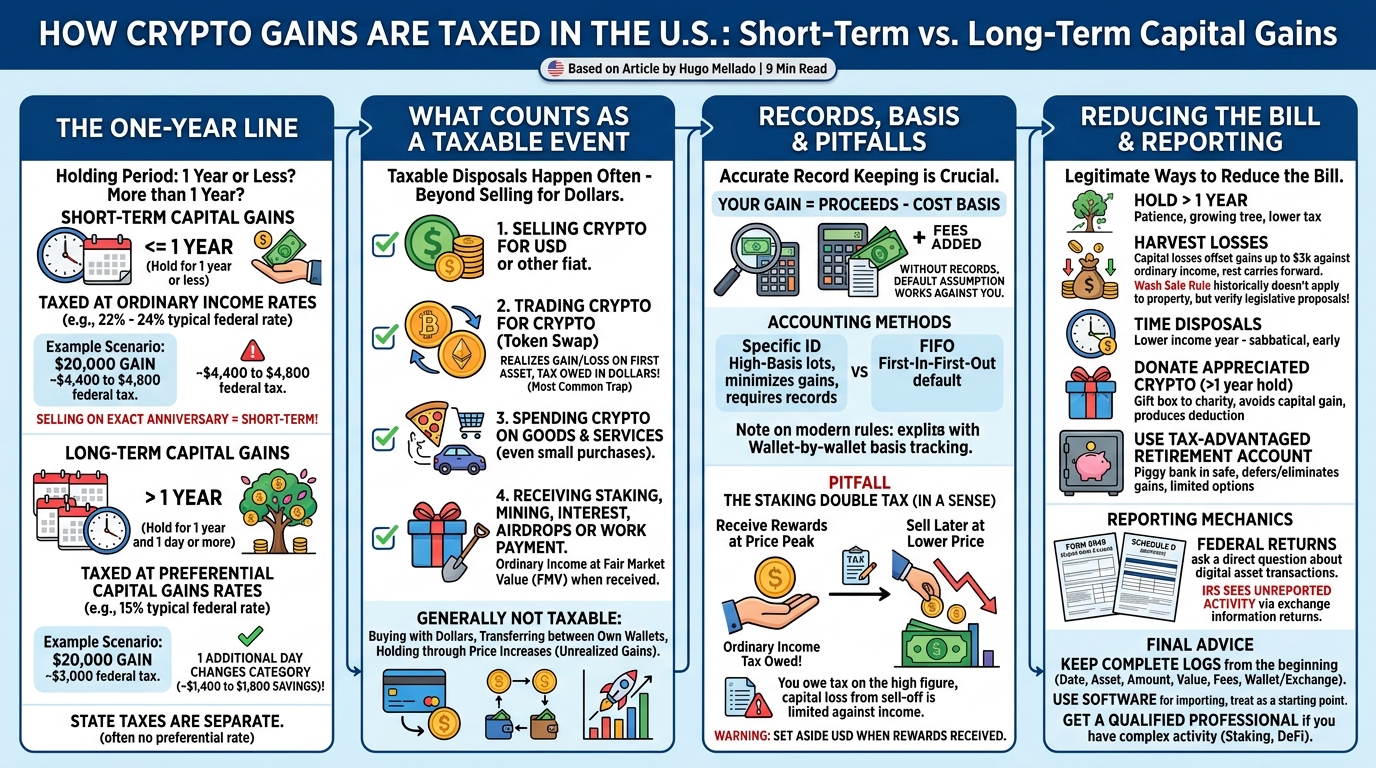
Sell an asset held for one year or less and the gain is short term, taxed at your ordinary income rate. Hold it more than one year and the gain is long term, taxed at preferential capital gains rates that for most taxpayers are meaningfully lower.
The counting is precise: the holding period begins the day after acquisition and includes the day of disposal. Selling on the exact anniversary is short term. One additional day changes the category.
| Scenario | $20,000 gain, short term | $20,000 gain, long term |
|---|---|---|
| Taxed at | Ordinary income rates | Preferential capital gains rates |
| Typical middle-bracket federal rate | 22% to 24% | 15% |
| Approximate federal tax | $4,400 to $4,800 | $3,000 |
| Difference | Roughly $1,400 to $1,800 on the same gain |
State tax is separate. Most states tax capital gains as ordinary income with no preferential rate, so the federal advantage is the part you can plan around.
What Counts as a Taxable Event
This is where crypto surprises people, because taxable disposals happen far more often than selling for dollars.
- Selling crypto for U.S. dollars or another fiat currency
- Trading one cryptocurrency for another, which is a disposal of the first asset at fair market value
- Spending crypto on goods or services, including small purchases
- Receiving staking rewards, mining income, interest or airdrops, which is ordinary income at fair market value when received
- Receiving crypto as payment for work, taxed as compensation
What is generally not a taxable event: buying crypto with dollars, transferring between wallets you control, and holding through price increases. Unrealized gains are not taxed.
The crypto-to-crypto rule catches the most people. Swapping one token for another with no dollars involved still realizes a gain or loss on the token you gave up, and the tax is owed in dollars regardless of whether any dollars were received.
Cost Basis and Why Records Matter
Your gain is the proceeds minus your cost basis — what you paid, including fees. Without accurate records, you cannot establish basis, and the default assumption works against you.
When you hold multiple lots acquired at different prices, the accounting method determines which lot you are deemed to have sold. Specific identification lets you designate particular units, which allows you to sell high-basis lots to minimize gains, but it requires contemporaneous records adequate to identify the units. Absent that, first-in-first-out generally applies.
Recent reporting rules have moved toward wallet-by-wallet basis tracking rather than a universal pool across all accounts, which makes clean per-account records considerably more important than they used to be.
Losses Are Useful
Capital losses offset capital gains dollar for dollar. Net losses beyond gains can offset up to $3,000 of ordinary income per year for most filers, and any remainder carries forward indefinitely.
Notably, the wash sale rule that prevents claiming losses on stocks repurchased within thirty days has historically applied to securities, and crypto’s classification as property has meant this rule did not clearly reach it. Legislative proposals to close that gap have appeared repeatedly, so the treatment should be verified for the tax year in question rather than assumed.
Staking and Interest Are Taxed Twice, in a Sense
Rewards from staking, lending, or yield programs are generally ordinary income at fair market value when you gain control of them. That value then becomes your cost basis. Sell later at a higher price and you owe capital gains on the increase; sell lower and you have a capital loss.
The failure mode is timing. Rewards received during a price peak create income tax at that valuation. If the token then falls 60% before you sell any of it, you still owe income tax on the higher figure, and the offsetting capital loss may only be usable against gains and a limited amount of ordinary income. Setting aside dollars when rewards are received prevents this.
Reporting Mechanics
Capital gains and losses are reported on Form 8949 and summarized on Schedule D. Ordinary crypto income appears on Schedule 1 or Schedule C depending on whether it is incidental or from a business activity such as mining as a trade. Federal returns also ask a direct question about digital asset transactions, and answering it inaccurately is its own problem.
Exchanges increasingly issue information returns to both taxpayers and the IRS, which means unreported activity is more visible than it was in earlier years. Transactions on self-custodied wallets and decentralized protocols still require you to maintain your own records.
Legitimate Ways to Reduce the Bill
Holding more than a year before selling is the largest lever available and requires nothing but patience. Harvesting losses in declining markets to offset realized gains is the second. Timing disposals into a year when your income is lower — a sabbatical, a business loss year, early retirement before pensions begin — can move a gain into a lower bracket.
Donating appreciated crypto held long term to a qualified charity can avoid the capital gain while producing a deduction. And holding crypto inside a tax-advantaged retirement account, where available, defers or eliminates gains, though the options and custodial arrangements are limited and often expensive.
The Practical Advice
Keep a complete transaction log from the beginning — date, asset, amount, dollar value, fees, and the wallet or exchange involved — because reconstructing years of activity later is expensive and often impossible. Use software that imports from your exchanges and wallets, and treat its output as a starting point for review rather than a final answer.
Crypto taxation is one of the areas where a qualified professional genuinely pays for themselves, particularly if you have staking income, DeFi activity across multiple protocols, or gains large enough to matter.
Tax rules change and depend on your individual circumstances and state. This is general information, not tax advice — consult a qualified tax professional.
Sources and further reading
The explanations above are checked against official regulators, statistical agencies, standards bodies and non-profit financial education organizations. Use these primary sources to verify figures and rules before you act on them.
- Internal Revenue Service — Digital assets
- IRS Topic no. 409 — Capital gains and losses
- IRS — About Form 8949, Sales and Other Dispositions of Capital Assets
- IRS Notice 2014-21 — Virtual currency treated as property (PDF)
- IRS Publication 544 — Sales and Other Dispositions of Assets
Related reading
- Cryptocurrency Taxes: What Every Investor Needs to Know
- How Interest Works in Crypto: Staking, Lending, and DeFi Yields Explained
- Short-Term vs. Long-Term Investing: A Side-by-Side Comparison
- Form 1099-DA Explained: What Your Crypto Exchange Now Reports to the IRS
This content is for informational and educational purposes only and does not constitute financial, investment or tax advice. Always do your own research, and consider speaking with a licensed professional about your specific situation.